
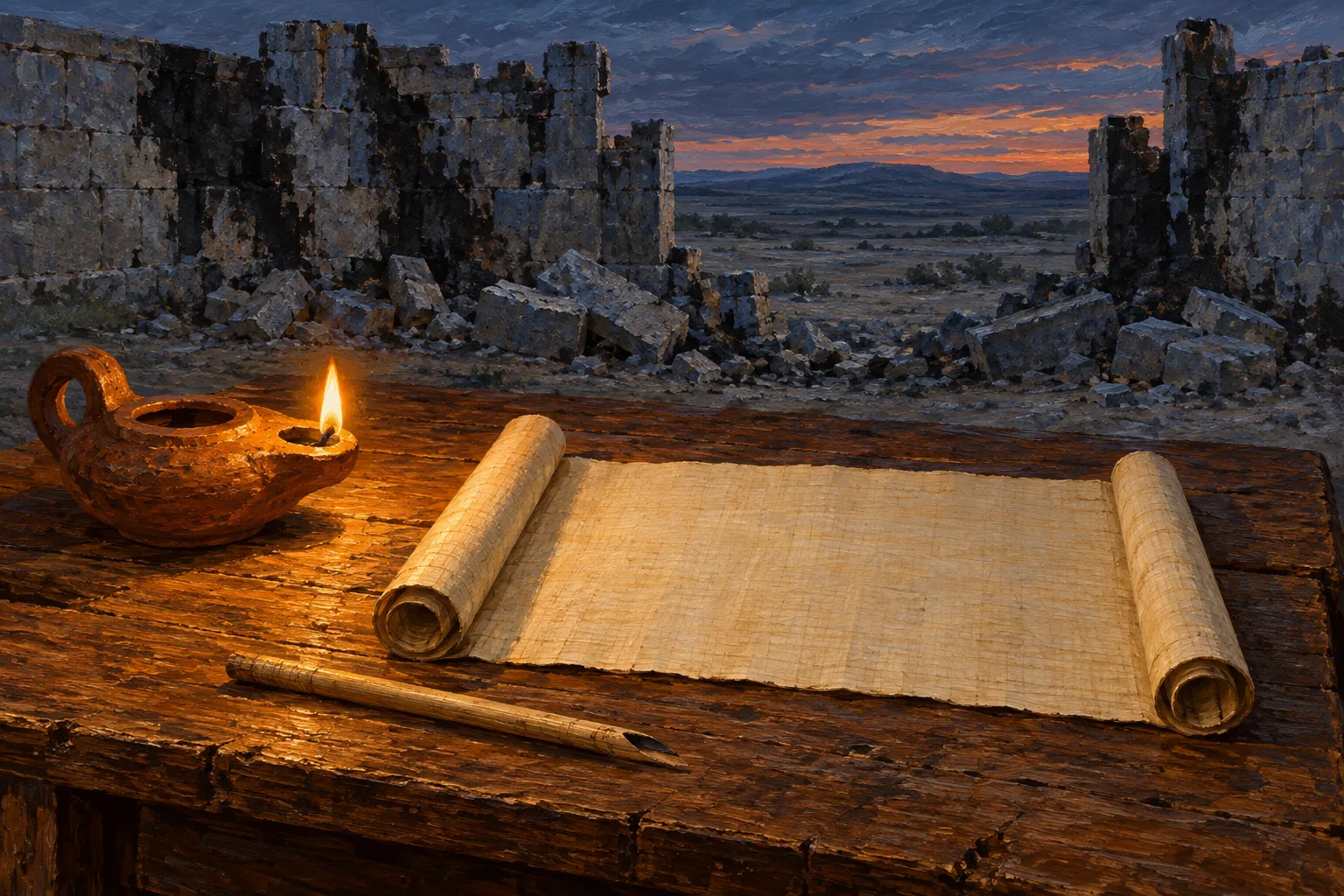
The visions of Baruch answer one event. Babylon broke the walls of Jerusalem, burned the temple and marched the people east. Three ancient books carry the name of Baruch, and each one asks the same blunt question. Why did God allow it?
They do not give the same answer, and that is what makes them worth reading. One book confesses. One argues back. The third climbs into the sky and looks down at the wreck from above.
Baruch the Scribe
Baruch son of Neriah belongs first to the book of Jeremiah. He was the prophet’s scribe, so he wrote down what the prophet said. When Jeremiah could not go to the temple himself, Baruch carried the scroll there and read it out loud.
Jeremiah 36:4 in the King James Version puts the job plainly:
Then Jeremiah called Baruch the son of Neriah: and Baruch wrote from the mouth of Jeremiah all the words of the LORD, which he had spoken unto him, upon a roll of a book.
So Baruch stands at the fall of the city with a pen in his hand. That is why later writers wanted him. A man who was there, and who wrote things down, makes a very good witness to borrow.
Where the Visions of Baruch Come From
None of the three books comes from that scribe. Ancient authors often wrote under an old and trusted name, and few readers thought it a trick. The name worked as a label. It told you which crisis the book meant to speak into.
The first book, plain Baruch, took its final shape late in the Second Temple period. No Hebrew copy of it survives, though the Greek in places reads like Hebrew underneath. Catholic and Orthodox Bibles keep it; Jewish and most Protestant Bibles do not. The old Catholic Encyclopedia entry on Baruch lays out that split.
The other two never entered anyone’s canon. Second Baruch survives mainly in Syriac, and Third Baruch in Greek. Both are Jewish books, and both are later than the first. So the visions of Baruch reach us through three separate manuscript traditions, in three languages, kept by three different sets of hands.
Three Books Under One Name
First Baruch is a short book that changes gear twice. It opens as a story: Baruch reads in Babylon, and the exiles send money home to Jerusalem. Then comes a long confession of sin. After that the book turns to poetry and asks where wisdom lives, and it closes by speaking to the ruined city as if she were a grieving mother.
Second Baruch is a different animal. It runs on dialogue, and the seer argues with God for chapter after chapter. Its stated setting is Babylon, but the real wound is Roman. Jerusalem fell again in 70 CE, and this book is thinking about that fire. The dates and manuscripts are set out at Early Jewish Writings on 2 Baruch.
Third Baruch leaves the ground. An angel takes the seer up through the heavens, one level at a time, past strange creatures and stranger machinery. The ruined streets drop out of view. Instead the book shows a universe that is still running exactly as it should.
Why the City Fell
Judgment is the thread that ties the visions of Baruch together. First Baruch takes the hardest line of the three. We broke the covenant, the speakers say, so the penalty fell on us, and God is not weak.
Even so, the book does not enjoy the verdict. It keeps lamenting while it confesses, and it will not let the reader forget what exile cost. The sky goes dark, the ground shakes, and one city’s grief spreads out until the whole world seems to feel it.
Second Baruch refuses to settle that fast. If Zion deserved this, it asks, then what about Babylon? Rome was worse and Rome is thriving. The book never resolves the complaint. Rather, it holds protest and obedience together and lets both stand.
That habit runs through this literature. Prophecy here does not mostly predict; it explains afterwards, as the piece on the role of prophecy in apocryphal texts shows. Still, a modern reader should notice the danger in it. An argument that turns defeat into punishment can also be used against the defeated.
The Search for Wisdom
The wisdom poem in the middle of First Baruch is the finest thing in the three books. Where is wisdom found? Not with the merchants, the poem says, and not with the giants of old, and not with the kings whose armies once filled the earth. They are gone, and none of them found it.
Wisdom belongs to God, who gives it to Israel as a law to live by. So the way back is not military and not clever. It is study, repentance and attention.
Trees do a lot of work in the visions of Baruch. A tree can mean growth in knowledge, but a cedar can just as easily mean an empire about to fall. Second Baruch builds a whole forest, with a vine and a spring, and expects the reader to decode it. Therefore the safest rule is to read each image inside its own vision first, before reaching for Eden.
The Visions of Baruch and the Heavens Above
Angels do the explaining in the two apocalyptic visions of Baruch. Baruch sees; the angel says what the sight means. Without that guide the visions would stay pictures, and mediation is part of the point.
Third Baruch makes the ascent its whole plan. The seer rises through the heavens and finds reward, punishment and supervision built into the structure of things. Consequently the book reads less like an argument and more like a guided tour of a moral machine.
Other Jewish writers were doing the same work. The prophecies in the Book of Enoch use angels and cosmic tours for the same purpose, and Christian visionaries later took up the habit too. The Apocalypse of Peter shows punishment in order to make the moral law visible. Shared scenery, however, does not mean shared belief.
The Promise of Return
Judgment never gets the last word here. Jerusalem will trade mourning for glory, and the scattered children will walk home. Baruch 4:36-37, in the Charles translation kept at sacred-texts and in modern versions alike, gives that hope a voice:
Look toward the east, O Jerusalem, and see the joy that is coming to you from God. Look, your children are coming, whom you sent away.
The return is not only geography. It comes with a renewed covenant, and the peace at the end of it means justice and worship, not merely quiet.
Second Baruch pushes further, into resurrection and a messianic age. Its sequence is untidy, and different chapters stress different things. Yet the mess is honest, because nobody had a timetable. The radiant city of the New Jerusalem in Revelation grew from the same soil, though it belongs to a Christian book and a later argument.
How to Read the Visions of Baruch
Begin with First Baruch, because it is short and it sets the terms. Then read Second Baruch, and keep asking which Jerusalem each page has in mind: the Babylonian one, the Roman one, or the one still to come. Third Baruch comes last, since it makes most sense once you know what it is refusing to look at.
Watch the genre change under you. Confession, wisdom poem, dialogue and heavenly tour all make different promises to the reader. Second Baruch also rewards a comparison with 2 Esdras, which asks the same questions and answers them more darkly; the study of the eschatology of 2 Esdras sets the two side by side.
Finally, check the introduction to whatever translation you hold. It will tell you the language, the date and the arguments still open, and that context changes what a symbol seems to say. The wider survey of the Apocrypha explains why different communities kept different books.
Why They Still Land
People usually come to the visions of Baruch after something has collapsed. The books earn their keep because they refuse to tidy the feeling up. Grief and hope sit in the same chapter, and neither one is asked to leave.
That is also their warning. Blame is a quick way to make sense of disaster, and it lands on the people already flattened by it. So the useful question is always who is speaking, and whose loss the explanation is being built on.
What the wisdom poem offers instead is patience. Look at the texts, look at the history, and admit where the evidence runs out. Ancient hope of this kind is not optimism. It is the refusal to stop imagining justice while the walls are still down.
Check out the author’s book here: The Books of Enoch.

Leave a Reply