
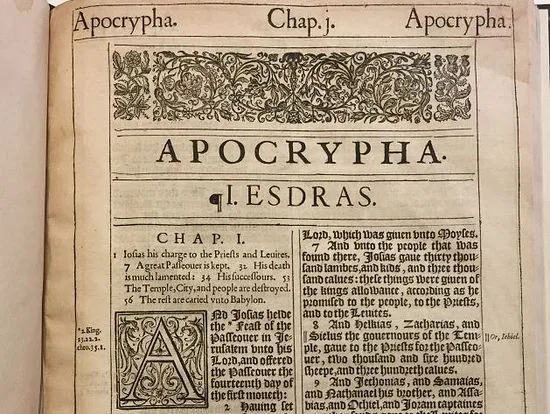
Open a Catholic Bible and a Protestant one side by side, and the Catholic one is thicker. Seven books sit in it that the other leaves out, plus extra chapters of Daniel and Esther. Those books are the Apocrypha, and nothing about them is secret.
The word means hidden, which is a poor fit. These texts were copied, read aloud, argued over and painted for centuries. So the real question is not where they went, but who decided they did not belong.
Where the Apocrypha Came From
Most of them were written between roughly 300 BCE and 100 CE. That is the gap between the last books of the Hebrew Bible and the first Christian letters, and it was not a quiet stretch.
Alexander had swept through, and Greek was now the language of trade, government and schooling. Jewish communities had to decide how much of it to take. Some embraced the new learning, while others treated every Greek habit as a betrayal.
The Apocrypha record that argument rather than settle it. One book praises armed revolt. Another locates faithfulness in burying the dead and paying a debt. A third borrows Plato to talk about the soul. Nobody edited the disagreements out.
They also come from different places. Judea produced some, whereas Alexandria and the wider diaspora produced others, and it shows in what worries them. A book written under occupation asks about survival. A book written among Greek neighbours asks about justice and the soul.
Why the Apocrypha Split the Canons
Greek-speaking Jews read their scriptures in the Septuagint, and the Septuagint carried these books alongside Genesis and Isaiah. Early Christians inherited that Bible whole, so for centuries most of them simply read the lot.
Jerome broke the pattern in the fourth century. He learned Hebrew, noticed that these books had no Hebrew original, and said so. Augustine disagreed, the Latin church kept them, and the argument went quiet for a thousand years.
Then the Reformation reopened it. Luther moved the disputed books into an appendix and called them useful but not equal to scripture. Trent answered in 1546 by declaring them canonical, and the Deuterocanonical list has stayed fixed in Catholic Bibles since. Orthodox churches keep a slightly larger set again.
So four communities now use four different lines. The article on what the word apocrypha actually means untangles the labels, and the story of their removal follows the Protestant side in detail.
One more distinction is worth keeping straight. Pseudepigrapha are books written under a famous old name, like Enoch or Moses, and hardly any church treats them as scripture. Outside the Protestant canon is a wide field, and the Apocrypha occupy only one corner of it.
Tobit: Providence in a Household
Tobit is a family story, and that is its point. A devout exile buries bodies the authorities have left in the street, goes blind, and prays to die. On the same day, far off, a young woman named Sarah prays the same prayer, because a demon has killed seven husbands on her wedding nights.
Heaven answers both at once. Tobit’s son sets out to collect a debt, and a stranger offers to guide him. The stranger is the angel Raphael, though nobody on the road knows it.
What follows is almost domestic. There is a fish, a dog, a marriage, a cure for blindness and a debt repaid. Providence works through travel arrangements here, not through thunder, which is why the book has been loved by readers who found the prophets forbidding.
Raphael also gave later Christianity a working model of what an angel does. Our piece on angels in the Book of Tobit traces that influence, while the faith and providence in the story takes up its spiritual argument.
Judith and the General’s Head
Judith is the opposite of domestic. A widow watches her town’s elders agree to surrender in five days if God has not saved them. She tells them the plan is blasphemy, dresses for the enemy camp, and walks out of the gate.
Holofernes, the besieging general, invites her to dinner. He drinks too much, his servants withdraw, and she takes his own sword off the bedpost. Then she carries his head home in the food bag.
The book has almost no history in it. Its king is wrong, its geography is wrong, and the errors look deliberate, as though the author were writing a parable and saying so. Still the story landed. Caravaggio, Artemisia Gentileschi and Klimt all painted that bedroom.
Read beside Deborah, Jael and Esther, Judith belongs to a pattern the canonical books already know. A woman does what the men will not, and the text refuses to apologise for the violence.
Maccabees and the Cost of Refusal
First and Second Maccabees cover the same crisis and tell it differently. Antiochus IV banned the Jewish law, put a pagan altar in the Temple, and a priestly family revolted.
First Maccabees is a war chronicle. It moves through campaigns, treaties and successions, and it ends with the family in power. The rededicated Temple in it is the origin of Hanukkah.
Second Maccabees wants something else. It slows down for the martyrs, especially the mother who watches seven sons die rather than eat pork, and it is the first Jewish book to state a bodily resurrection plainly. Because of that single line, the book later anchored Catholic teaching on prayer for the dead.
Early Christians under Roman pressure read those martyr scenes constantly. A pattern already existed for what a faithful death looked like, so nobody had to invent one.
The two books also show why the Apocrypha reward slow reading. Same revolt, same decade, two authors who wanted different lessons from it. Put them side by side and you are not collecting facts any more. Instead you are watching two people argue about what the facts were for, which is the honest way to use any of this literature.
Wisdom of Solomon Meets Greek Philosophy
The Wisdom of Solomon speaks in Solomon’s voice, though it was written in Greek in Alexandria centuries after him. The pretence is not a forgery so much as a genre.
What matters is the blend. The souls of the righteous are in the hand of God, it says, and their death looked like disaster only to the foolish. That is Jewish confidence in Israel’s God, carried in vocabulary Plato would have recognised.
Wisdom herself is the striking part. She is a person in this book, present at creation, a breath of the power of God. Paul later calls Christ the wisdom of God in 1 Corinthians 1:24, and the resemblance has kept scholars busy ever since.
Nobody can prove Paul read this book. Shared language is not borrowing, since both writers drew on a common stock of ideas. Hellenistic philosophy in the Jewish apocrypha sets out the exchange, and the ethics of the book itself follows its moral argument.
Second Esdras and the Questions That Stay Open
Second Esdras was written after Rome burned the Temple in 70 CE, and it reads like it. A seer named Ezra demands to know why God let it happen, and an angel named Uriel is sent to answer.
The answers do not satisfy him. Uriel tells him to weigh fire, or measure wind, and Ezra keeps pressing anyway. Few religious books let the complaint run this long before the visions take over.
That is the value of it. Apocalyptic writing is not a code for tomorrow’s headlines, because it was written for people whose world had already ended. Beasts, eagles and judgment scenes are how a grieving community argued about fairness.
How to Read the Apocrypha
Start with the genre. Tobit is a folk tale, First Maccabees is a chronicle, Wisdom is philosophy and Second Esdras is a vision, so reading them all as history guarantees confusion.
Then name the canon you are standing in. A Catholic reads Tobit as scripture, whereas a Protestant reads it as worthwhile ancient literature, and the same page carries different weight. Neither position is a mistake as long as it is stated.
Finally, compare translations where a passage turns on one word. These texts survive in Greek, Hebrew, Aramaic, Latin and Syriac copies that do not always agree, and honest editions say so in the notes.
The Apocrypha are not a lost Bible or a suppressed one. They are the record of Jews and early Christians working out how to stay themselves under empire, and they disagreed about it loudly. That argument is the inheritance, and it never really closed.
Check out the author’s book here: The Apocrypha.

Leave a Reply