
The angels in Tobit have names. So does the demon. That is unusual, because the Hebrew Bible almost never tells you what a heavenly being is called.
Raphael walks beside a young man for weeks. He carries prayers to God, prescribes a remedy, ties up a demon and only then says who he is. Tobit shows a heaven with staff, ranks and errands, and it does so before the New Testament exists.
Where the Book Comes From
An anonymous Jewish author probably wrote Tobit in the third or early second century BCE. The story is set centuries earlier, during the Assyrian exile, but the ideas belong to its own time. Historians therefore read it as diaspora fiction rather than as a memoir.
Copies survive in several languages. Qumran gave up Aramaic fragments and one Hebrew witness, while the Greek tradition runs in two different lengths. An overview of the book and its manuscripts sets out the evidence.
Catholics and Orthodox read Tobit as Scripture. Most Protestants file it under Apocrypha, and the Hebrew canon leaves it out. As our introduction to the Apocrypha explains, those labels describe communities rather than quality.
What Came Before the Angels in Tobit
Older Hebrew narratives keep their messengers vague. The angel of the LORD speaks to Hagar with God’s own authority, and the visitors who eat with Abraham are simply called men. Nobody hands out names.
Groups appear without a hierarchy. Seraphim surround the throne in Isaiah 6, and the sons of God present themselves in Job 1. Neither scene gives an archangel a portfolio, and neither counts seven attendants who carry prayers.
The satan of Job and Zechariah is an accuser inside God’s court, not a rebel with a kingdom. Daniel at last supplies names, Gabriel and Michael. That book took its final shape while Jews were being killed for their faith in the 160s BCE. So Daniel and Tobit stand at neighbouring points on the same road.
The Angels in Tobit Get Names and Ranks
Raphael’s name means God heals, and no book of the Hebrew Bible mentions him. Tobit makes him both a person and a rank. In the King James Version he introduces himself at 12:15:
I am Raphael, one of the seven holy angels, which present the prayers of the saints, and which go in and out before the glory of the Holy One.
Seven is about access, not a headcount of heaven. The verse ties rank to a job, since these angels go in and out and carry something with them. Heaven gains a chart of posts, and every post on it still reports to God.
First Enoch names Raphael too. There he heals human wounds and binds the rebel Azazel in the desert. The lists of chief angels shift too. Six in one manuscript, seven in another, four in a third. Our piece on the angelic hierarchies of 1 Enoch shows how unsettled those lists remained.
Revelation 8:2 also has seven angels standing before God, and it hands them trumpets. It never names them. Thus Daniel, Tobit, 1 Enoch and Revelation sketch an emerging hierarchy rather than a fixed bureaucracy.
The overlap of duties is what makes the comparison useful. Raphael heals and binds in both 1 Enoch and Tobit, yet the two books never agree on how many chief angels there are. Whoever wrote about the angels in Tobit was working with a shared stock of ideas rather than copying a settled chart.
Angels Who Carry Prayers
Tobit 12:12 says Raphael brought a record of two prayers before the glory of God. The Psalms imagine prayer rising, but they never give the job to an angel. That mediation is one of the book’s genuine novelties.
First Enoch does something similar. Leading angels hear the blood crying from the earth and take the cry upward. The righteous, in turn, are told to set their prayers as a memorial before the angels. Revelation later shows an angel offering incense with the prayers of the saints. Our article on angels in Revelation follows that liturgy further.
Nothing here amounts to a settled doctrine. Still, the angels in Tobit give us the earliest clear picture of prayer that travels by hand.
The detail has consequences. If a petition has to be carried, then heaven is a place with distance in it, and somebody has to cross that distance. Later Jewish writers argued about whether angels should intercede at all. The idea was clearly live enough to be worth a fight.
Asmodeus, a Demon With a Name
Asmodeus kills seven bridegrooms before they can reach Sarah. He is one of the first named demons in Jewish writing. That makes his treatment here all the odder. He never speaks, never explains himself and never gets a family tree.
The gap is the point. Raphael goes in before God and carries out an errand. Asmodeus only preys on the weak. Evil is real in Tobit, and it is also plainly outranked.
Many scholars link the name to the Persian Aeshma daeva, a demon of wrath. Tobit itself says nothing about that background. A reference overview of Asmodeus traces both the proposed etymology and the figure’s long afterlife.
That afterlife grew enormous. The Testament of Solomon turns him into a talkative spirit under interrogation, and the Talmud makes Ashmedai king of the demons. Tobit’s version stays small: a hostile force that gets driven off and tied up.
First Enoch explains its demons differently again, tracing them to the dead offspring of rebellious Watchers. Tobit adopts none of that machinery. The angels in Tobit face an enemy whose origins the book simply does not discuss, because the story needs him defeated rather than explained.
The Smoke in the Bridal Chamber
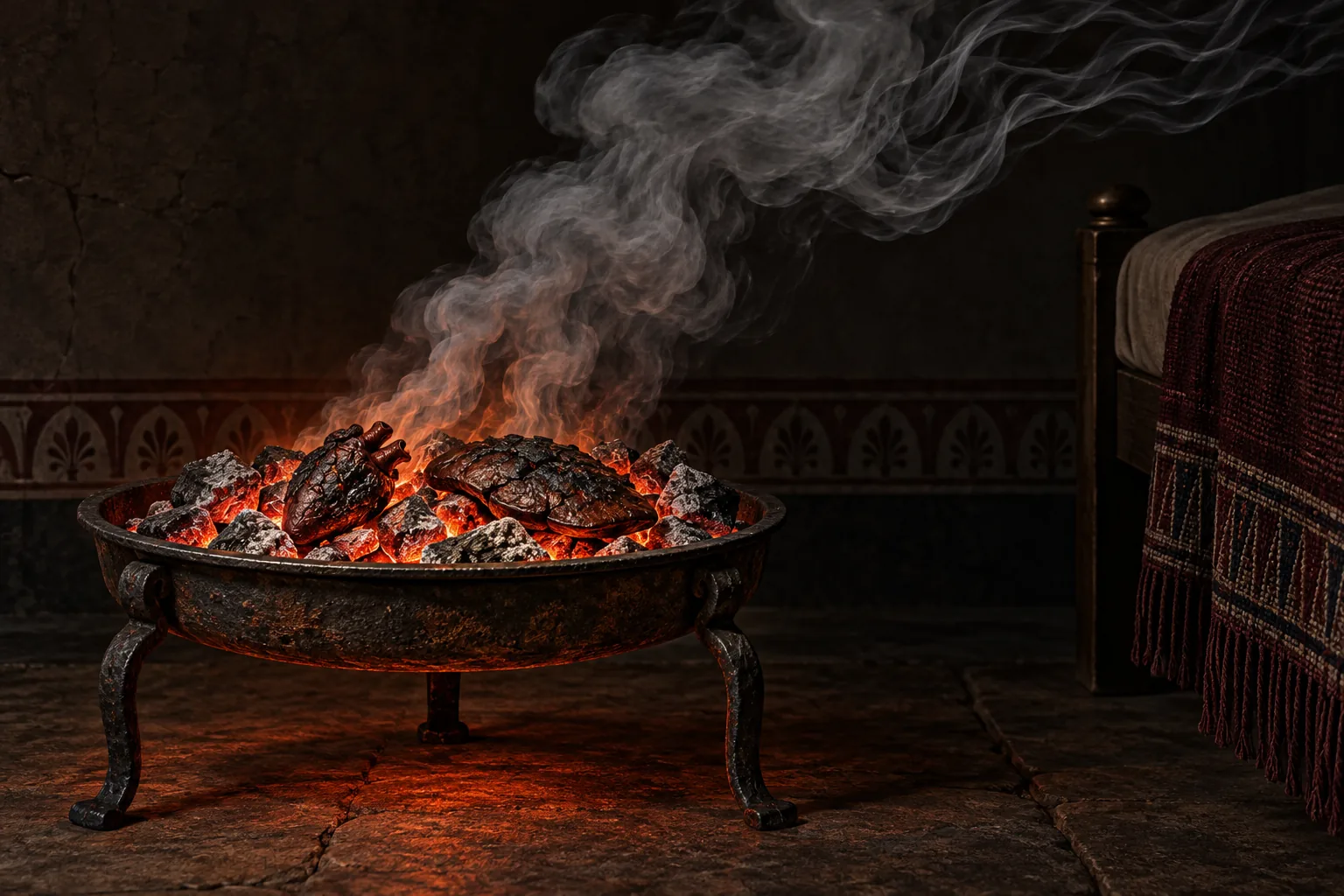
Raphael prescribes smoke from a fish’s heart and liver, and Tobias burns them on the coals when he enters the bedroom. The demon flees to Upper Egypt, and the angel goes after him and binds him. Prayer follows immediately afterwards.
The sequence is worth slowing down over. An angel supplies the recipe, a young man performs it, a prayer follows and the angel handles the pursuit himself. Nothing in the chapter treats the remedy and the prayer as rival explanations.
Modern readers usually file this under magic. Ancient readers would not have drawn the line there. In their world medicine, ritual and safety from spirits were one subject. Greek and Mesopotamian healers used harsh smoke and animal parts in much the same way. Qumran, closer to home, kept songs sung against hostile spirits.
Binding is the detail worth watching. Raphael binds Azazel in 1 Enoch, an angel binds Satan in Revelation, and Raphael binds Asmodeus here. The Gospels take a different route, where Jesus expels demons by command alone, with no ingredients at all.
The Angel Nobody Recognises
Tobias hires a travelling companion and never suspects what he is. The disguise is not a costume, since nothing about the stranger’s body gives him away. Weeks of shared roads, meals and conversation pass without a slip.
At the end Raphael explains that what they saw him eat and drink was appearance rather than appetite. The line draws a careful distinction. An angel can be genuinely present and genuinely tangible without being alive in the way a man is alive.
Scripture keeps circling this problem. Abraham’s visitors seem to eat. The angel in Judges turns down Manoah’s food. Hebrews tells readers that some have hosted angels unawares. Tobit pushes it furthest, because its angel keeps up the act for a whole journey.
There is a moral edge to the disguise as well. In these stories a welcome is tested just when nobody knows who the guest is. The angels in Tobit look exactly like hired help. So the family’s kindness counts for something it could never have planned.
Why the Angels in Tobit Still Matter
The New Testament rarely stops to explain its supernatural furniture. Gabriel turns up announcing births, demons recognise Jesus on sight, seven angels stand before God and Satan gets bound. Readers were evidently expected to know how such a world worked already.
Tobit shows where that expectation came from. Its manuscripts prove that Jewish readers were passing these ideas around well before Christianity appeared. The vocabulary was already in place when the Gospels borrowed it. Our companion pieces on Tobit as a story of faith and providence and on Raphael’s role in the book follow the story itself.
None of it adds up to one biblical view of angels. The sources disagree, develop and leave gaps, and later communities tidied them up in different ways. Reading the angels in Tobit honestly means letting those differences stand.
Check out the author’s book here: The Apocrypha.

Leave a Reply