
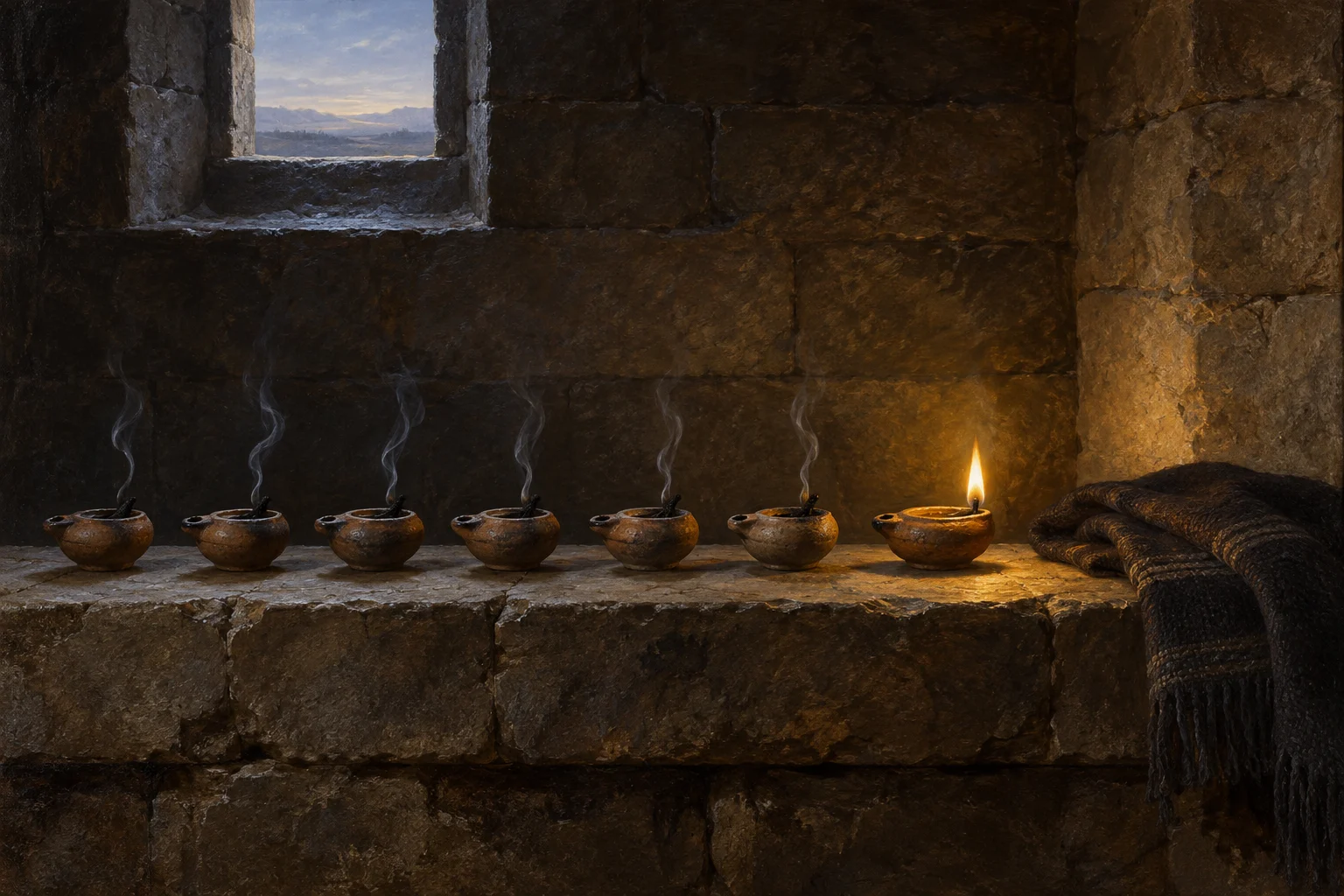
Most heroes of the Bible win battles or call down fire. The Woman with Seven Sons does neither. She stands in a royal court and watches her boys die, one after another. Yet she never begs the king to stop. Instead, she urges each son to stay faithful to the end. Her story is short, brutal and strange. Still, it changed how Jews and Christians thought about death. In fact, it holds one of the clearest early statements of faith in the resurrection of the body.
She has no name in the oldest text. Later readers called her Hannah, Miriam or Solomonia. However, the first account simply calls her a mother. That silence fits her. She is not remembered for who she was, but for what she did on one terrible day.
A Kingdom Under Pressure
The story takes place in the reign of Antiochus IV Epiphanes, who ruled the Seleucid Empire from 175 to 164 BCE. Judea was a small part of his realm. At first, Greek culture attracted many Jews in Jerusalem. Some built a gymnasium. Others hid the marks of their circumcision. Then, in 167 BCE, the king went much further. He banned the Sabbath, circumcision and the food laws. He also set up an altar to Zeus Olympios in the Temple itself.
For faithful Jews, this was a crisis of loyalty. They could obey the king, or they could obey the Law of Moses. In short, there was no middle way. Some fled to the hills and took up arms, as the Maccabees did. Others stayed put and refused to comply. The mother and her sons belong to this second group. If you want to see where these books sit among the others, this timeline of the apocryphal books is a good place to start.
The Woman with Seven Sons in 2 Maccabees 7
The oldest version of the tale fills one chapter, 2 Maccabees 7. In it, the king has the family arrested and orders them to eat pork. The first son speaks for all of them. They are ready to die, he says, rather than break the laws of their ancestors.
So the torture begins. The king’s men cut out the first son’s tongue. Next they scalp him and cut off his hands and feet. Finally they fry him in a great pan while his mother and brothers watch. The second son suffers the same fate. Before he dies, he tells the king that the King of the universe will raise them up to an everlasting renewal of life.
The third son holds out his tongue and his hands at once. He got them from Heaven, he says, and he hopes to get them back again. Likewise, the fourth speaks of hope in God. The fifth warns the king that God will punish him and his descendants. The sixth admits that the Jews suffer because of their own sins. But he adds that the king will not go unpunished for fighting against God.
What the Woman with Seven Sons Told Her Boys
Through all of this, the Woman with Seven Sons is present. The writer calls her marvellous and worthy of honourable memory. She sees her seven sons die in a single day. Even so, she bears it with good courage because of her hope in the Lord. The text says she was filled with a noble spirit and that she fired her woman’s reasoning with a man’s courage.
Her words to her sons are the heart of the chapter. She tells them she does not know how they came into being in her womb. It was not she who gave them life and breath. Rather, it was the Creator of the world who shaped the beginning of humankind. And the same Creator, she says, will give life and breath back to them again. In other words, her hope rests on creation itself. The God who made them once can make them a second time.
The Last Son and the Last Word
Only the youngest boy is left. At this point Antiochus tries a new tactic. He promises the boy riches and a high post at court if he turns from the Law. When the boy ignores him, the king asks the mother to talk sense into him.
The Woman with Seven Sons agrees, but she mocks the tyrant in her own language. Leaning close to her son, she reminds him that she carried him for nine months and nursed him for three years. Then she asks him to look at the heaven and the earth. God did not make them out of things that existed, she says. Therefore, he need not fear this butcher. “Accept death,” she tells him, “so that in God’s mercy I may get you back again along with your brothers.”
The boy does not wait for her to finish. He speaks to the king directly and refuses to obey. As a result, the guards treat him worse than the others. Last of all, after her sons, the mother dies too. The text gives no details of her death, only a single line.
Why Her Words on Creation Matter
Her short speech carries two big ideas. The first is the bodily resurrection. Older books of the Hebrew Bible speak of Sheol, a shadowy place where the dead simply rest. Daniel 12 is the main exception. Here, however, the hope is plain. The dead will rise, and they will rise with bodies. In fact, the third son expects to get his own hands back.
The second idea is creation from nothing. When the Woman with Seven Sons says God did not make the world out of things that existed, she gives one of the earliest clear forms of that teaching. Later Christian writers leaned on this verse when they argued that God made all things freely. Because of this, the chapter was read not only as a martyr story but as a key text of doctrine. For more on how these books fed later belief, see this overview on exploring the Apocrypha.
The Woman with Seven Sons as a Stoic Heroine
About a century later, another writer retold the story at much greater length. The result is known as 4 Maccabees. Its author writes in polished Greek, and the book reads like a philosophical speech. Its opening line gives the thesis: devout reason is sovereign over the emotions.
In this version, the Woman with Seven Sons becomes a model of that thesis. The author admits that no love is as strong as a mother’s love. After all, she feels every blow her sons receive. Even so, her reason, trained by the Law, rules her grief. The writer compares her soul to that of Abraham, who was ready to offer Isaac. He also calls her the mother of the nation and a defender of the Law.
The later book adds one more detail. As the guards come to seize her, she throws herself into the fire so that no one will touch her body. Some readers find this ending hard. But the writer presents it as a final act of control. Even at the end, she chooses.
Hannah in Jewish Memory
The story did not stay in Greek. The rabbis told it too, in the Talmud (Gittin 57b) and in Lamentations Rabbah. In these versions, the mother is called Miriam bat Tanhum. The king is a nameless Caesar, and the sin he demands is idolatry. Before the youngest son dies, she sends a message to Abraham: “You bound one altar. I bound seven.” Then she climbs to a roof and falls to her death.
Over time, the name Hannah became the common one. In medieval Europe, her story was tied to the feast of Hanukkah, which celebrates the rededication of the Temple after the Maccabean revolt. Hence Jewish families still tell of her alongside Judith as a brave woman of that age. You can read more about Judith in this post on Judith in the Apocrypha.
The Woman with Seven Sons in the Early Church
Christians took up the story of the Woman with Seven Sons even more eagerly. Under Roman persecution, they saw their own trials in hers. Origen quoted her in his Exhortation to Martyrdom and urged believers to follow her example. Augustine preached on the Maccabean martyrs at least twice, in sermons 300 and 301. Gregory of Nazianzus and John Chrysostom both praised her as well.
For these writers, she proved that faith could be stronger than family love, and that a woman could be as brave as any soldier. Her story set the pattern for later tales of women martyrs, such as the one told in the Acts of Paul and Thecla. The Orthodox Church still honours her as Solomonia, with a feast on 1 August. A wider look at such figures is in this post on the role of women in apocryphal texts.
What Her Story Asks of Us
Modern readers may flinch at this tale. After all, it is hard to praise a mother who urges her son toward death. Yet the writers did not see her as cold. On the contrary, they saw her grief as real and her courage as greater than it. She did not choose death over life. She chose one kind of life over another.
That is why the Woman with Seven Sons still matters. Her story gave early Judaism some of its clearest words on the resurrection and on creation. It also gave both faiths a model of courage under a tyrant. She lost everything that a mother can lose. Still, she held on to the hope that the God who made the world would one day make it new.
Check out the author’s book here: The Apocrypha.
Leave a Reply