
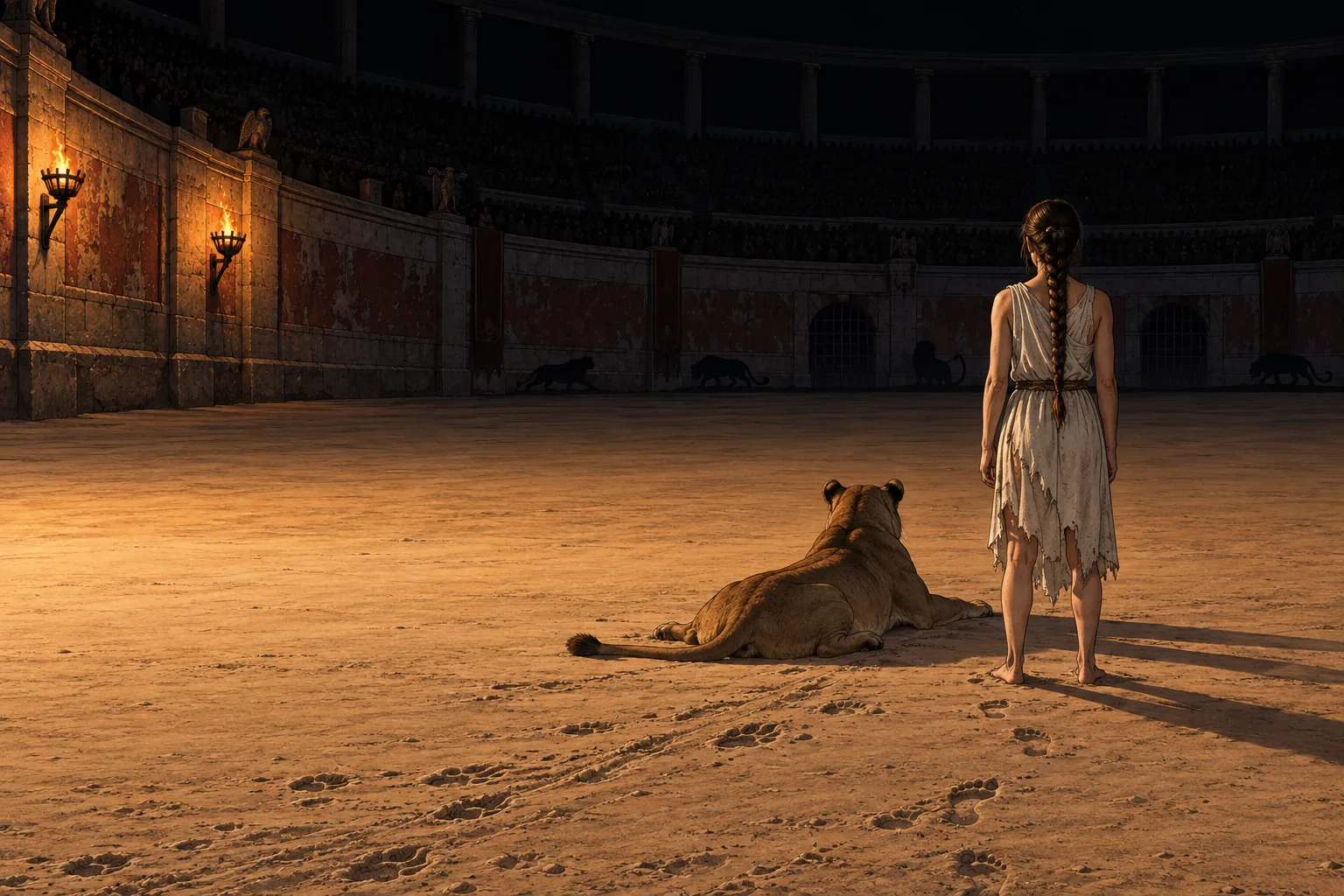
A bride calls off her wedding, survives a pyre, fights beasts in an arena and then baptizes herself in a tank full of seals. That is the plot of the Acts of Paul and Thecla, and it was one of the best-loved stories in the early church.
It is also a story the church later wished it had not told. The heroine preaches. She baptizes. She does both without a man’s permission, and one of the men who declines to help her is Paul himself.
What the Acts of Paul and Thecla Actually Is
The text dates from the second century, when it formed part of a longer work, the Acts of Paul. Unlike the canonical Acts of the Apostles, it keeps its camera on one person: Thecla, a young woman of good family from Iconium, in what is now central Turkey.
It travelled far. The story survives in Greek, Latin, Syriac, Coptic, Armenian, Slavonic and Arabic, which is the surest sign that people wanted it. Our survey of the Apocryphal Acts of the Apostles sets it beside its cousins, and the historical summary of the text lays out the manuscript evidence.
The genre matters too. Indeed these books are adventure stories, written for audiences who liked shipwrecks, trials and talking animals. However, what sets the Acts of Paul and Thecla apart is that it gives the adventure to a woman and never takes it back.
Paul Preaches, and a Girl Stops Eating
Paul arrives in Iconium and preaches in the house of Onesiphorus. His sermon is not the one readers of the letters expect. Blessed are the bodies of the virgins, he says, for they shall please God.
Thecla is engaged to a leading citizen named Thamyris. Meanwhile she sits at her window next door and listens for three days. The narrator says she clings there like a spider, and she will not eat, drink or move.
Her fiancé cannot reach her. Her mother cannot move her. Then she breaks the engagement. In short, she gives up a fiancé, a fortune and a place in the city, and she does it for a travelling preacher she has never actually met.
The Fire That Would Not Burn
Refusing marriage was not a private choice in that world. It insulted the fiancé, embarrassed the family and removed a woman from the household economy that held the city together.
Her own mother, Theocleia, demands the death penalty. Burn the lawless one, she shouts, so that the other women learn. The governor agrees, and Thecla goes to the pyre.
She makes the sign of the cross as the flames catch. Then the sky opens. Rain and hail put out the fire, and she walks away from it.
Notice who does the condemning. Not a pagan magistrate acting alone, but her mother, backed by the household she was born into. The story is clear about where the danger sits, and it sits at home.
The Arena in the Acts of Paul and Thecla
Antioch is worse. A local notable called Alexander tries to buy her in the street, and Thecla tears his cloak and knocks his crown into the dust. Consequently she earns a second death sentence, because public humiliation of that kind demanded an answer.
This time the beasts are waiting. A lioness licks her feet instead of attacking, and later kills a bear and a lion to defend her. The women in the stands riot on her behalf. The queen Tryphaena, who has taken her in, faints at the spectacle, and the officials panic.
Roman arenas did not usually work that way. A condemned woman was there to die badly and in public, as a lesson to everyone in the seats. Here the lesson collapses. In fact the animals refuse their part, the crowd changes sides, and the governor ends up looking foolish rather than severe.
Thecla is never a victim in these scenes. She argues, she acts, and she keeps her own counsel, which is what our piece on the role of women in apocryphal texts finds again and again in this literature.
Thecla Baptizes Herself
In the middle of the arena stands a tank of water full of seals. Thecla sees it and realises she has still not been baptized. Nobody is going to do it for her.
So she throws herself in. In the name of Jesus Christ, she says, on this last day I baptize myself. Lightning strikes the tank, the animals float up dead, and she comes out alive.
The scene is deliberately outrageous. Baptism belonged to the clergy, and the water in the arena was a pool kept for the animals. Nevertheless Thecla takes the sacrament, in public, with the crowd watching and death a few steps away.
Tertullian noticed. In his treatise On Baptism he complains that women were citing this very story to claim the right to teach and to baptize, and he wants his readers to know who wrote it. The presbyter confessed, he says, and lost his office. Our separate account of who wrote the Acts of Paul and Thecla weighs that claim.
Paul Comes Off Badly
The apostle does not shine here. First he converts Thecla, then he vanishes whenever the authorities appear. In Antioch, asked directly whether he knows her, he answers that he does not know the woman, and that she is nothing to him.
Thecla faces the fire and the beasts alone. By the end her courage plainly outmeasures his, and the text seems content to let readers notice.
Later she finds him, tells him she has baptized herself, and says she is going to teach. He does not argue. Go, he tells her, and teach the word of God. The Gospel of Mary Magdalene Explained: Secret Teachings Revealed stages a similar scene, with Mary Magdalene holding her ground against the doubts of the male disciples.
Celibacy as Refusal
The engine of the story is celibacy, though not as a rule about bedrooms. Rather, virginity here is a political move. A woman who refuses to marry steps out of the Roman machinery of dowries, heirs and property, and she answers to nobody in it.
That is why the story frightened bishops and delighted its readers. Our guide to the apocrypha as a whole shows how often withdrawal from ordinary life signals authority in these books. The same instinct runs through the secret gospels, as our comparison of the Gnostic Jesus and the canonical Jesus describes.
Why the Acts of Paul and Thecla Stayed Out
Three things kept the book outside the New Testament. It is late, written a century after Paul died. Second, its asceticism is extreme, and it sits badly beside the household advice of the Pastoral Epistles. Above all, it shows a woman baptizing herself and then preaching with apostolic approval.
None of that stopped people reading it. Jerome knew it, Church councils argued about it, and the scribes kept copying it for more than a thousand years.
The exclusion therefore says more about the fourth century than about the second. By then the churches had bishops, property and a settled view of who could speak, and the Acts of Paul and Thecla belonged to an older, wilder moment. Copying it was safe enough. Reading it as scripture was not.
What Happened to Thecla Afterwards
Thecla became a saint with a cult of her own. Furthermore, her sanctuary at Seleucia grew into one of the great pilgrimage complexes of the eastern Mediterranean, and prayers for the dying invoked her name for centuries across both east and west. The Catholic Encyclopedia entry on Thecla traces the shrines and the feast days.
Later writers trimmed her as they went. Some versions soften the self-baptism, while others hand the teaching back to Paul. So the saint kept growing while the book that made her was quietly edited.
So the character outlived the book. Readers who had never opened the text still knew who she was, which is a rare fate for a heroine of second-century fiction.
Why the Acts of Paul and Thecla Still Reads Well
Strip out the miracles and a recognisable situation remains. A young woman decides her life is hers to spend. Yet everybody around her, including her mother, treats that decision as a crime.
The Acts of Paul and Thecla is not history, and it makes no serious claim to be. Still, it records what some second-century Christians thought a life of faith could look like, and it gives that life to a woman who takes her own baptism when nobody offers it.
Check out the author’s book here: The Apocrypha.

Leave a Reply