
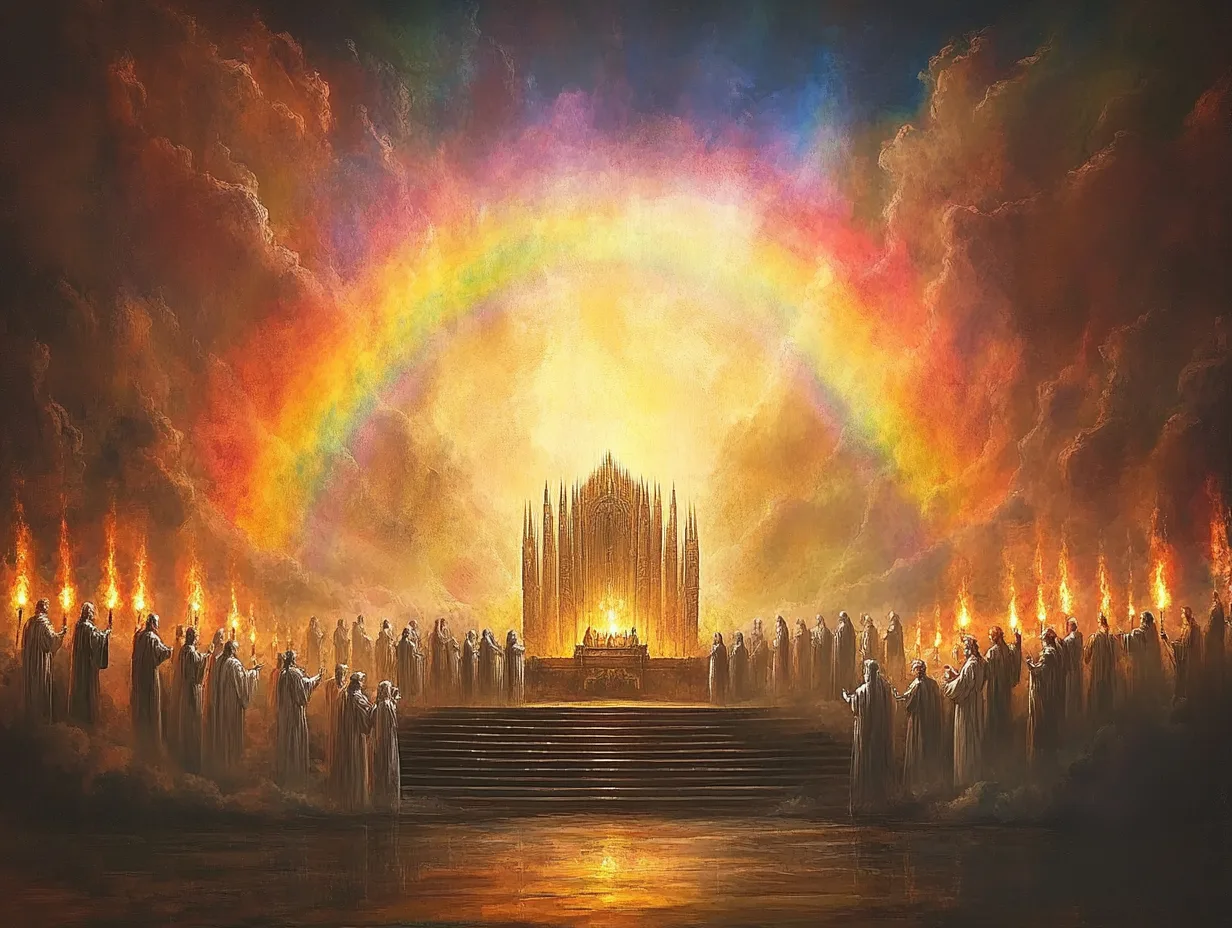
The throne of God is the picture Revelation returns to most. John comes back to it again and again, from the first vision of heaven to the last page. It is not just a piece of heavenly furniture. For his first readers, it was a claim about who really ruled the world, and the answer was not Caesar.
That claim cost something. The churches John wrote to lived inside Roman cities, where loyalty to the emperor was part of daily life. So every scene around the throne asked them a quiet question: whom do you trust?
Seven Cities Under Rome
The writer calls himself John. He was on Patmos, a small island off the coast of what is now Turkey, and he wrote to seven churches in the Roman province of Asia. Most scholars date the book to around AD 95, late in the reign of Domitian. A smaller group puts it in the late 60s, after Nero.
The seven cities were rich and proud. They competed for the right to host a temple to the emperor, because such a temple brought visitors, festivals and trade. For example, Pergamum had one for Rome and Augustus from 29 BC. Smyrna won one for Tiberius in AD 26, and Ephesus gained a temple for Domitian’s family near the end of the century.
Emperor worship was not the same everywhere. Nobody stood at every door checking that each person had made an offering. Still, feasts, games and trade guilds tied loyalty to Rome with business and social standing. Saying no could cost a job, a friend or a place at the table. You can read more about the Roman imperial cult and how it worked in the provinces.
So John’s readers stood between two claims. On one side was the emperor’s throne, close and visible. On the other was the throne of God, which they could see only in a vision.
Where Satan Has His Throne
Pergamum shows the conflict most clearly. In the letter to that church, Jesus says, I know where you live, where Satan has his throne. You can read the letter to Pergamum in Revelation 2 in a few minutes.
However, scholars still argue about what John meant. Many point to the city’s temple to Rome and Augustus. Others think of the huge altar of Zeus on the hill, or the healing shrine of Asclepius, whose sign was a serpent. Each reading places the danger inside the city’s proudest buildings.
John is not attacking stone and marble. He is asking how believers can live in a place where public loyalty had become a kind of worship. And the phrase sets up what comes later. In chapter 13 the dragon gives the beast his power and his throne. Rome’s rule appears as a copy of the real thing, a throne that is borrowed and bent.
Why the Throne of God Keeps Coming Back
The Greek word for throne, thronos, appears about forty-seven times in Revelation. That is more than in all the rest of the New Testament put together. In other words, John repeats it like a drumbeat.
Most of the time it points to the throne of God, or to the throne God shares with the Lamb. A few times it points the other way: to Satan’s throne, the dragon’s gift to the beast, and the beast’s own throne in chapter 16. So the book sets two courts side by side, and each one asks for full loyalty.
The great vision in chapter 4 shows the heavenly side. John sees someone seated on a throne, and every voice around it gives him honour. Heaven’s throne room in Revelation 4 walks through that scene piece by piece. Here the point is simpler. Every earthly throne is borrowed, and one day it must answer to this one.
Heaven’s Songs Against the Emperor’s Titles
Some of the words sung in heaven were also heard in Rome. The historian Suetonius says Domitian liked to be called our lord and god. In chapter 4 the elders sing, you are worthy, our Lord and God, to receive glory and honour and power. That title now belongs to the one on the throne of God, not to the man in the palace.
The elders also throw down their crowns before the throne. In fact, ancient readers knew that gesture. Tacitus tells how a king of Armenia, Tiridates, laid his crown before a statue of Nero and then received it back from the emperor. In Revelation the crowns are given up, and nobody hands them back.
Scholars often call these hymns a counter-liturgy. Roman festivals built loyalty through marches, songs and cheers, and Revelation builds a different loyalty the same way, through praise said again and again. The study of music in Revelation shows how these songs explain the events around them.
Not every scholar reads the scene alike. David Aune compares it closely with the ceremony of the Roman court. Richard Bauckham sees the worship as a challenge to any power that claims too much. Leonard Thompson warns that Domitian was not a monster who persecuted everyone. All three help, as long as no single symbol is treated as a coded news report.
A Slain Lamb on the Throne of God
In chapter 5, John hears about a conquering lion. Then he turns and sees a lamb that looks as if it had been killed. That surprise changes what winning means.
By contrast, Rome showed its power through armies, statues and lines of captives. It also used the cross, a public death meant to shame and to warn. So the wounds of the Lamb are not just a picture of pain. They recall a Roman way of killing people who got in the way.
And yet that Lamb stands at the centre of the throne of God. In chapter 7, a great crowd cries that salvation belongs to our God, who sits on the throne, and to the Lamb. Rome ruled by conquest, while heaven gives the highest honour to someone Rome put to death. Why the Lamb is central in Revelation follows that idea through the whole book.
This does not remove every problem. Revelation is also full of plagues, battles and harsh judgments. Some readers take them as future events, while others see them as a picture of the violence empires already do. An honest reader leaves room for that tension.
Babylon and the Price of Luxury
Chapter 17 shows a woman dressed in purple and gold, seated on seven hills. Any reader in the first century could think of Rome, the city on seven hills that ruled the kings of the earth. The beast carries her for a while, so wealth and force travel together.
In chapter 18 she falls, and kings, merchants and sailors weep. Their cargo list starts with gold and silk. However, it ends with horses, carriages, slaves and human lives. That order is the point, because the luxury at the centre was paid for by people far away.
Even so, John does not condemn trade itself. He condemns wealth joined to power, false worship and blood. What Babylon represents in Revelation follows the symbol further. At the same time, it is wise not to pin every detail onto one modern country or company.
Older Visions Behind the Throne of God
John did not invent his throne scenes. Isaiah 6 gives him a heavenly court and the cry of holy, holy, holy. Likewise, Ezekiel 1 gives him a blazing throne that moves. Daniel 7 sets beastly kingdoms against the court of the Ancient of Days, where power is taken from the beasts and given to another.
Other Jewish writings shared this language, though they are not in most Bibles. First Enoch describes trips through heaven and a throne of glory. Fourth Ezra, written after Rome burned the temple in AD 70, asks why God lets empires crush his people. These books show how common the ideas were. But John writes to named churches, in public, and he looks for a renewed earth, not an escape from it.
The Last Throne Gives Life
Near the end, in chapter 20, John sees a great white throne. Earth and sky flee from it, books are opened, and the dead are judged by what they have done. Readers disagree about timing, but the message is plain: every power will give an account.
Then the last scene changes the tone. A river flows from the throne of God and of the Lamb, through the middle of the new city. On its banks grows the tree of life, and its leaves are for the healing of the nations. There is no more curse.
That is the final contrast with Caesar. Rome’s throne collected taxes and kept people in their place. The last throne in the Bible gives water, light and healing to everyone. The imagery of Revelation traces how these pictures build on each other.
Reading the Throne of God Today
Revelation is not a timetable for the evening news. It is a book about loyalty. Its first readers had to decide how far to go along with their neighbours, their guilds and their city.
Of course, every age has its own versions of Caesar, but careless comparisons can do harm. The best use of the symbol is to test ourselves first: what we fear, what we buy, what we praise. Only then does it make sense to point at others.
The Lamb makes that test harder, because he does not win the usual way. Readers may find hope in him, yet they still have to face the book’s hard images. History cannot remove that tension. It can, however, keep guesswork from replacing care.
So the question John left open is still open. When a power asks for sacred loyalty, which throne is it copying? The throne of God answers with a slain Lamb and a healing river, and that answer still unsettles every Caesar.
Check out the author’s book here: The Book of Revelation.

One response to “The Throne of God in Revelation: Heaven’s Answer to Caesar”
The books you write inspire my spiritual growth. You do a great job explaining things I may not be able to understand without your guidance. I thank you.