
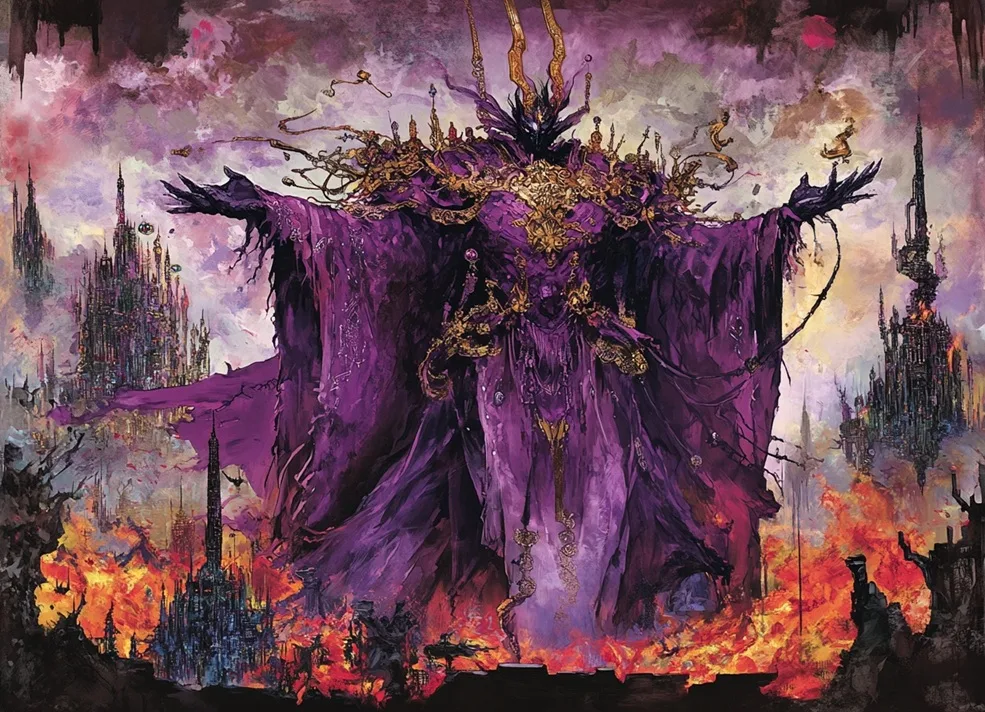
An angel carries the seer into the wilderness and shows him a woman. She wears purple and scarlet, she holds a golden cup, and she is drunk. Then the angel explains the vision, and the explanation is unusually direct. The seven heads of the beast beneath her are seven hills. The woman is the great city that rules over the kings of the earth. So what does Babylon represent in Revelation, once the angel has said it outright?
For a first-century reader, that sentence closed the question. What does Babylon represent in Revelation? Only one city sat on seven hills and ruled the kings of the earth. The text points at it as plainly as a book of this kind ever points at anything: Babylon is Rome.
What the Vision Actually Describes
The material runs across chapters 17 and 18 of the book. Chapter 17 gives the vision and its interpretation; chapter 18 gives a funeral song for a city that has already fallen.
The woman rides a scarlet beast covered with blasphemous names, with seven heads and ten horns. She wears gold and jewels, and her cup is full of abominations. On her forehead is a name, which the seer presents as a mystery: Babylon the great, mother of harlots.
Then the angel interprets, and the waters on which she sits are peoples and nations. Seven heads mean seven hills, and they also mean seven kings. Ten horns are kings who will turn on her and burn her. The vision does not end with her enemies destroying her from outside: her own allies do it.
When the Book Was Written, and Under Whom
Before anyone argues the identification, the date has to come first, because everything else depends on it.
Most scholars place Revelation in the last decade of the first century, under Domitian, and a minority argue for the late 60s, under Nero. Either way the setting is the same: a small network of assemblies in the province of Asia. They lived inside an imperial system that expressed its legitimacy through public cult.
That cult is the pressure the whole book responds to. Cities in Asia competed for the honour of hosting a temple to the emperor. Civic life meanwhile required sacrifices that a strict monotheist could not offer. Refusal was not martyrdom in every case; more often it meant exclusion from trade guilds, festivals and offices.
Seen against that background, the vision of a wealthy city that everyone admires and no one questions is not an abstraction. It describes the world those readers walked through every day.
What Does Babylon Represent in Revelation, and Why Rome
Three details point the same way, and they are not subtle.
- Seven hills. Rome’s identity as the city of seven hills was a commonplace, celebrated on coins and in poetry. No other candidate carried that description.
- Rule over the kings of the earth. In the 90s of the first century, one power answered to that phrase.
- The commerce of chapter 18. The lament lists cargo arriving by sea — gold, silk, ivory, marble, cinnamon, spices — and ends with a chilling item: bodies and souls of men. That is the trade of an imperial capital, and it was Rome’s.
Scholars differ on much in this book, though on the identification of the great city they are, for once, close to unanimous. Even commentators who read the rest of the visions as descriptions of a distant future usually concede that this particular woman wore a Roman face for the people who first heard about her.
The Detail That Scholars Cannot Agree On
One passage resists every attempt to close it, because the angel says the seven heads are seven kings. Five have fallen, one is, another has not yet come, and the beast itself is an eighth who belongs to the seven.
Attempts to count emperors against that sequence have produced a small library. Beginning with Augustus gives one answer, beginning with Julius Caesar another, and both require decisions about whether to include the three claimants of the year 69. No arrangement anyone has proposed satisfies every clause of the passage.
Some readers conclude that the numbers are schematic rather than historical: seven is the number of completeness in this book, as it is for the churches, the seals and the trumpets. The count would then say “a full sequence of kings, and one more”, which is a statement about totality rather than a calendar.
Serious scholars hold both positions, and the honest report is that nobody has solved the passage. Where the text is opaque, saying so is better than choosing a reading because it tidies the page.
Why Not Say “Rome” Outright
If the meaning was obvious, the code looks pointless, and yet it was not.
Two reasons hold together here, and the first of them is prudence. A text circulating among the seven churches of Asia under Roman administration gains nothing by naming its target on the page.
The second is theological, and it matters more, because calling Rome “Babylon” places it in a pattern. Babylon was the empire that destroyed the first Temple and carried Judah into exile. Rome was the empire that destroyed the second, in the year 70. Naming one after the other says that this has happened before, and that the earlier oppressor did not last either.
That usage was not unique to Revelation, because Jewish writings composed after 70 use Babylon for Rome in the same way. Among them stand 4 Ezra and 2 Baruch, so the seer was drawing on a convention his readers already knew.
The Charge Is Economic Before It Is Moral
Readers often take chapter 18 as a denunciation of immorality, and the imagery of the harlot invites that. Yet the actual complaint, once the metaphor is set aside, is about trade.
Merchants and shipmasters do the mourning, and what they lament is the loss of a market. Their list of goods reads like a customs manifest, and its final entry places slaves at the end of a catalogue of luxuries, counted alongside cinnamon and fine flour. The critique lands on a system that made human beings a commodity and grew rich on it.
This reframes the famous call: come out of her, my people. It is not primarily an instruction about personal purity, but a demand to withdraw from an economy. The seer regards that economy as built on blood, and he addresses communities that lived off it.
How the Fall Is Described
The judgment scene is worth reading closely, because its logic is unusual.
Babylon does not fall to an invading army of the righteous. The ten horns destroy her, her own client kings, who hate her and burn her with fire. The powers it had co-opted are the ones that undo the empire.
Then comes the reversal, because in one hour, the text repeats, so great a wealth was laid waste. The traders stand at a distance and weep, not for the dead but for their cargo. Then the text calls heaven to rejoice, and the contrast between the two reactions is the point of the chapter.
The angels of Revelation execute this judgment without triumph on the human side. The celebration happens above; below there is only the accounting.
How the Passage Was Read Afterwards
Identifying the woman with Rome did not stay uncontested for long, and the reason is instructive.
Once the empire became Christian in the fourth century, a reading that condemned Rome as the enemy of God grew awkward. Augustine offered a way out, and he took it in The City of God. There he treated the two cities as moral orders rather than as places. Babylon became any community organised around self-love, and Jerusalem any community organised around God.
That move preserved the passage and drained it of its edge. It also set the pattern for most later interpretation, in which Babylon is whatever the interpreter opposes. Reformers applied the name to the papacy; their opponents returned it.
Modern historical scholarship went back the other way, and it reads a first-century text against a first-century situation first. Both approaches survive, and a reader should know which one an author is using.
What Babylon Does Not Represent in Revelation
Two readings deserve setting aside here, and for different reasons.
One of them treats Babylon as a cipher for a specific modern institution, a nation, a church or a financial system. Every generation has proposed a candidate, and every candidate has outlived its identification. The text addressed a situation its first readers were living in, and any reading that forgets them is building on air.
Another flattens the figure into a general symbol of wickedness, and that is too thin. The seer is not condemning sin in the abstract: he is describing a particular arrangement of power, money and violence, and he names its capital.
Between these two errors there is a defensible middle, because Rome is the referent and the pattern is transferable. The imagery of Revelation works by placing one empire in a line of empires. A later reader can therefore ask the same questions of a later arrangement, without pretending the book describes it.
What Does Babylon Represent in Revelation for a Reader Today
The value of this passage is not that it predicts. It is that it describes, and describes accurately, a mechanism that recurs.
An order grows wealthy on the labour of people it does not count. Everyone admires it while it lasts, and its admirers are the first to abandon it. Its collapse comes from inside, from the very allies it purchased. The seer, watching from a small island with no power of any kind, said that such an order was not permanent.
He was right about Rome, and that matters for the question. To ask what does Babylon represent in Revelation is therefore to ask about one empire first, and only afterwards about the pattern. Whether that pattern holds elsewhere is a question the text leaves open, and leaving it open is the honest reading. The new Jerusalem that follows stands as the opposite of this city: open gates, no market, and nothing bought.
Check out the author’s book here: The Book of Revelation.

Leave a Reply