
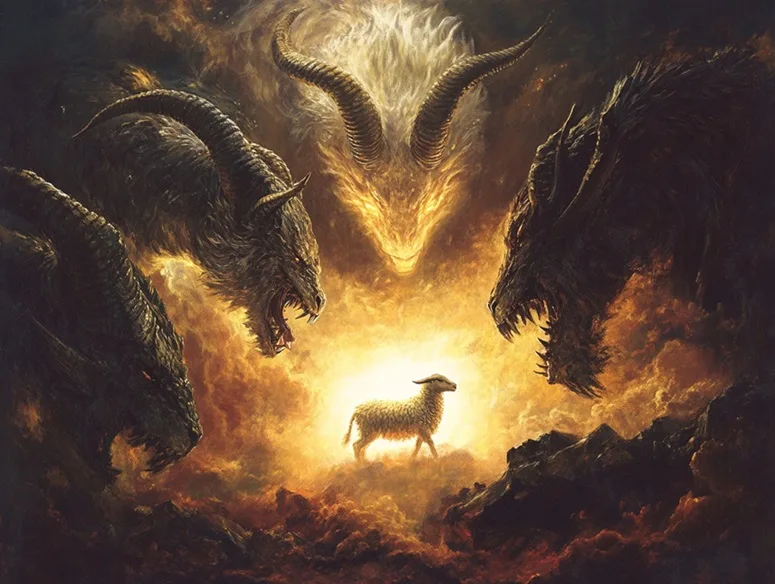
A dragon with seven crowned heads. Out of the sea, a beast. Then a second beast with the horns of a lamb and the voice of a dragon. And at the centre of it all, a lamb that has been killed and is standing anyway. This is the imagery of Revelation at its most concentrated.
The imagery of Revelation is not decoration on top of an argument. It is the argument. John could have written a letter about Roman power and Christian loyalty, and instead he wrote monsters, because monsters say something a letter cannot.
Who Was Writing, and to Whom
The author calls himself John and says he was on Patmos, a small Aegean island, because of his testimony. He wrote in Greek to seven congregations in the Roman province of Asia, in what is now western Turkey. Later tradition made him the apostle. The book never says so.
Most scholars date Revelation to the mid-90s, under Domitian, though a few argue for the years after Nero. Either way the setting is the same. Imperial temples, civic festivals, trade guilds with their own gods, and a growing expectation that decent people would take part.
That is the pressure the seven churches lived under. Not usually soldiers at the door, but a hundred small occasions to go along, and a social cost for refusing. So the imagery of Revelation is aimed at people choosing between an easy life and an awkward loyalty.
Where the Imagery of Revelation Comes From
John almost never quotes his sources, and he borrows constantly. Exodus, Isaiah, Ezekiel, Daniel, Zechariah and Genesis supply him with plagues, thrones, living creatures, lampstands and a bride. His audience heard the scroll read aloud, and John expected them to catch the echoes.
Daniel matters most. Daniel saw four beasts come up out of the sea, and an angel told him plainly that the beasts were kingdoms. So a composite monster already meant empire before John wrote a word, and readers knew it.
Apocalyptic writing works by disclosure. It shows the hidden shape of a present crisis through visions, angels, numbers and impossible animals, so the imagery of Revelation does not replace history. It interprets history, in a register that lets you say things about Rome that you could not say in plain prose.
The conventions are steady enough to follow. Seven means completeness, horns mean power, eyes mean perception, and a city can stand in for an empire. But the visions keep more meaning than any key can unlock, and that is deliberate.
The Dragon
Chapter 12 opens with a woman about to give birth and a great red dragon waiting to eat the child. The dragon has seven heads, ten horns and seven crowns, and his tail sweeps a third of the stars out of the sky.
John does something unusual here. He names the symbol. The dragon is the ancient serpent, the devil, Satan, the one who deceives the whole world, and you can read the whole scene in Revelation 12 for yourself.
Then Michael and his angels throw him out of heaven, and the surprise is what follows. The dragon does not stop. He goes after the woman, and then after the rest of her children, so defeat above becomes persecution below.
That is the logic the chapter delivers. Evil rages because it has lost, not because it is winning, and a congregation under pressure was meant to hear that as an explanation of their own week. The cosmic battle in Revelation follows the same war across the book.
The Sea Beast and the Number
Chapter 13 brings a beast out of the sea with seven heads and ten horns, made of leopard, bear and lion. Those are Daniel’s animals, recombined into one, and the message is that this empire contains all the others.
The beast blasphemes, makes war on the saints, and the whole earth admires it. One head carries a mortal wound that has healed, which is probably the rumour that Nero had not really died and would come back with an army.
Then comes the number. Six hundred and sixty-six, which in Hebrew letter values spells Nero Caesar, and some manuscripts read 616 instead, which spells the same name with a different spelling. That variant is the best evidence the number meant somebody, because scribes who knew the name adjusted the arithmetic. Who the Beast and Antichrist might be weighs the other candidates, while Revelation’s debt to Daniel explains why the animals come stacked.
The beast gets its authority from the dragon, and that link does the theological work. Empire is not simply human politics gone wrong, and it is not simply demonic either. It is both, which is why John refuses to let rulers off and refuses to stop at them.
The Land Beast and the Mark
A second beast comes up out of the land. It has two horns like a lamb and it speaks like a dragon, which is the sharpest single image in the book.
This one does not conquer. It persuades. Signs follow it, it sets up an image of the first beast and makes it speak, and later the text simply calls it the false prophet. This is the propaganda arm, and its gentleness is the point.
Then the mark. On the right hand or the forehead, and without it nobody buys or sells, so allegiance reaches into the marketplace. It stands against the seal that the angels put on the servants of God, since both marks answer the same question about who you belong to.
The warning is about systems that make survival depend on a small surrender. But this image has a bad history, because readers keep attaching it to whatever technology or minority they already disliked. The honest test asks what an institution demands and whom it crushes, not what it looks like.
The Lamb Is the Key to the Imagery of Revelation
Chapter 5 is where the whole book turns. Somebody announces the Lion of the tribe of Judah, John turns to look, and what he sees is a lamb standing as though it had been slaughtered.
Nothing else in the imagery of Revelation does that. The announcement and the picture do not match, and the mismatch is the message: conquest here takes the shape of faithful witness and death.
The Lamb has seven horns and seven eyes, so he holds complete power and complete perception in conventional apocalyptic shorthand. He alone can open the sealed scroll, because he bought people out of every tribe and language. And heaven sings to him beside God, which for a first-century Jewish writer is an enormous claim. Why the Lamb is central follows that reversal through the rest of the book, and the throne of God keeps the beasts in proportion.
The tension never resolves, though. The same Lamb appears later in scenes of terrifying judgment, and pretending otherwise flattens the book. In chapter 19 a rider goes out against the kings of the earth, but the sword comes out of his mouth, so the weapon is speech. The battle of Armageddon turns on exactly that detail.
Four Figures, One Question
Dragon, sea beast, land beast, Lamb. Put them side by side and they make two rival systems of authority rather than a cast of characters.
The dragon gives power, the first beast wields it, the second beast manufactures consent, and worship flows upward through the whole structure. The Lamb receives worship too, but because he was killed, so the imagery of Revelation sets counterfeit sovereignty against a sovereignty that bleeds.
Allegiance in this book is never a private opinion. It shows up in what you say, what you buy, what you refuse to attend, and whether you are still standing when it costs something. That is why the marks go on bodies.
And the ending replaces the empire rather than merely punishing it. Babylon falls, and a city comes down with open gates, clean water, fruiting trees and healing for the nations. So judgment turns out to be the middle of the argument and not the end of it. Revelation’s vision of new beginnings stays with that last movement.
Reading the Imagery of Revelation Now
The temptation is to use the monsters as name tags. Resist it, because the moment the beast becomes a person you dislike, the book stops examining you and starts arming you.
Better to keep the questions the images ask. What is being demanded here, who pays for it, what gets called inevitable, and what would refusing cost. Those work in any century, and John’s first readers had no political power at all.
The imagery of Revelation survives because it refuses to be solved. The dragon stays a dragon, the Lamb stays a contradiction, and a book that keeps both of them unsettling is more use than one that files them away.
Check out the author’s book here: The Book of Revelation.

One response to “The Imagery of Revelation: The Dragon, the Beasts and the Lamb”
That was thought provoking. I’ll rely on this a lot when I study revalations in the future. Thanks for the work you do to create stuff like this, it helps people like me.