
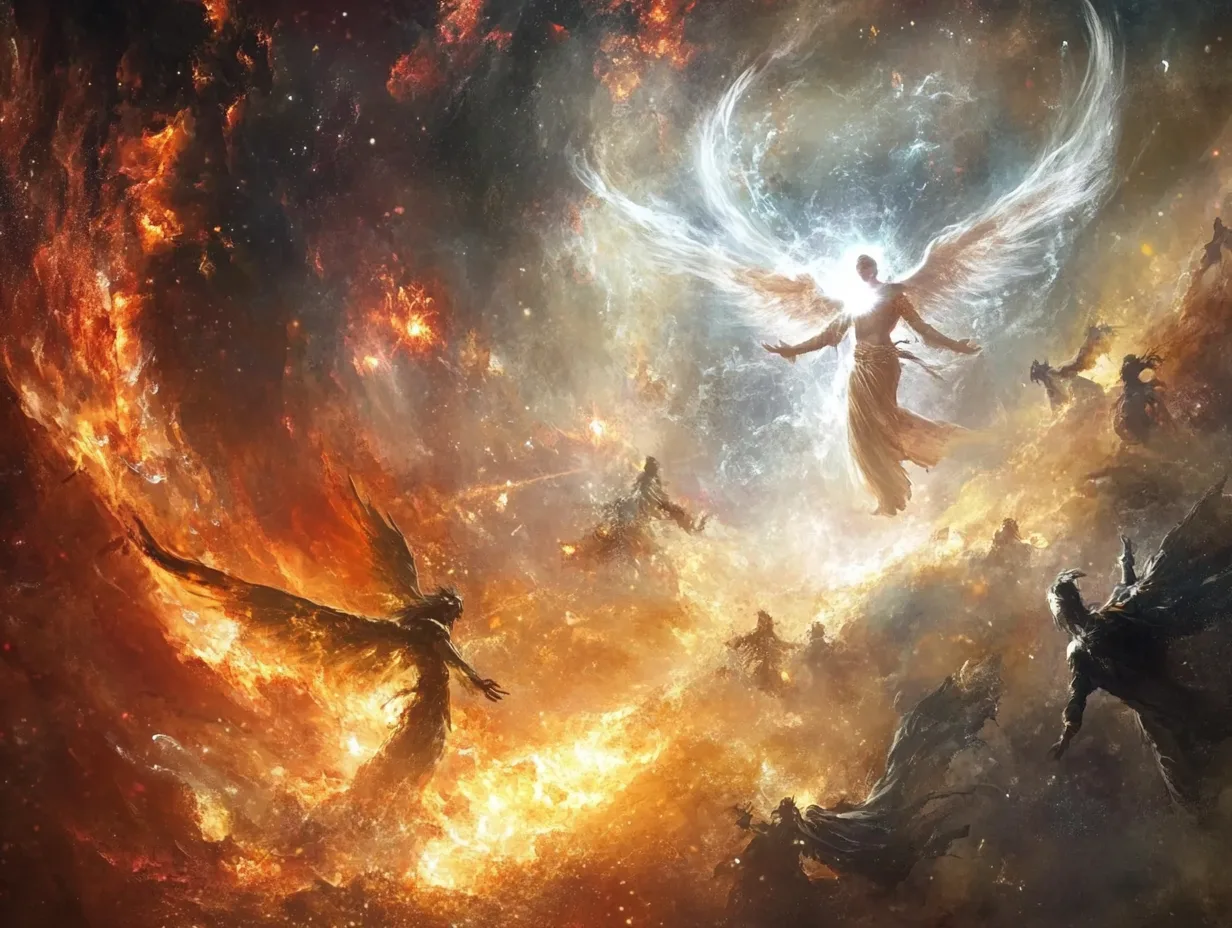
The Cosmic Battle in Revelation stages a conflict between divine rule and powers that deform worship, politics, and ordinary loyalty. John fills that struggle with dragons, beasts, angels, martyrs, and a slain yet victorious Lamb; however, these figures expose choices confronting seven churches under Roman rule rather than merely predicting catastrophe. The book finally directs terror toward hope, restoration, and faithful endurance.
John, Asia Minor, and an Apocalyptic World
The work identifies its author simply as John, while ancient Christian tradition associated him with the apostle. Scholars continue to debate that identification, yet the book clearly addresses seven Christian communities in Roman Asia Minor and many interpreters place its final form near the first century’s end. The Encyclopaedia Britannica overview summarizes the traditional authorship and historical setting.
Revelation belongs to the canonical New Testament, unlike later apocryphal apocalypses that circulated under famous names, and its genre draws upon Jewish apocalyptic traditions, Second Temple expectations, prophetic oracles, and ancient Near Eastern imagery. Meanwhile, Hellenistic rhetoric and Roman public life shaped how its first listeners heard its visions. John presents his message as prophecy, a letter, and an unveiling at once.
Roman cities joined commerce, civic identity, temples, and imperial honor in ways that pressured minority communities. Emperor worship did not operate identically everywhere, and persecution varied by place and period; nevertheless, refusal could bring social exclusion, economic loss, or official suspicion to believers. Therefore, Revelation translates local conflicts over allegiance into a universal drama of divine judgment and vindication.
The seven letters address heresy, persecution, complacency, compromise, poverty, and endurance within actual congregations, revealing how the larger conflict enters meals, trade, worship, teaching, and communal memory. Although the imagery reaches heaven, John never abandons those concrete settings. His apocalypse asks communities to interpret imperial splendor through the Lamb’s suffering victory rather than Rome’s claims.
The Cosmic Battle in Revelation and Its Symbolic Language
Apocalyptic writing communicates through visions, numbers, monsters, hymns, earthquakes, and scenes of heavenly judgment. Such language does not reduce every image to a private allegory or a single future event; instead, symbols can join spiritual powers with political institutions and recurring human conduct. The article on symbolism in the Book of Revelation offers a closer guide to that visual grammar.
John’s dragon represents more than an individual villain, because Revelation explicitly links it with the ancient serpent, Devil, and Satan. Within Christian interpretation, this adversary embodies deception, oppression, and hatred toward God’s people, while the dragon waits to devour the woman’s child, whom readers commonly connect with Christ or messianic hope. Yet the vision limits the monster’s reach and announces its eventual destruction.
Revelation 12:7–9, in the King James Version, reads:
And there was war in heaven: Michael and his angels fought against the dragon; and the dragon fought and his angels,
And prevailed not; neither was their place found any more in heaven.
And the great dragon was cast out, that old serpent, called the Devil, and Satan, which deceiveth the whole world: he was cast out into the earth, and his angels were cast out with him.
The Bible Gateway text of Revelation 12:7–9 allows readers to verify that wording and compare its context. Significantly, the heavenly victory does not make earthly life immediately calm, because the defeated dragon turns its fury toward the woman and her offspring. Thus, the scene explains persecution through mythic imagery while denying evil any final sovereignty.
The Lamb, Angels, and the Faithful Witnesses
Revelation repeatedly portrays Christ as the Lamb who suffered slaughter and now stands alive near God’s throne. This apparent contradiction shapes the book’s account of power, since victory comes through sacrificial witness rather than brute domination; moreover, the Lamb opens the scroll, receives worship, leads the redeemed, and defeats hostile kings. Why the Lamb remains central in Revelation develops this governing paradox.
Angels also sound trumpets, pour bowls, announce judgments, restrain winds, interpret visions, and fight the dragon’s forces, signifying divine involvement rather than a universe abandoned to chaos. However, John does not invite worship of these messengers, and an angel twice redirects him toward God. A focused study of angels in the Book of Revelation traces their varied responsibilities.
The faithful include martyrs, worshipers, servants, saints, and communities that refuse counterfeit allegiance despite pressure. Their witness gives the church an active role, although divine power secures the ultimate victory; consequently, endurance becomes neither passivity nor an excuse for retaliation. The saints resist through truth, worship, moral integrity, shared memory, and loyalty to the Lamb.
Revelation surrounds destructive scenes with songs that interpret events before heaven’s throne, so worship functions as a declaration of allegiance rather than merely singing or emotional refuge. Those hymns contest imperial praise by assigning honor, glory, and authority to God and the Lamb. Readers interested in that dimension can examine the role of music in Revelation.
Dragon, Beasts, and Babylon under Roman Power
The two beasts dominate chapter 13, while beastly power returns prominently in chapter 17. They signify oppressive political rule and deceptive religious authority that redirect worship away from God, while one beast coerces through intimidation and another promotes signs, propaganda, and the infamous mark. In this way, evil becomes institutional, economic, and liturgical rather than merely personal.
Babylon represents a corrupt world system whose luxury depends upon violence, exploitation, and seduction. For John’s first audience, her imagery strongly evokes imperial Rome, yet the symbol can outlive one empire; Revelation 17–18 mourns and celebrates her fall from sharply different perspectives. Merchants lament lost wealth, while heaven recognizes judgment upon a power stained by blood.
The book therefore connects heavenly rebellion with earthly arrangements without making those levels identical. Political regimes, false worship, economic appetite, and personal compromise can reinforce one another; however, interpreters should resist assigning every contemporary opponent a beastly label. Responsible hermeneutics tests analogies carefully, because reckless identification can reproduce the coercion that Revelation condemns.
John contrasts Babylon’s seduction with the Lamb’s self-giving rule and the saints’ patient witness. Accordingly, readers encounter a moral choice between rival cities, rival economies, and rival forms of worship. Babylon offers dazzling security but finally collapses before divine judgment. The New Jerusalem, by contrast, arrives as a healed community where God dwells with humanity.
The Cosmic Battle in Revelation across Four Movements
Revelation does not present a simple modern chronology, because its visions repeat themes and intensify earlier patterns. Still, four broad movements clarify how the conflict progresses from local churches toward renewed creation. Different schools arrange the seals, trumpets, and bowls in sequential or recapitulating schemes. Therefore, the following outline describes the narrative movement without settling every interpretive dispute.
- Revelation 1–3 examines seven churches facing false teaching, persecution, complacency, compromise, and competing loyalties.
- Revelation 6–16 unfolds seals, trumpets, and bowls that intensify judgment while repeatedly summoning humanity toward repentance.
- Revelation 17–20 depicts Babylon’s collapse, Christ’s return, Armageddon, Satan’s binding, final rebellion, and definitive judgment.
- Revelation 21–22 presents renewed creation, the New Jerusalem, divine presence, healing, and freedom from death and sorrow.
These cycles move between heaven and earth, allowing worship above to interpret suffering below. Moreover, escalating judgments show structured divine justice rather than meaningless catastrophe. The repeated refusal to repent exposes hardened allegiance, while pauses of sealing and worship preserve hope. For the climactic martial imagery, the Battle of Armageddon examines the relevant symbols and interpretations.
The millennium and final judgment have generated major disagreements among Christian interpreters. Some readings emphasize a future sequence, whereas others find recurring portrayals of the church’s entire historical struggle. Still others stress the text’s first-century political critique without denying later significance. Such disagreement encourages humility, especially when a symbolic apocalypse resists conversion into a precise timetable.
Finally, Revelation 21–22 resolves the conflict through creation’s renewal rather than humanity’s escape from creation. God removes sorrow, pain, and death, while the nations receive healing beside the river of life. This ending makes hope, not doom, the book’s destination. The discussion of the new heaven and new earth explores that restorative vision further.
Canonical Revelation and Related Apocalyptic Texts
Canonical Revelation shares motifs with Daniel, Ezekiel, Isaiah, Zechariah, and other Jewish scriptural books. Daniel supplies beasts and heavenly judgment, while Ezekiel contributes throne visions, scrolls, and renewed-city imagery. Isaiah helps shape the language of new creation and defeated chaos. Consequently, John’s visions remix inherited symbols rather than inventing an isolated mythology.
Other ancient apocalypses illuminate the genre but hold different canonical status. First Enoch and 4 Ezra belong to Jewish apocalyptic literature; most Christian traditions classify them among apocrypha or pseudepigrapha. The Apocalypse of Peter and Apocalypse of Paul are Christian apocryphal works rather than New Testament books. Comparing them reveals shared journeys, judgments, angels, secrets, and cosmic geography alongside important theological differences.
Gnostic writings also discuss cosmic rulers, salvation, and revelatory knowledge, although their surviving manuscripts usually come from later settings. Texts associated with Nag Hammadi often emphasize gnosis and complex heavenly hierarchies rather than Revelation’s public defeat of Babylon. Therefore, resemblance does not prove direct dependence or identical belief. Careful comparison respects each manuscript’s language, date, community, and literary purpose.
Unlike many pseudepigrapha, Revelation names John without adopting an ancient patriarch’s identity. Nevertheless, debates about authorship remind readers that traditional attribution and modern historical judgment answer different questions. The canonical status of Revelation also developed through contested reception in early Christianity. Its eventual place in the New Testament gave its imagery exceptional influence on art, politics, worship, and expectations of history.
Ethical Resistance, Spiritual Discipline, and Community
The Cosmic Battle in Revelation turns everyday faithfulness into resistance against corrupt powers. Personal temptation matters, yet John also exposes social structures that reward greed, violence, and counterfeit worship. Therefore, readers should not reduce spiritual warfare to invisible beings or private morality. The book joins inward discipline with public allegiance, communal responsibility, and compassion for people vulnerable to deception.
Several practices follow naturally from that account of endurance:
- Prayer, fasting, and regular Scripture reading can ground discernment when persuasive voices demand compromised allegiance.
- Shared worship realigns communal priorities by directing ultimate honor away from wealth, empire, celebrity, and fear.
- Honest fellowship counters isolation through encouragement, correction, material care, and accountability during periods of pressure.
- Holiness joins sexual integrity, generosity, truthfulness, and justice as visible alternatives to Babylon’s corrupt economy.
- Compassionate service and truthful witness extend hope into broken places without imitating the dragon’s methods of coercion.
These disciplines do not guarantee comfort, since Revelation repeatedly honors witnesses who suffer despite fidelity. Instead, they train communities to recognize manipulation and remain loyal under pressure. Moreover, vigilance must accompany compassion because every person remains vulnerable to fear, appetite, and deceptive certainty. Christians can expose injustice without treating opponents as less than human.
Historical recurrence gives the visions continuing force across periods of persecution, ideological conflict, and moral decline. Nevertheless, application requires caution, since every empire or crisis does not fulfill each image in an exclusive way. The symbols can reveal patterns without functioning as interchangeable labels. This balance preserves historical context while allowing the book to question later cultures, churches, and individuals.
Fear, Hope, and Responsible Hermeneutics
Revelation’s terrifying scenes can overwhelm readers who encounter them apart from the surrounding songs and promises. Yet John writes to strengthen endangered communities, not simply to terrify them with speculative horrors. Scenes of destruction alternate with worship, protection, patient endurance, and divine sovereignty. Consequently, fear becomes morally serious without receiving the final word.
Interpretive traditions disagree about how literally readers should map particular symbols onto historical events. A historically grounded approach first asks what Roman Asia Minor communities could recognize in John’s language. A literary approach then studies repetition, contrast, irony, and allusions to earlier Scripture. Finally, theological readings consider how the Lamb’s victory shapes ideas about divine power, justice, and hope.
The cosmic conflict also raises difficult questions rather than dissolving them. Why does judgment intensify, why do people refuse repentance, and how should sacrificial victory relate to violent imagery? Moreover, why does the book condemn imperial domination while portraying universal divine rule? Curious, non-dogmatic reading can hold these tensions open while examining how the whole narrative frames them.
Revelation ultimately closes with redeemed creation and eternal fellowship with God, not evil’s apparent dominance. The Lamb stands victorious, and faithful people share that victory without becoming beasts themselves. Therefore, the final vision challenges despair as firmly as it challenges compromise. Hope rests upon renewal, judgment, and divine presence rather than human control of history.
Frequently Asked Questions
Who wrote Revelation, and when?
The text names its author as John, whom ancient tradition linked with the apostle. However, modern scholars debate that identification and commonly place the work near the first century’s end. John addressed seven churches in Roman Asia Minor from the island of Patmos.
Is Revelation canonical or apocryphal?
Revelation belongs to the canonical New Testament in Christian Bibles, although some early communities disputed its status. By contrast, the Apocalypse of Peter and Apocalypse of Paul remain Christian apocryphal works. First Enoch and 4 Ezra generally enter discussions of Jewish apocrypha or pseudepigrapha.
Do the beasts represent real spiritual powers or political institutions?
Revelation’s imagery can connect both dimensions without collapsing one into the other. The beasts portray coercive rule and deceptive worship, while the dragon supplies their authority. Therefore, the visions present earthly institutions as expressions of a deeper spiritual rebellion.
Does the battle end with the destruction of creation?
Revelation ends with a new heaven, new earth, and New Jerusalem rather than sheer annihilation. God dwells with humanity, removes death and sorrow, and brings healing to the nations. Thus, renewal and restored communion provide the narrative’s final horizon.
Keep Reading the Visions with Care
The Cosmic Battle in Revelation remains compelling because its monsters expose recognizable alliances among fear, power, appetite, and worship. At the same time, the slain Lamb unsettles ordinary assumptions about victory and authority. Readers can keep testing interpretations against history, literary structure, and the book’s ethical demands. Such patient reading leaves room for wonder, disagreement, warning, and durable hope.
Check out the author’s book here: The Book of Revelation.

Leave a Reply