
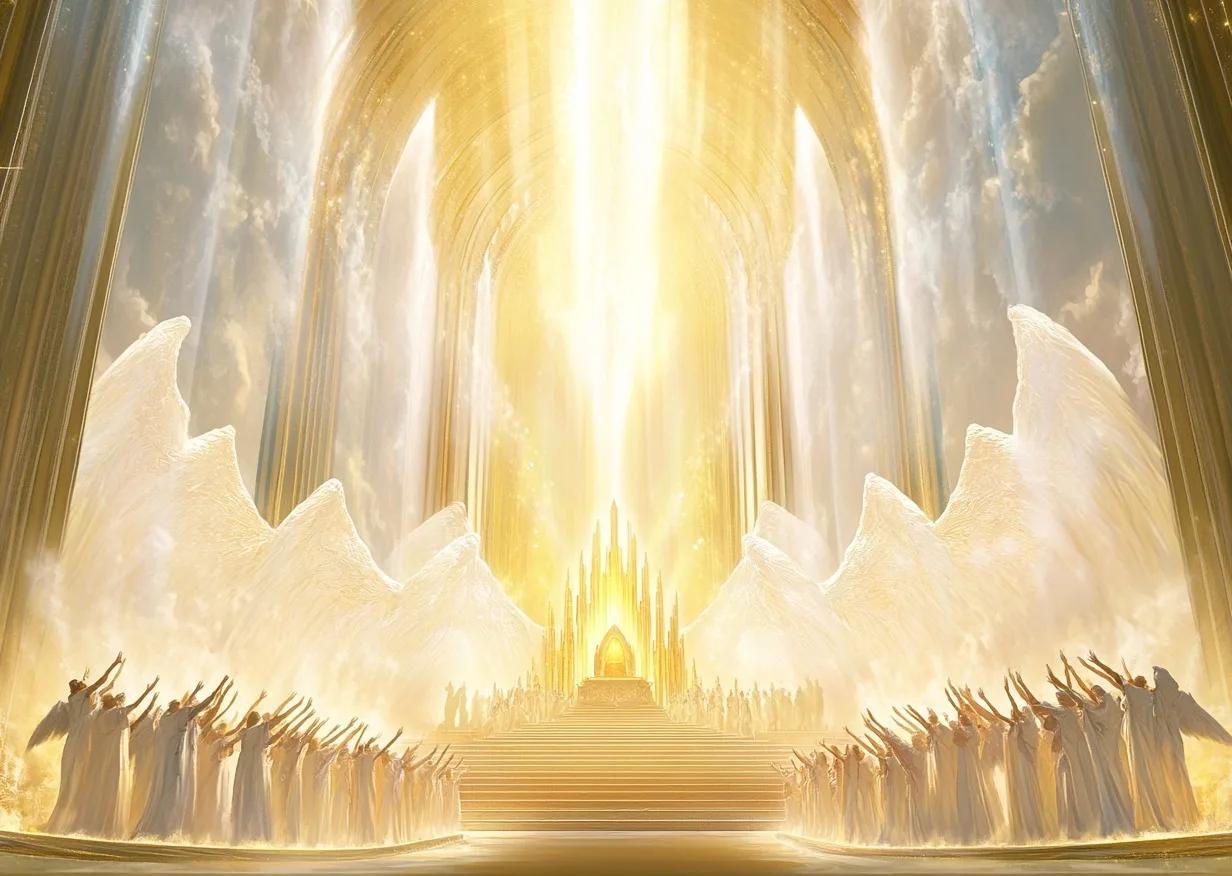
Revelation 4 begins with a door standing open in heaven. A voice like a trumpet says come up here, and John goes. What he finds is heaven’s throne room, and the rest of the book never really leaves it.
It is not a tour of the afterlife. It is a court, a palace and a temple all at once. So every judgment and every promise that follows is sent out from this one room.
Who Saw It, and When
The writer calls himself John. Later tradition made him the apostle, but the book never says so, and scholars still argue about it. He wrote from Patmos, a small island off the coast of what is now Turkey, to seven churches in the Roman province of Asia.
Most scholars date the Book of Revelation to around AD 95, near the end of Domitian’s reign. A few argue for an earlier date. Either way, the readers lived in Greek-speaking cities full of imperial temples and loyal festivals.
The book belongs to a type of writing called apocalyptic. It shows hidden things through visions, strange animals, numbers and scrolls. Daniel had used this language, and so had the Book of Enoch, so John’s first readers knew the rules even when they argued over what the pictures meant.
Kings in the ancient world showed their power through courts. They had attendants, guards, music and long ceremonies. John borrows all of that and then turns it away from Caesar and toward God. The imagery of Revelation works the same trick again and again.
Through the Door Into Heaven’s Throne Room
The first thing John sees is someone sitting on a throne. He does not describe a face or a body. Instead he reaches for stones, jasper and carnelian, bright and red, as if the only honest way to describe God is through light.
Around the throne there is a rainbow that looks like emerald. That is the sign God gave Noah after the flood, the promise not to destroy the earth again. So before a single seal is broken, mercy is already wrapped around the seat of judgment.
Then lightning, rumbling and thunder come out from the throne. That is the sound of Sinai, where God met Moses on the mountain. In front of the throne burn seven lamps, which John calls the seven spirits of God. Many readers take them as the Holy Spirit in its fullness.
And before the throne lies a sea of glass, clear as crystal. In the Bible the sea is usually wild and dangerous. Here it lies flat and still. Nothing in heaven’s throne room is out of control, even though the chapters ahead will be full of storms.
Four Creatures and Twenty-Four Elders
Four living creatures stand close to the throne. One looks like a lion, one like an ox, one has a human face, and one is like an eagle in flight. Each has six wings and is covered in eyes. They come from Ezekiel’s vision and from Isaiah’s seraphim, merged into one scene.
Many readers see them as the best of creation: wild animals, farm animals, people and birds. Later Christians linked the four faces to the four Gospels, and that reading shows up in church art everywhere. But the text itself only tells us what they do. Day and night they never stop saying holy, holy, holy is the Lord God Almighty, who was and is and is to come.
Around them sit twenty-four elders on smaller thrones. They wear white and they wear gold crowns. Many readers link the number to the twelve tribes of Israel and the twelve apostles, the whole people of God together. John never says that, though, so it is wise to hold the idea loosely.
The elders keep doing one thing. Each time the creatures give praise, they fall down and throw their crowns in front of the throne. Whatever honour they hold is borrowed, and they give it back. The twenty-four elders around the throne looks at who they might be.
The Songs of Heaven’s Throne Room
The worship here is not background music. It is the structure of the scene. The creatures speak, the elders answer, and then the circles grow wider. The role of music in Revelation follows that sound through the whole book.
Their reason is simple. God is worthy of glory, honour and power because he created all things, and by his will they exist. So praise here grows out of creation itself. The world is here because God wanted it, and that is enough to sing about.
That had a sharp edge in Roman Asia. Cities held festivals for the emperor, and public worship was a way of showing loyalty. John puts all the glory in one place, and it is not Rome. The hymn sounds gentle, but it is a political act.
The Scroll and the Lamb
Chapter 5 carries the scene forward. In the right hand of the one on the throne is a scroll, written on both sides and sealed with seven seals. Nobody in heaven or on earth can open it, and John weeps.
An elder tells him not to cry, because the Lion of the tribe of Judah has won. John turns to look for the lion and sees a lamb instead, standing as if it had been killed. That is the turn the whole book hangs on. The one who wins is the one who was slain. Why the Lamb is central in Revelation follows that surprise to the end.
The Lamb takes the scroll, and heaven’s throne room explodes into song. The elders bring harps and bowls of incense, which John says are the prayers of God’s people. Then thousands upon thousands of angels join in, crying that the Lamb who was slain is worthy. You can read the whole of Revelation 4 and the chapter after it in one sitting.
Finally every creature joins, in heaven, on earth, under the earth and in the sea. The room that began with four creatures ends with the whole of creation singing.
Where the Picture Came From
John did not build this room from nothing. Isaiah 6 gives him the cry of holy, holy, holy. Ezekiel 1 gives him the creatures, the eyes and the blazing throne. Daniel 7 gives him a heavenly court with books opened for judgment.
Other writers of the time also took their seers up to heaven. The Book of Enoch has long journeys through the heavens with angels as guides. The Ascension of Isaiah takes its hero through seven heavens, one after another. These books show how common the idea was, though they do not prove that John copied any of them.
But the others tend to wander, from level to level and from secret to secret. John does not wander. His vision keeps pulling back to one centre, the throne and the Lamb. That focus is what makes heaven’s throne room feel steady while the rest of the book shakes.
Reading Heaven’s Throne Room Honestly
No single key opens every detail. The rainbow means mercy, while the thunder means judgment. A lamb is weak, and this one wins. A glass sea lies calm, yet it reminds us of chaos held back. The symbols pull against each other, and that is part of the message.
Readers still disagree about the elders. Are they people, angels, priests or a council? The creatures have been read as nature, as royal virtues, even as signs of the zodiac. A good reader checks each idea against the older scriptures and the first readers’ world before trusting it.
Some things are clear, though. God rules creation, worship answers his holiness, and only the Lamb can open the scroll. Why the throne of God is central shows how every later scene circles back here, while the cosmic battle in Revelation shows what happens when rival thrones make their claim.
Why It Still Matters
For believers, heaven’s throne room teaches a kind of praise that is not about personal success. Throwing down crowns is a picture of humility, and every gift goes back to the giver. When the world feels out of control, the still sea is a reminder that chaos does not have the last word.
For readers outside the faith, the chapter is still worth study. It shows how an ancient writer could criticise an empire without naming it. Every seat, sound and gesture in the room says what deserves loyalty, and that question never goes out of date.
The best way in is simple. Read Revelation 4 and 5 aloud, then Isaiah 6, Ezekiel 1 and Daniel 7. Heaven’s throne room was written to be heard, and it still sounds best that way.
Check out the author’s book here: The Book of Revelation.

Leave a Reply