
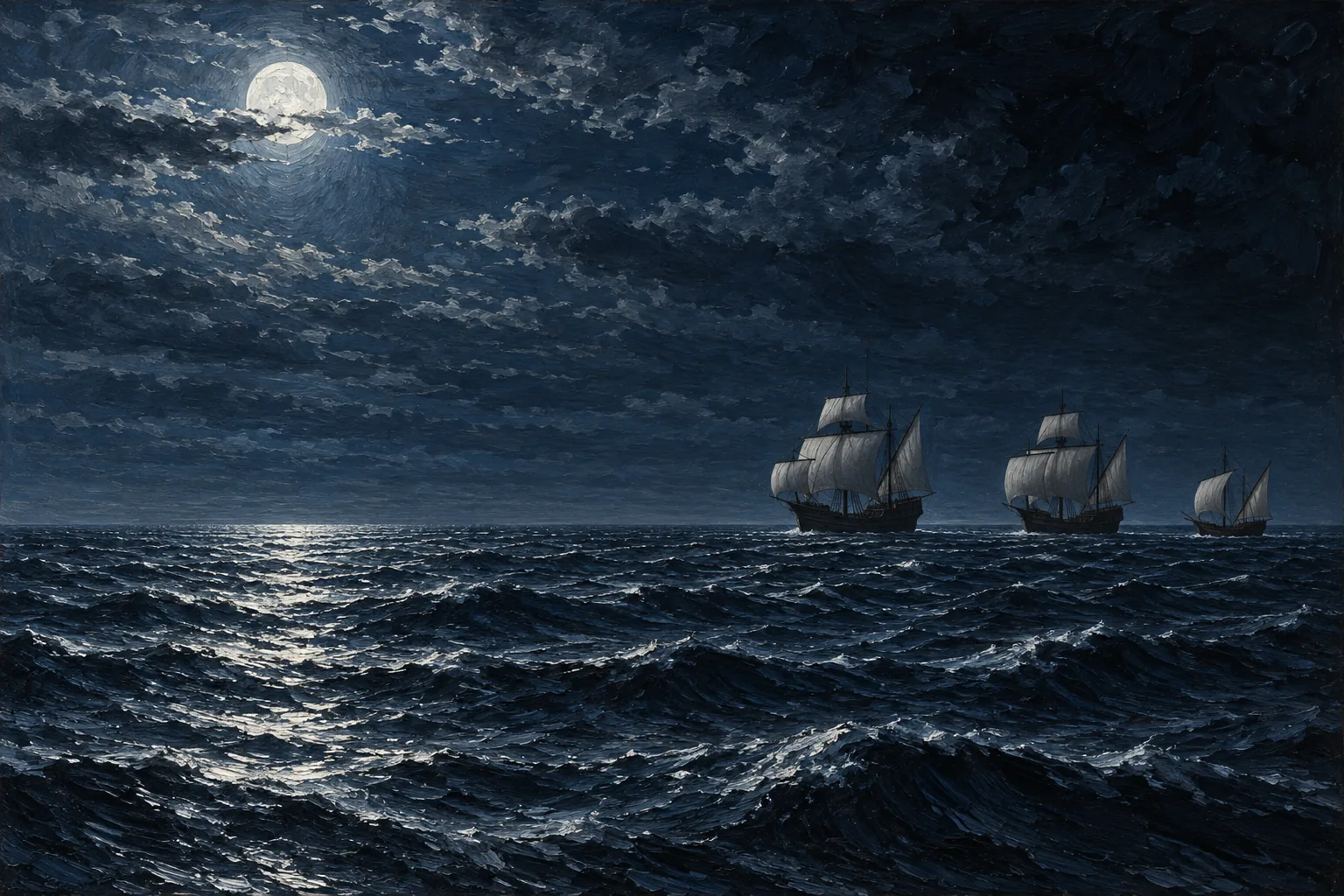
Every October the story of 1492 is retold as a triumph of navigation, courage, and stubborn arithmetic. The version Christopher Columbus told about himself was rather different, and he wrote it down.
Between 1501 and 1502, back in Spain after his third voyage, he assembled a notebook of biblical and patristic passages. He meant it for the Catholic Monarchs, Ferdinand and Isabella. Historians call it the Columbus Book of Prophecies, the Libro de las profecías, and its argument is blunt. The discovery of new lands, Columbus insisted, had been foretold, and he was the man chosen to fulfill the prediction.
One of the texts behind his confidence was not in the Hebrew Bible at all. It came from 2 Esdras, a Jewish apocalypse that most Protestant Bibles now leave out entirely.
The Columbus Book of Prophecies and Its Purpose
The manuscript survives in the Biblioteca Colombina in Seville, the library founded by his son Ferdinand. It is not a finished book but a working file of quotations, arranged under headings about the past, the present, and the future. Some leaves are missing, and scholars still argue about who removed them.
Columbus did not compile it alone. A Carthusian monk named Gaspar Gorricio, from the monastery of Las Cuevas in Seville, helped him gather and copy the passages. The collection draws on Isaiah, the Psalms, Augustine, Nicholas of Lyra, and a line from Seneca’s tragedy Medea. That line promised that a later age would see Ocean loosen its bonds and reveal new lands.
The purpose was political as much as devotional. By 1500 a royal investigator had arrested Columbus, shipped him home in chains, and stripped him of his governorship. The notebook argued that his enterprise belonged to God’s plan, and that anyone who hindered it was resisting providence. It also sketched a larger mission: gold from the Indies should fund the recovery of Jerusalem before the world came to an end.
The Verse From 2 Esdras
The apocryphal text that mattered most sits in the sixth chapter of 2 Esdras. The seer Ezra rehearses the days of creation in a long prayer, and on the third day he describes how God gathered the waters.
Upon the third day thou didst command that the waters should be gathered in the seventh part of the earth: six parts hast thou dried up, and kept them, to the intent that of these some being planted of God and tilled might serve thee.
(2 Esdras 6:42, King James Version; Bible Gateway carries the full chapter in a modern translation.)
Read as a statement of geography, the verse makes a startling claim. Six parts of the globe are dry land, and only one part is sea. If that were true, the ocean between Spain and Asia could not be very wide.
Columbus did not find the verse on his own. He met it in the Imago Mundi of Cardinal Pierre d’Ailly, a treatise on world geography that he read closely and covered with notes in his own hand. D’Ailly had taken the argument from the English friar Roger Bacon. Bacon treated Esdras as an inspired authority on the size of the earth.
Columbus repeated the claim for the rest of his life. In a letter written from Jamaica in 1503, stranded on his fourth voyage, he still insisted that the world was small. Six parts were dry, he wrote, and only the seventh was covered by water.
Why an Apocryphal Book Counted
A modern reader may wonder why anyone would stake a voyage on a book that sits outside the canon. The answer is that in 1492 the question was far less settled than it later became.
2 Esdras circulated in Latin Bibles as 4 Esdras, usually copied after the canonical books or among them. Medieval readers knew that theologians disputed its status, yet they quoted it freely. Ambrose had drawn on it, and the Latin liturgy borrowed its words for the prayer “eternal rest grant unto them.”
The core of the book is a Jewish apocalypse from about a century after the destruction of the Temple in 70 CE. Christian writers later added opening and closing chapters. For a closer look at its visions, see the eschatology of 2 Esdras and the Eagle Vision, where Ezra watches a winged empire rise and fall.
The Church drew the line only after Columbus had died. In 1546 the Council of Trent defined the Catholic canon and left 1 and 2 Esdras out of it. The official Latin Bible of 1592 then printed them in an appendix, as texts worth preserving but not binding. Protestant reformers had already placed them among the Apocrypha. That sorting has its own history, traced in why the apocryphal books left the Bible.
Canonical Prophecy and Apocryphal Geography
It helps to separate what Columbus took from each source, because he used them in different ways.
From Isaiah he took promises about islands and distant coasts. “Surely the isles shall wait for me, and the ships of Tarshish first,” says Isaiah 60:9, and Columbus read the verse as a description of his own fleet. From Isaiah 65 and Revelation 21 he took the language of a new heaven and a new earth. He applied it, with remarkable boldness, to the lands he had reached. In a letter of 1500 he described himself as the messenger of that new heaven and new earth, and claimed God had shown him where to find it.
From 2 Esdras he took something else: not a promise but a measurement. Isaiah told him that he would sail, and Esdras told him that the sailing would be short. The canonical prophets supplied the destiny, and the apocryphal seer supplied the arithmetic.
That division matters because the arithmetic was wrong. The experts who reviewed his proposal in Portugal and in Castile were not flat-earth zealots, whatever the popular legend says. They knew the globe was round, and they suspected, correctly, that the distance to Asia was far greater than Columbus claimed. He survived because an unknown continent lay in the way.
The End of Days in the Columbus Book of Prophecies
The Columbus Book of Prophecies also contains a calculation about the end of the world. Following a tradition that gave history seven thousand years, Columbus counted the years since creation. He concluded that only about a century and a half remained.
That deadline explains his urgency. The gospel had to reach every nation, and Christians had to recover Jerusalem, before the time ran out. He believed the voyages were a step toward both goals.
Here again 2 Esdras fits the mood even where Columbus does not quote it directly. The book is obsessed with the question of how much time remains. Ezra keeps asking whether the age is nearly over, and the angel answers that the world has grown old. Columbus shared that anxiety, and he read his own career as part of the answer. The role of prophecy in apocryphal texts traces the wider pattern of such readings.
Why the Columbus Book of Prophecies Still Matters
For a long time historians treated the notebook as an embarrassment. The rational navigator seemed to fit poorly with the man who called himself a messenger of the Apocalypse. More recent scholarship, including the work summarized in Britannica’s biography of Columbus, takes the religious side seriously. It no longer treats it as a late symptom of illness or disappointment.
The notebook shows how a medieval mind combined sources that we now keep apart. Scripture, apocrypha, classical poetry, and geography sat on the same shelf, and each could correct the others. A verse about the third day of creation could carry the weight of a nautical chart.
It also shows how much the boundaries of the Bible shaped what people thought they knew. A generation after Columbus, editors would push Esdras to the margins of Catholic and Protestant Bibles alike. Few navigators after him would cite it as evidence about the size of the sea. The change was not only theological, because it altered which texts could count as facts about the world.
And it is a reminder of how apocalyptic hope travels. The visions that Jewish writers composed after the fall of Jerusalem ended up in the planning of an Atlantic crossing. For the fuller biblical theme Columbus borrowed, see the new heaven and new earth in Revelation.
Frequently Asked Questions
What is the Columbus Book of Prophecies?
It is a manuscript collection of biblical, patristic, and classical passages that Columbus assembled around 1501 and 1502. He intended it for Ferdinand and Isabella, to show that his voyages fulfilled prophecy. The original survives in the Biblioteca Colombina in Seville.
Which apocryphal verse did Columbus use?
He relied on 2 Esdras 6:42, which says that six parts of the earth are dry land and only one part is water. He found it through Pierre d’Ailly’s Imago Mundi and used it to argue that the ocean was narrow.
Was 2 Esdras part of the Bible in 1492?
It appeared in many Latin Bibles as 4 Esdras, but scholars disputed its status. The Council of Trent excluded it from the Catholic canon in 1546, and Protestant Bibles grouped it with the Apocrypha.
Did Columbus believe the world was about to end?
He did. Using a scheme of seven thousand years of history, he calculated that roughly a century and a half remained. He saw the spread of the gospel and the recovery of Jerusalem as tasks that Christians must finish first.
A Verse Longer Than the Ocean It Measured
The most famous voyage in Western history rested, in part, on a sentence from a book that its own church would soon set aside. That sentence was wrong about the sea. It was right, though, about how seriously people could take a text that most of us have never read.
Columbus did not sail because of Esdras alone. He sailed because of ambition, royal money, winds, maps, and a stubborn misreading of the evidence. Yet when he explained himself, he reached first for prophecy. Among the prophets he placed a seer whose voice now survives mostly in the Apocrypha.
Whatever one thinks of that choice, it shows how porous the old boundaries were. It also shows how much weight a single verse could carry across an ocean.
Check out the author’s book here: The Apocrypha.

Leave a Reply