
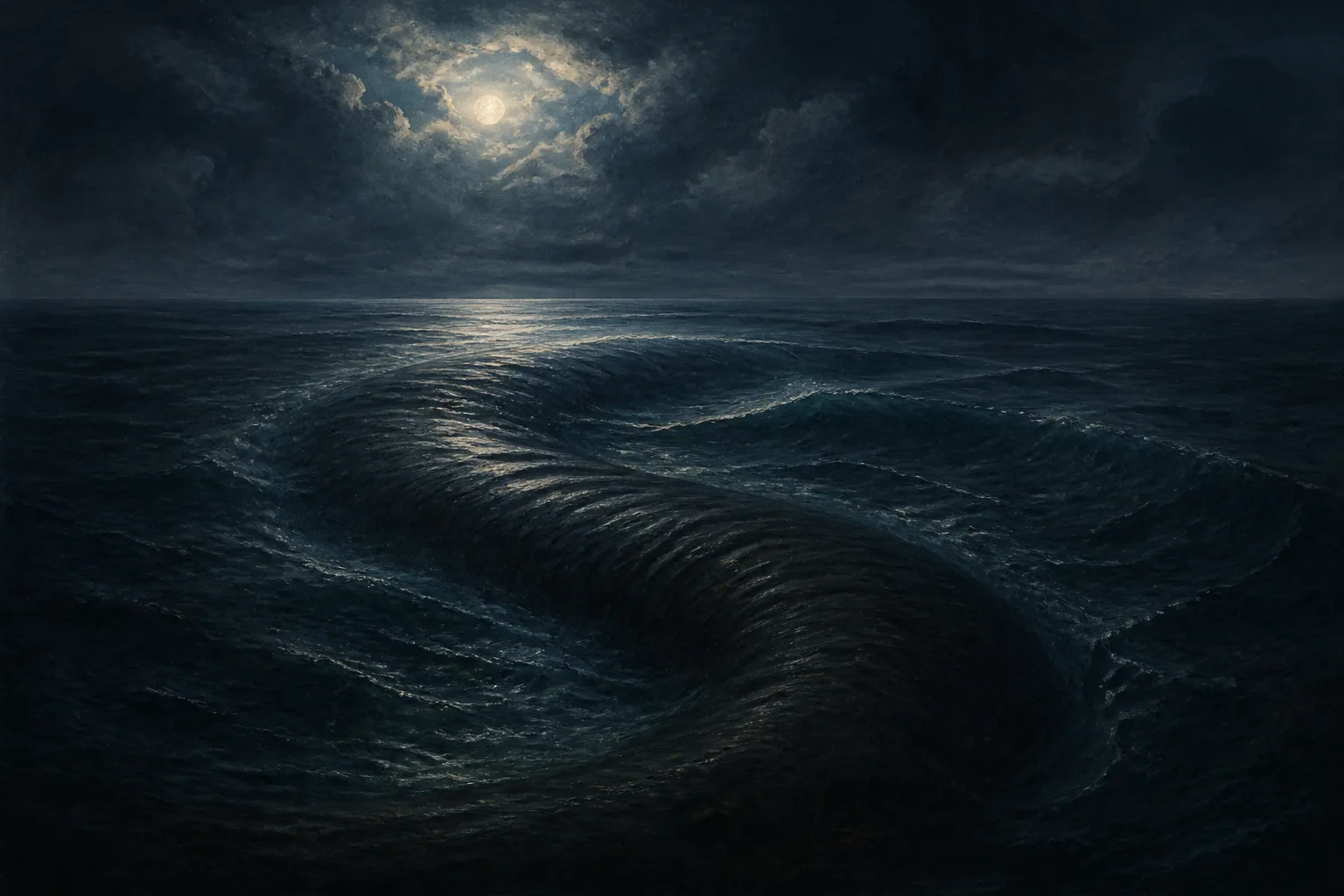
At the climax of the book of Job, God answers a man’s complaint about suffering by describing two animals at enormous length. One is a land beast of impossible strength, and the other is a sea creature that no weapon can touch.
Readers have always found the answer strange, because Job asked about justice and the reply is a zoology lecture. Yet ancient interpreters did not treat these creatures as illustrations at all. For them, Leviathan and Behemoth were real, primordial, and — crucially — still around.
Where the canonical text describes, the apocryphal literature schedules, and it tells you where the monsters live. It says why God separated them, and what will happen to them at the end.
Leviathan in the Hebrew Bible
The name appears only a handful of times, and the passages do not agree with each other.
Psalm 74 recalls a victory in which God crushed the heads of the sea monster. That language belongs to an old combat myth about creation as conquest. Isaiah looks forward instead, promising that a sword will punish the fleeing serpent and slay the dragon in the sea. Job, meanwhile, presents a creature that inspires awe rather than a defeated enemy. Psalm 104 goes further still, describing something that God formed to play in the water.
Canst thou draw out leviathan with an hook? or his tongue with a cord which thou lettest down?
(Job 41:1, King James Version; Sefaria carries the Hebrew alongside several translations.)
Four passages, four attitudes: defeated at the beginning, doomed at the end, admired in the present, and playing in the sea. Interpreters had to do something with that, and what they did produced the apocryphal tradition.
The Separation in 1 Enoch
The Book of Enoch supplies the detail the Hebrew Bible withholds. In its account God divides the two creatures and confines each one to a realm. Leviathan is female and dwells in the depths of the sea, above the springs of the waters. Behemoth is male and occupies a vast waste east of the garden.
That separation is the key move, and it is not decorative. Two creatures of that scale, kept apart, are two forces held in reserve. The text presents the arrangement as a deliberate act of restraint rather than as a fact of natural history.
Later apocalyptic writers extended the idea, and both 4 Ezra and 2 Baruch return to the pair. 2 Baruch supplies the ending that rabbinic tradition would take up enthusiastically: at the last days the two will feed those who remain.
For the wider apocalyptic setting these writers shared, see the eschatology of 2 Esdras and the apocalyptic imagery of the Apocalypse of Peter.
The Banquet at the End of the World
The image is worth pausing on, because creation begins with a struggle against chaos. History then ends with that same chaos served at a table.
Rabbinic literature developed the theme with evident delight, adding details about the hide of Leviathan used as a canopy for the righteous. Whatever else the picture is, it is certainly not solemn. A monster too dangerous to exist among us becomes provision at the end.
Consider what the image argues, because the forces that terrify a community do not simply vanish. The end subordinates them so completely that they turn into a benefit. That is a considerably more interesting theological claim than simple destruction. It explains why the tradition kept the monsters alive instead of writing them out.
Older Than the Bible
The background reaches beyond Israel, into texts recovered at Ugarit, in northern Syria. They describe a sea dragon called Lotan, whose name is linguistically related to Leviathan. In the cycle of stories about the storm god Baal, Baal defeats him. Mesopotamian tradition has its own version of a conflict between a god and the personified sea.
Israelite writers therefore inherited a widespread image and worked with it rather than inventing it. They did the same with much else: see the wisdom literature of the ancient Near East. What they changed matters more than what they borrowed, because in the Ugaritic material the combat is a contest among gods. In the biblical texts the outcome is never in doubt. In Job the creature becomes evidence of a maker’s range rather than a rival.
The apocryphal writers then took a further step, because they dated the conflict. They placed the separation at creation and the defeat at the end, and so they turned a myth into a chronology.
Why Leviathan Still Matters
The sea monster has proved unusually portable, and Hobbes borrowed the name for the commonwealth. A power that overawes must be greater than any individual. Melville built a novel on the pursuit of a white whale and cited Job repeatedly. The word survives in ordinary speech for anything vast and beyond control.
Underneath the borrowings sits the original problem, which has not aged. The world contains forces that people cannot govern, and any account of a good order must say something about them. Denying that they exist is one option, and the Hebrew and apocryphal writers declined it.
Their answer was to place the monsters inside the plan: created deliberately, confined deliberately, and scheduled for an end. Whether that satisfies is a matter for the reader, though it certainly refuses the easier move. The easier move would be pretending the deep is empty.
Leviathan in the Book of Revelation
The New Testament never uses the name, though the imagery is unmistakable.
A beast rises from the sea with seven heads and ten horns, and a dragon stands ready to devour. At the end, the text notes almost in passing that the sea was no more. For the full picture, Revelation beast symbolism unpacks that imagery at length.
That last detail is the key, because a reader who knows the older material understands why the sea has to go. The sea is not scenery: it is where the monster lives.
Seven heads carry the same freight, because Psalm 74 speaks of crushing the heads of the sea creature in the plural. Ugaritic material describes a seven-headed serpent, so the apocalyptic writer is working with inherited furniture.
Consider how the pieces fit, because creation begins with a conflict at the water. History ends with the water removed, and between those points sits everything the tradition wanted to say about danger and its limits.
What the Leviathan Tradition Argues
Strip the imagery away and a proposition remains, stated in the only vocabulary available.
The world contains real menace, and that menace is not an accident. It is not the work of a rival power either, because God made it, bounded it, and placed it where it is.
Notice how much that claim gives up, because an easier theology would deny the monster or blame it on an enemy god. This one refuses both moves, and it accepts the cost: a creator who made the deep and put something in it.
Job pushes hardest here, because the speech from the whirlwind does not console. It describes a creature no human can master, and it asks whether the questioner could have made such a thing.
The apocryphal writers softened that severity by adding a schedule: bound now, banqueted later. Whether the addition improves the answer or evades it is a fair question, and readers have taken both sides for two thousand years.
Frequently Asked Questions
Is Leviathan a real animal?
Readers have linked the Job description to the crocodile and to the whale, and some phrases fit either. Most scholars read the passage as mythological language rather than natural description, since the creature breathes fire and no weapon harms it.
Is Leviathan the same as Satan?
Not originally: the identification developed much later, helped by the serpent imagery in Isaiah and by the dragon of Revelation. In the earlier texts the monster is a creature of chaos, not a moral tempter.
Where does the end-time banquet come from?
Chiefly from 2 Baruch, with related material in 4 Ezra, and rabbinic sources develop it extensively. No canonical book of the Hebrew Bible describes the banquet at all.
Why are there two monsters rather than one?
Job names both, and 1 Enoch explains the pair by assigning one to the sea and the other to the dry land. The division covers the two realms, which suggests the arrangement is about completeness rather than about two separate stories.
The Deep That Was Never Emptied
Leviathan survives in the tradition because the tradition never claimed the danger had passed. The texts bind the creature, locate it, and date it, yet it remains in the water, and they say so plainly.
That honesty is the appeal, because a literature that wanted only comfort would have killed the monster at creation and moved on. Instead it kept the sea populated, gave the depths an occupant, and postponed the ending. That is, if we are candid, a more accurate description of how the world actually feels.
Follow the creature across the sources and a shape appears. Job admires it, the psalmist recalls its defeat, and Isaiah promises another. Enoch confines it, and Baruch serves it at a table.
Five attitudes, and none cancels the others: the tradition kept them all, side by side, without reconciling them.
That refusal to tidy up is unusual, and it is easy to mistake for confusion. Better to read it as a decision, since a single answer would have been cleaner and less true.
Ancient readers lived with storms, with famine, and with empires. They knew perfectly well that the world contains things nobody controls. A theology that denied it would have been useless to them.
So they named the thing instead, giving it a location, a size, a keeper, and a date. Naming is not mastery, but it is the beginning of a reply, and it was the reply they had.
What they never did was declare the boundary secure, because the creature stays in the water, alive, on every page that mentions it. The banquet waits for a day that has not come, and that is not comfort, nor was it ever meant to be.
Check out the author’s book here: The Book of Revelation.

Leave a Reply