
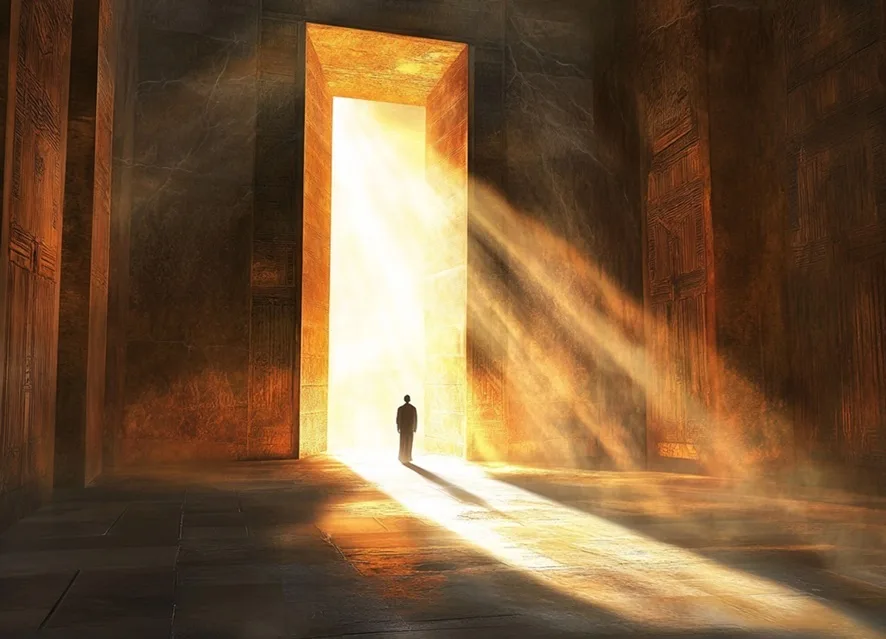
The New Jerusalem in Revelation as a Vision of Renewal
The New Jerusalem in Revelation crowns the final chapters of the canonical Christian New Testament with a vision of radical renewal. After beasts, plagues, warfare, and judgment, John sees a holy city descending from heaven into a transformed creation. Consequently, the book ends not with humanity escaping the world, but with divine life joining earth and its peoples.
This city promises hope, renewal, and eternal peace after the text portrays the defeat of evil and final judgment. Here suffering, death, and corruption no longer govern existence, while God dwells directly among humanity. However, the vision also raises questions about exclusion, judgment, empire, and the symbolic language through which apocalyptic writers imagined justice.
John of Patmos and the World Behind Revelation
The author identifies himself as John and locates his visions on Patmos, an Aegean island under Roman rule. Although later tradition linked him with Jesus’ apostle, the book itself never makes that identification. Most scholars place its composition near the end of Domitian’s reign, around 95 CE, though some propose an earlier date.
John wrote in Greek for seven assemblies in Roman Asia, within cities shaped by commerce, civic religion, and imperial power. Therefore, his images address concrete communities as well as an imagined cosmic future. The Encyclopaedia Britannica overview summarizes Revelation’s authorship, apocalyptic form, and disputed dating within early Christianity.
Revelation belongs to the canonical New Testament for most Christian traditions, unlike several Jewish and Christian apocalypses discussed below. Its apocalyptic language uses visions, angels, monsters, numbers, hymns, and heavenly journeys to disclose history’s hidden meaning. Meanwhile, John’s harsh contrast between Babylon and Jerusalem turns Roman splendor into a moral problem rather than an unquestioned achievement.
How the Holy City Descends from Heaven
Revelation 21 opens after the lake of fire, the final judgment, and the disappearance of the former heaven and earth. Then John sees a renewed cosmos and hears that the sea exists no longer. The new heaven and new earth provide the setting for the city’s descent, linking cosmic change with restored human community.
John introduces the city through bridal imagery, which joins architecture with relationship and celebration. Rather than presenting human builders, he says the city comes from God, already prepared for union. Revelation 21:2, in the New International Version, reads:
I saw the Holy City, the New Jerusalem, coming down out of heaven from God, prepared as a bride beautifully dressed for her husband.
The descent expresses God’s direct involvement in human destiny and portrays renewal as a divine gift. Moreover, the bride symbolizes a close, loving relationship between God and God’s people. Biblical prophets had pictured Jerusalem as a woman or bride, so John reshapes an older scriptural metaphor around the followers of Christ.
The New Jerusalem in Revelation: Measurements and Sacred Space
An angel measures the city at 12,000 stadia in length, width, and height, producing a perfect cube. Likewise, the inner sanctuary of Solomon’s temple had a cubic form, according to 1 Kings 6:20. John’s geometry therefore extends the sacred space of the Holy of Holies until the whole city shares its holiness.
The wall measures 144 cubits, while twelve gates carry the names of Israel’s tribes. In addition, twelve foundations bear the names of the Lamb’s apostles, joining Israel and the Christian community symbolically. Readers interested in this repeated pattern can compare the city’s arithmetic with biblical numerology in Revelation, where twelve commonly signals ordered completeness.
Jasper walls, golden streets, pearl gates, and jeweled foundations give the city an almost impossible radiance. However, John does more than celebrate wealth, because these materials transform imperial luxury into shared sacred beauty. What Rome concentrated in palaces and monuments, the vision places throughout a city whose inhabitants live before God’s unveiled presence.
- The twelve gates recall the tribes of Israel and open toward every direction.
- The twelve foundations associate the city’s future with the Lamb’s apostles.
- The 12,000-stadia cube enlarges the temple’s inner sanctuary beyond ordinary scale.
- The 144-cubit wall multiplies twelve by twelve, reinforcing order and completeness.
Open Gates, Named Foundations, and a Missing Temple
The gates never close, since the city experiences no night and defeated enemies cannot threaten it. Thus, openness conveys lasting security rather than careless vulnerability. Yet Revelation also says that nothing impure enters, creating a tension between universal welcome and the book’s severe scenes of judgment.
John sees no temple inside the city because God and the Lamb serve as its temple. Similarly, the city needs neither sun nor moon, since divine glory supplies its light. These claims move holiness beyond a single building, although they preserve temple language through measurements, priestly imagery, worship, and God’s immediate presence.
The nations walk by that light, and their rulers bring their glory into the city. Therefore, the renewed world retains cultural plurality instead of reducing everyone to an unnamed mass. The statement complicates interpretations that imagine complete cultural erasure, because nations still contribute their treasures after Revelation has condemned oppressive imperial trade.
River, Tree, and the Healing of the Nations
Revelation 22 shifts from precious architecture toward flowing water, fertile trees, and continuous life. A river runs from the throne of God and the Lamb through the city’s central street. Meanwhile, the tree of life stands on both sides, bearing twelve fruits and producing its harvest each month.
The imagery recalls Eden in canonical Genesis, where humanity lost access to the tree after disobedience. It also echoes Ezekiel 47, where healing water flows from the temple and nourishes fruit-bearing trees. Accordingly, John does not merely restore a garden; he combines Eden, Jerusalem, and prophetic sanctuary into one inhabited landscape. Revelation 22:2 (NIV) ends with this line:
And the leaves of the tree are for the healing of the nations.
That phrase makes abundance social and political, not merely personal, because whole peoples receive healing. Moreover, the river represents the continuous flow of God’s grace and life among the city’s inhabitants. The image suggests restored relations between God, humanity, and creation, recovering what the Genesis story says Eden lost.
Divine Presence and a World Without Suffering
A voice from the throne explains the city’s central promise before John describes its walls or jewels. God now dwells among mortals, removing the separation that temples once negotiated symbolically. The declaration gives the architecture its theological purpose:
Look! God’s dwelling place is now among the people, and he will dwell with them.
This promise recalls Emmanuel, the name that Matthew 1:23 explains as “God with us” while quoting the canonical prophecy of Isaiah. In other words, the New Jerusalem fulfills the theme of divine nearness across several biblical books, from prophecy to gospel to apocalypse.
Revelation then names the sufferings that no longer determine human life, offering comfort to communities facing grief and pressure. However, the text grounds consolation in God’s action rather than denying present pain. Its famous promise states:
He will wipe every tear from their eyes. There will be no more death or mourning or crying or pain, for the old order of things has passed away.
Finally, the enthroned speaker announces renewal in language that reaches beyond a repaired city or improved political order. The claim extends to physical creation and humanity’s spiritual relationship with the divine. John records the announcement simply:
I am making everything new!
Babylon, Judgment, and New Beginnings
The city’s meaning sharpens when readers compare it with Babylon, the richly adorned woman in Revelation 17 and 18. Babylon traffics in luxury, bodies, and violence, while Jerusalem receives splendor without exploitation. Consequently, the cosmic battle in Revelation culminates through two rival cities and their opposing economies.
Nevertheless, hope arrives only after frightening punishments, including the lake of fire and the second death. The sequence prevents an easy reading of Revelation as gentle spiritual reassurance. A study of Revelation’s final judgment can clarify how destruction frames the city’s peace and why interpreters debate its moral implications.
The New Jerusalem represents a fresh beginning because the former order of death and mourning passes away. Likewise, new beginnings in Revelation emerge through creation’s transformation rather than history’s simple cancellation. The vision therefore asks whether renewal means replacement, purification, fulfillment, or some unresolved combination of all three.
Canonical and Apocryphal Cities of the End
Revelation’s city participates in a broader Second Temple and early Jewish tradition of imagined sanctuaries and renewed Jerusalems. For example, the noncanonical New Jerusalem text from Qumran describes an enormous city through an angelic survey. Scholars classify those fragmentary Aramaic manuscripts among the Dead Sea Scrolls, not within Jewish or Christian biblical canons.
Second Esdras also presents an eschatological Zion amid judgment, grief, and restoration. Many scholars call its Jewish apocalypse 4 Ezra, while English Bibles often transmit it inside the larger work called 2 Esdras. Its status varies by tradition, but many Protestant readers classify it as apocryphal, and scholars regularly discuss it with pseudepigraphal literature.
In the eschatology of 2 Esdras, Zion appears first as a mourning woman and then reveals herself as a city. By contrast, canonical Revelation presents Jerusalem directly as both bride and urban space. Both works use personification, yet each arranges grief, judgment, and communal hope through a distinct visionary drama.
First Enoch, another Jewish apocalyptic collection, describes judgment and a renewed earth but does not enter most Christian canons. Scholars usually call it pseudepigraphal because its authors wrote under Enoch’s ancient name, although the Ethiopian Orthodox Tewahedo Church treats it as canonical. Thus, labels such as canonical, apocryphal, and pseudepigraphal depend partly on communities and partly on authorship claims.
These comparisons reveal shared apocalyptic habits without proving direct borrowing in every case. Angels measure sacred space, cities embody communities, and cosmic geography expresses moral order throughout this literature. Yet John’s combination of bride, cube, nations, river, and absent temple gives the canonical Christian vision its unusual concentration and enduring force.
Reading the City’s Symbols Without Flattening Them
Some interpreters expect a future city with measurable dimensions, jeweled materials, and identifiable gates. Others read the whole vision symbolically, finding the redeemed community itself within John’s architecture. Meanwhile, many historical readings combine these approaches because apocalyptic symbols can describe hoped-for realities without functioning like engineering plans.
Hermeneutics matters especially when readers ask who enters, who remains outside, and what healing means after final judgment. The open gates suggest welcome, whereas the exclusion lists preserve sharp boundaries around communal holiness. Therefore, responsible interpretation should acknowledge both movements instead of allowing either universal openness or punitive separation to silence the other.
The city’s relevance today need not depend on calculating its arrival or reproducing its materials. Its images challenge communities to connect beauty with justice, security with openness, and worship with restored relationships. Furthermore, its healing leaves direct attention toward nations and public life, not solely toward private survival after death.
FAQ About The New Jerusalem in Revelation
Is the New Jerusalem a literal city or a symbol?
The text presents an actual visionary city while saturating every feature with scriptural symbolism. Therefore, literal and symbolic readings need not cancel each other, although traditions weigh them differently. John’s cube, bride, river, and numbered gates communicate theological meaning even when readers expect a future material fulfillment.
Why does the city come down instead of believers going up?
John’s vision emphasizes God’s movement toward creation, because the holy city descends from heaven to the renewed earth. Consequently, the ending portrays divine presence transforming human space rather than souls permanently abandoning material existence. This downward movement supports the book’s larger promise that God makes all things new.
Who can enter through the always-open gates?
Revelation says the nations walk by the city’s light and bring their glory through its gates. Yet the same passage excludes impurity and people absent from the Lamb’s book of life. The resulting tension has generated competing interpretations about salvation, holiness, and the reach of the nations’ promised healing.
How does the New Jerusalem differ from Eden?
Eden offers a garden with a life-giving tree, whereas Revelation joins garden imagery to a vast urban community. Moreover, the city includes nations, gates, streets, and a throne beside its river. John’s ending therefore restores Eden while expanding its solitary beginnings into cultural, civic, and communal life.
A City That Keeps Asking Questions
The New Jerusalem closes Revelation with beauty, healing, and divine nearness, yet judgment remains part of its narrative horizon. Its symbolism invites hope while resisting a single, effortless interpretation. As readers keep thinking about its open gates and guarded boundaries, the city can provoke serious reflection on renewal, power, belonging, and peace.
Check out the author’s book here: The Book of Revelation.
Leave a Reply