
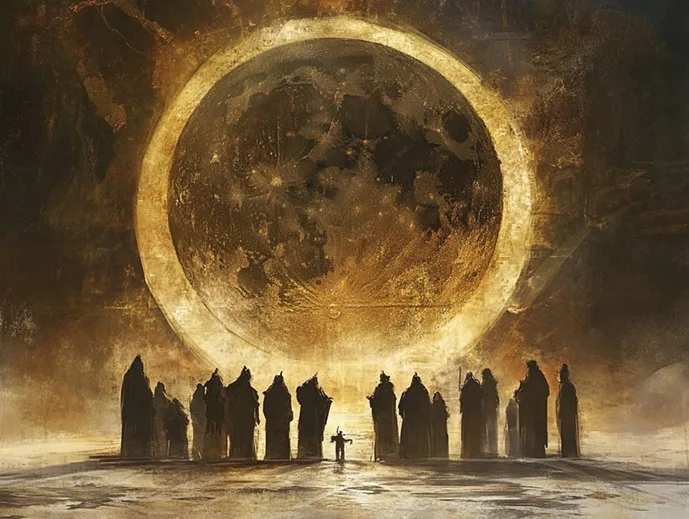
A scroll sits in the right hand of the one on the throne. Writing covers both sides, and wax holds it shut. Nobody in heaven or on earth can open it, and John weeps about that, which is a strange thing to put in a vision. What follows, as the seven seals break one by one, is the heart of the book.
Then a Lamb takes it. The seven seals come off one at a time, and each one lets something out. Read them as a countdown and they are just a list of disasters. Read them in order and they turn into an argument.
That order is the whole reason the seven seals still repay attention. Conquest, war, famine, death, then a protest from the dead, then the sky itself, and finally half an hour of nothing at all.
What the Scroll Actually Is
Ancient seals did three jobs. They kept a document shut, they proved who authorised it, and they controlled who got to read it. A will stayed shut until the right moment and the right witnesses.
So the scroll in Revelation is not a mystery for its own sake. It is a document with contents, and the drama is about access. Somebody must qualify to break the wax.
The elder announces the Lion of Judah. John turns to look and sees a Lamb that has been slaughtered. That switch is the hinge of the whole book, because every judgment that follows comes from the hand of a victim rather than a conqueror. Why the Lamb stays central is worth following on its own.
Why There Are Seven Seals and Not Five
Seven runs through the book like a heartbeat. Seven churches, seven spirits, seven lampstands, seven seals, seven trumpets, seven bowls. In Jewish writing the number carried a sense of a finished cycle, the whole of a thing rather than a lucky charm.
So the seven seals are not seven random blows. They are a complete disclosure, and the completeness is the point. Biblical numerology in Revelation sets out how the numbers work without turning the book into a cipher.
One detail spoils any neat countdown. That seventh seal does not end the vision, since it opens another series of seven. Its architecture nests one cycle inside another, and that shape matters more than any timetable.
The First Four: The Horsemen
The first seal sends out a white horse. Its rider has a bow and a crown and goes out conquering. White usually means purity in this book, so the rider has been read as Christ, as the gospel spreading, and as a counterfeit of both. The company he keeps argues against the kindest reading.
The second seal sends a red horse, and its rider takes peace from the earth with a great sword. Conquest has turned into mutual slaughter. That is not a new idea, but the sequence makes it feel inevitable.
The third seal brings a black horse with scales, and a voice quoting prices. A day’s wage buys a day’s wheat. Then the voice protects the oil and the wine, which is the cruellest line in the passage, because luxury survives while bread does not. Famine here is not a failed harvest. It is a market.
The fourth seal brings a pale green horse. Death rides it and Hades follows on foot, and between them they use the sword, hunger, plague and wild animals. The fourth rider adds nothing new, since he simply collects what the first three set in motion. The symbolism of the four horsemen takes each rider further.
Read together, the four are a chain and not a list. Conquest makes war, war wrecks the harvest, scarcity kills. Anyone in the Roman provinces had watched that sequence run at least once. You can read the horsemen in Revelation 6 in a few minutes and feel how fast it moves.
John did not invent the colours. Zechariah has coloured horses patrolling the earth in his first and sixth chapters. Revelation takes the older image and puts it under the Lamb’s scroll, which is how this writer works throughout.
The Fifth Seal Changes the Camera
Four seals look down at the earth. The fifth looks up, and under the heavenly altar there are souls.
They were killed for their testimony, and they are shouting. How long, they ask, before you judge and avenge our blood. That is a complaint, not a hymn, and the book leaves it standing.
The answer is white robes and an instruction to rest a little longer, until the number of their fellow servants is complete. It is not much of an answer. Nobody tells them why, and nobody promises a date.
That refusal is deliberate. The fifth seal admits that justice has not arrived yet, so faithfulness has to be possible without it. Revelation keeps the protest in the text rather than tidying it away.
It also settles what the seven seals are for. A book that only wanted to frighten people would not stop here to let the victims speak, and it certainly would not let them go unanswered.
The Sixth Seal Takes the Roof Off
Then comes an earthquake. The sun goes black, the moon turns the colour of blood, the stars fall and the sky rolls up like a scroll being put away.
Kings, generals, the rich, the enslaved and the free all run for the same caves. Rank stops working. In a world organised entirely by rank that image does more damage than the earthquake does.
Isaiah, Joel and Ezekiel all used this language, and so did Jesus in the gospels. Cosmic collapse was a known way of saying that God is acting, so a reader did not need to check the sky. Whether John meant literal events, political upheaval or the unmaking of creation is still argued, and the argument is honest.
The chapter ends with a question. Who is able to stand? The next chapter answers sideways, with two crowds: a sealed group of 144,000 from the tribes, and a multitude nobody can count, worshipping. Preservation frames the judgment, which stops the sixth seal from closing the book.
The Seventh Seal Is Silence
The Lamb opens the last seal and nothing happens. Heaven goes quiet for about half an hour.
It is the strangest beat in the book. Every other seal releases something, while this one withholds. Then an angel brings incense, mixed with the prayers of the saints, and fire from the altar is thrown down to the earth.
So the silence is not empty. It holds the prayers, including the shouting from the fifth seal, and it ends by sending them back down as fire. After that seven angels raise their trumpets, and the role of the seven trumpets begins. Later still come the seven bowls of wrath, which pour out the same judgment undiluted.
Why the Order of the Seven Seals Matters
Take the order away and you have seven catastrophes. Keep it and you have a movement.
The first four show what destructive power does from the outside, as geopolitics and economics and mortality. Then the fifth shows the same events from underneath, counted in bodies that history books would not name. Seal six puts everyone who profited in the same cave as everyone who suffered. And the seventh stops to listen.
That is why the seven seals are an argument about power rather than a schedule. They start with the people who make history, they end with the people who were buried by it, and they insist that both are being looked at.
Notice also what the sequence refuses to do. It never explains suffering. Nobody in these chapters offers a reason why the riders were allowed out, and the martyrs who ask for one are told to wait. So the seven seals are a description of how ruin travels, given in the order a reader would actually meet it, and the explanation is simply withheld.
The four main schools read the timing differently. Preterists point at Rome and the first century, futurists at a tribulation still ahead, historicists at long stretches of church history, idealists at patterns that repeat. Each asks a decent question, though none of them can close the case.
Reading the Seven Seals Without a Timetable
The temptation is to match each seal to a headline. People have done it with plagues, wars, inflation and eclipses for nineteen centuries, and the matches keep expiring.
The images survive because the structures do. Conquest still makes war, war still wrecks food supplies, and the dead still outnumber the named. The third seal reads uncomfortably well in any year when staples get expensive while luxuries stay on the shelf.
A better habit reads each scene as a comment on the one before it. Horsemen show the cascade, martyrs show its cost, the sixth seal shows that nobody is exempt, and the silence makes room for the prayers of everyone underneath. Holding all of it together is the throne of God in Revelation, which the book keeps at the centre of every scene.
One more warning is worth saying plainly. Apocalyptic language is easy to borrow and easy to abuse, because anyone can call an enemy a rider and a rival nation a beast. John wrote for small congregations under pressure, not for people with armies. Reading the seven seals as permission to hurry judgment along gets the book exactly backwards.
Revelation ends a long way past the seals, with death and mourning and pain gone. That ending is what keeps the seven seals from being a catalogue of cruelty. They are the diagnosis, while something else entirely is the cure.
Check out the author’s book here: The Book of Revelation.

Leave a Reply