
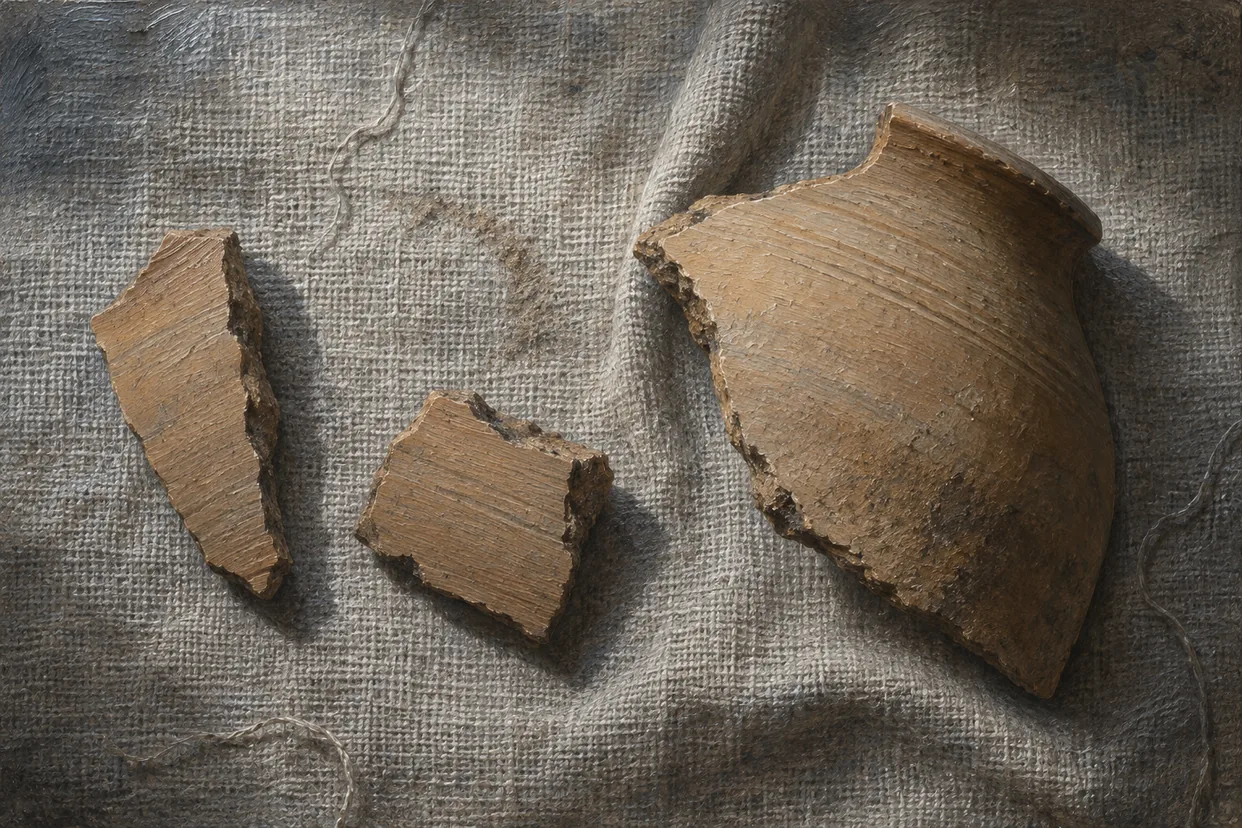
Mary Magdalene and Her Gospel come down to us in three copies, and the three do not say the same thing. Two are scraps of Greek papyrus and one is a Coptic book, and they disagree at the point where the story turns.
That disagreement is not a scribe nodding over a difficult word. It falls on the last page, where the men decide whether to accept what a woman has told them, and the two versions answer differently.
Most accounts of this text argue about its theology, while the manuscripts themselves are more interesting. They record a community still arguing while it copied.
Mary Magdalene and Her Gospel: the Three Witnesses
The complete copy is Coptic, and it sits in a museum in Berlin. Carl Reinhardt bought the codex in Cairo in 1896, and it carries the shelf number Papyrus Berolinensis 8502.
Scholars date that book to the fifth century, so it stands three hundred years from anything its author wrote. It also contains three other works, which tells us somebody assembled it as a collection rather than copying one text alone.
The other two witnesses are Greek, much smaller, and a great deal older. Papyrus Rylands 463, published in 1938, preserves part of the ending; Papyrus Oxyrhynchus 3525, published in 1983, preserves a passage from the middle.
Both Greek pieces come from the third century, which puts them two hundred years closer to the source than the Coptic book. Neither of them is longer than a single leaf of papyrus.
Why the Coptic Copy Cannot Be the Original
The Berlin book is a translation out of Greek, and nobody disputes that. Its Greek loanwords sit awkwardly in the Coptic, and the Greek fragments confirm what language the text started in.
Ten of its pages have vanished, and the gaps fall in the worst places. Pages one to six are missing from the opening, and pages eleven to fourteen from the middle of Mary’s vision. That second gap takes out the most contested teaching altogether.
Neither Greek fragment covers those gaps, and all three copies lack the same material, so the loss happened long before any surviving witness.
The Sixty Years Between Buying the Book and Reading It
Owning a manuscript and being able to read it are different things. Reinhardt bought the
codex in 1896, and the first full edition appeared in 1955.
Carl Schmidt had the text ready for the press in 1912, when a burst water pipe in a Leipzig
printing house destroyed the sheets. He went back to work, and each time something intervened: the First World War, then the Second, then his death in 1938 pushed the edition further away.
Walter Till inherited the job and eventually finished it. He waited several more years first, hoping the newly announced Nag Hammadi codices would supply the missing pages, and they did not.
That delay shaped everything which came after it. For the whole first half of the twentieth century this gospel was a title in a catalogue rather than a text anybody could quote. Its modern reception therefore starts in the late fifties, and gathers pace only in the seventies.
Where the Copies Part Company
The surviving ending is short and dramatic, and it turns on one exchange. Peter objects that the Savior would not have spoken privately with a woman, Levi rebukes him, and the disciples respond.
In the Coptic they all respond together, since the text says that they began to go out to teach and to preach. Mary’s testimony carries the whole group with it.
In the Greek of Papyrus Rylands 463, only Levi goes. He departs and begins to preach, and the text does not mention the others at all.
One word of difference changes the whole ending. Either a woman’s vision persuaded the apostles, or it persuaded exactly one man and left the rest where they stood.
What Hangs on That Word
The stakes here are easy enough to state. A community reading the Coptic ending has scriptural warrant for a woman teaching the twelve. A community reading the Greek has a woman whom exactly one man believed.
Neither version is obviously later than the other, although the Greek copy is older as an object. An older copy can preserve a revised text just as easily as an original one.
What the variant does establish is that the ending mattered enough to change. Somebody in the chain of transmission was uncomfortable, and the quarrel between Peter and Mary was live enough to leave marks on the page.
The wider setting of the second century sharpens the point. In the same decades a letter circulating under Paul’s name told Timothy that a woman should learn in silence. Churches reading that letter had to decide what to do with a gospel that ends the other way.
People copied both texts by hand, and they chose what to copy. One of them ends with the apostles taking a woman’s word for it. The earliest copy we have already shows that ending under pressure.
What the Greek Fragments Settle About Mary Magdalene and Her Gospel
Two things become firm once the fragments are in view, and the first is a date. The text circulated in Greek in Egypt by the third century, so somebody composed it in the second. That places it among the earliest non-canonical gospels rather than among later Gnostic works.
That timing matters a great deal for how we describe the book. A second-century date puts Mary Magdalene and Her Gospel in the same generation as writings the churches were still weighing, not in a later fringe.
The fragments also settle a question of geography, because Oxyrhynchus was an ordinary provincial town rather than a centre of anything. A text turning up in its rubbish heaps was one ordinary people read, not one a sect guarded.
The Company the Coptic Copy Keeps
The Berlin codex is not a single-work book, and its contents say something about how a fifth-century owner read it. Alongside the Gospel of Mary it carries the Secret Book of John, the Sophia of Jesus Christ and an Act of Peter.
Three of the four are revelation dialogues, where a risen Christ answers questions from named disciples. Whoever assembled the book was collecting a genre rather than a doctrine. The Gospel of Mary sat in that company because it does the same thing.
The fourth item is the odd one, since an Act of Peter belongs to a different kind of writing altogether. Its presence is a small reminder that ancient collections follow the taste of a compiler, not a catalogue.
The Fourth Witness That Does Not Exist
One correction here saves a great deal of confusion. Nobody found the Gospel of Mary at Nag Hammadi, and it appears in no Nag Hammadi codex.
The confusion is understandable, because the Berlin codex shares two works with that library, and modern anthologies print it alongside them. The manuscript itself surfaced half a century earlier, in a Cairo antiquities shop, with no connection to the Egyptian jar of 1945.
Anyone citing this gospel as one of the Nag Hammadi texts has taken the anthology for the find. The distinction matters, because the two discoveries prove different things about where and when these works circulated.
What They Leave Open
Three copies sound like a rich tradition, and by the standards of this literature they are. Set against the canonical gospels, with their thousands of manuscripts, three witnesses are almost nothing.
The author remains unknown, and the attribution to Mary is a claim the text makes rather than a signature. Nothing in any copy names a compiler or a place of writing.
The missing pages stay missing, and no library holds a fourth witness. Every reconstruction of what stood there is inference, and the honest ones say so.
Reading Mary Magdalene and Her Gospel With Three Voices
The practical consequence is a habit rather than a conclusion, and it is easily kept. Any quotation from this gospel should carry its source, because the Coptic and the Greek are not interchangeable.
Translations vary in how they handle this: some print the Coptic and relegate the Greek to a footnote. Others set the versions in parallel columns, which shows the reader what is actually known.
The reward for the trouble is a sharper picture of the early church. Gospel of Mary Magdalene Explained: Secret Teachings Revealed is striking. What left physical traces, though, is the argument at the end about who may speak.
Why Mary Magdalene and Her Gospel Was Worth the Argument
Mary holds a position in the canonical gospels that needs no apocryphal support. John has her alone at the tomb, and she carries the first news of the resurrection to the men who had scattered.
A community that took that scene seriously had a problem to solve. If a woman brought the first report, scripture did not settle the question of whether women could teach: it opened it. The Gospel of Mary works through exactly that difficulty.
The later church solved the difficulty differently. By the sixth century the West had merged Mary Magdalene with two other women and remade her as a penitent. That composite would hold for fourteen centuries, and it shaped every later portrait.
Against that background the three copies read as evidence of a road not taken. Somebody in second-century Egypt thought the argument worth writing down, and somebody else thought the ending worth changing.
Frequently Asked Questions
How many copies of the Gospel of Mary survive?
Three. One Coptic codex of the fifth century in Berlin, and two Greek fragments of the third century, one at Manchester and one from Oxyrhynchus.
Do the copies say the same thing?
Not quite. The wording differs at several points, and at the ending the Coptic has all the disciples go out to preach, while the Greek has only Levi.
Is the Gospel of Mary a Gnostic text?
The label fits loosely at best. Its vision of the soul’s ascent resembles Gnostic material, and it lacks the elaborate cosmology that usually defines those systems.
Was Mary Magdalene the author?
Almost certainly not. The text presents her as its central figure and its source of revelation. Ancient books made that kind of authority claim routinely.
Why is so much of it missing?
The Berlin codex had already lost ten pages when it surfaced, and no other copy fills them. Papyrus survives by accident, and half a book is a good outcome by the standards of this literature.
People usually discuss Mary Magdalene and Her Gospel as a matter of belief, asking the reader to accept or reject a portrait of the apostle. The manuscripts ask a smaller question, and answer part of it.
Three copies exist, made two centuries apart, and they disagree about whether the men listened. That disagreement is the most solid thing this text has left us.
Check out the author’s book here: The Gospel of Mary Magdalene.

2 responses to “Mary Magdalene and Her Gospel: Three Copies That Do Not Agree”
Fantastic.
I would love to read whatever you have on Mary Magdalene’s gospel. I don’t think she was a prostitute. I think that Jesus healed her of over a half dozen demons, after which she became his follower.