
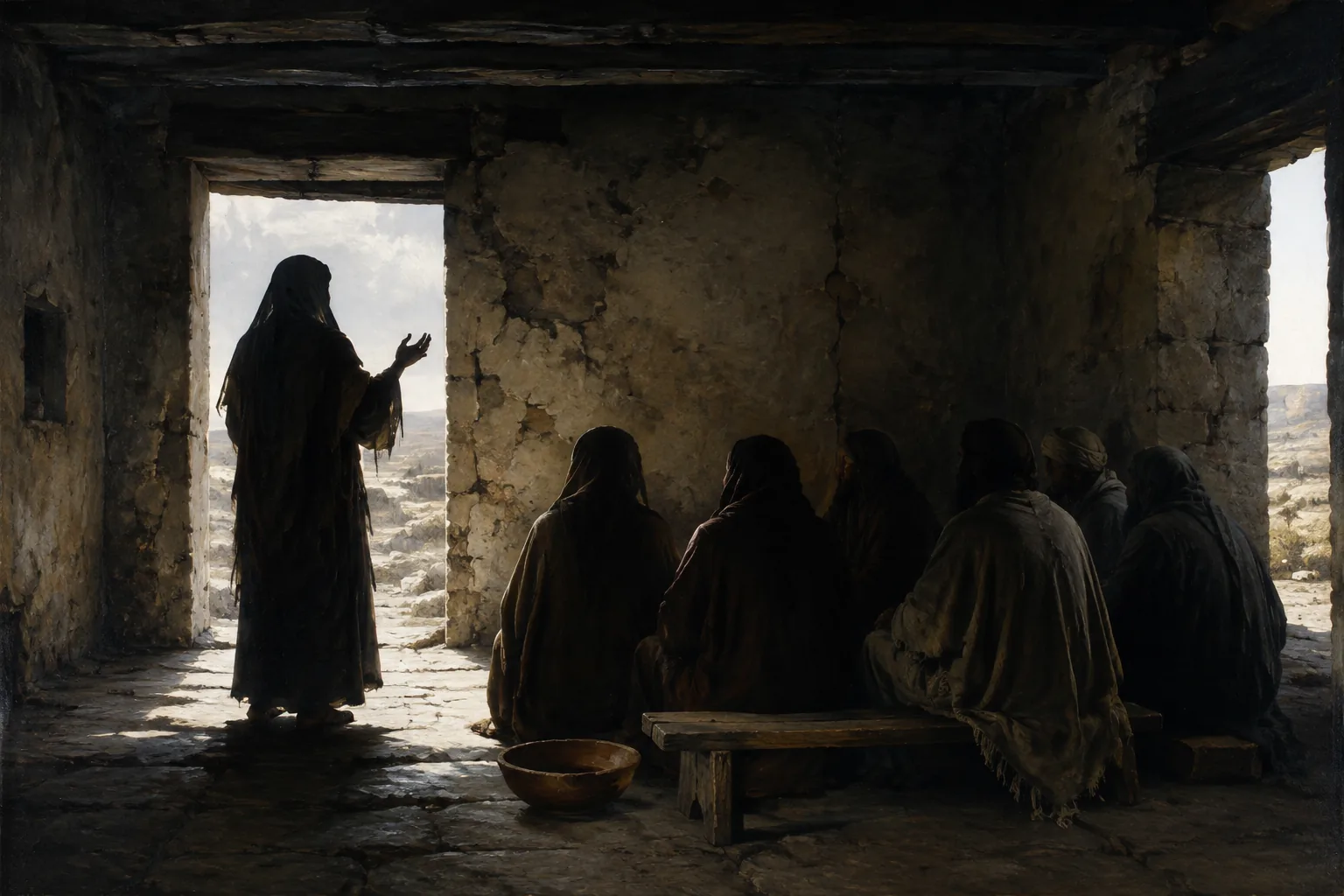
The place of women in the Gospel of Mary raises a question that reaches beyond one remarkable disciple. Who could teach, interpret revelation, and steady a frightened community during Christianity’s unsettled early centuries? The apocryphal gospel answers through Mary Magdalene, whom it presents as a leader, teacher, and spiritual guide whose authority rests on insight and faithfulness rather than gender.
Unlike the canonical gospels, this work places Mary at the center of a sustained dispute about authority. However, it does not offer a simple manifesto for modern equality, since its broken manuscript preserves competing ideas about revelation, flesh, sin, and leadership. Therefore, the contradictions deserve attention alongside the text’s bold portrait of Mary.
Women in the Gospel of Mary and Its Historical Setting
An anonymous Christian author probably composed the Gospel of Mary during the second century CE. No ancient witness names that author, so “Gospel of Mary” describes its central figure within Greek-speaking, Hellenistic Christianity, perhaps in Egypt. Yet the surviving evidence cannot establish one city or community with certainty.
During that century, Christians debated doctrine before any universally settled New Testament canon governed every congregation. Teachers argued about resurrection, spiritual knowledge, apostolic memory, and the material world, while churches developed offices that sometimes narrowed women’s public authority. The gospel reflects those contests, although it does not record a council meeting or provide a neutral history.
The manuscript story also requires care because no complete ancient scroll survives, although a fifth-century Coptic copy appears in the Berlin Codex from Cairo. Two earlier Greek fragments confirm that readers knew portions of the work by the third century. Early Christian Writings summarizes the witnesses, dating, and scholarly discussion.
Several gaps interrupt the surviving Coptic book, including its opening pages and part of Mary’s revelation. Consequently, every interpretation begins with an incomplete text that nonetheless preserves enough material to reveal its main disputes. A readable English version appears in the Gnostic Society Library, alongside notes about the missing leaves.
The basic chronology helps separate composition from surviving physical copies:
- Second century CE: an anonymous Christian likely composes the gospel within a diverse Hellenistic culture.
- Third century CE: Greek papyrus fragments show that early readers circulated portions of the apocryphal work.
- Fifth century CE: a Coptic codex preserves the longest surviving version, although several pages remain missing.
- 1896: the Berlin Codex emerges in Cairo, bringing Mary’s disputed teaching into modern scholarship.
What the Apocryphal Gospel Actually Says
The surviving narrative opens with the Savior discussing matter, sin, inner peace, and the danger of imposing new rules. Then he departs, leaving the disciples afraid that hostile authorities may treat them as they treated him. Mary rises, greets everyone, and turns their thoughts toward courage and divine grace.
Her first act therefore involves pastoral leadership, since she comforts the fearful group before Peter asks her to share private teaching. Mary recounts a vision and describes how mind mediates between soul and spirit. Unfortunately, manuscript damage removes part of that explanation and much of the soul’s ascent.
In the remaining vision, the soul confronts hostile powers during its upward journey. Desire, ignorance, wrath, and related forces try to restrain it, but the soul answers each power with knowledge about its origin and freedom. This apocalyptic ascent resembles other ancient journeys through threatening cosmic regions, yet its drama remains inward and ethical.
The account then turns from revelation to conflict among the disciples. Andrew doubts the unfamiliar teaching, while Peter questions whether the Savior favored a woman and thereby challenges Mary’s truthfulness and right to speak. Finally, Levi rebukes Peter, defends Mary, and urges the disciples to preach without adding further laws. In the Nag Hammadi Library translation, Levi says:
“Surely the Savior knows her very well. That is why he loved her more than us.”
Levi’s defense makes personal recognition central to authority within this apocryphal text. The Savior knows Mary, according to Levi; therefore, the scene ends with a command to proclaim the gospel rather than Mary claiming an office. The narrative thus joins revelation, conflict, reconciliation, and mission without resolving every institutional question.
Women in the Gospel of Mary: Leadership and Authority
Mary’s leadership appears through actions that the other disciples need but cannot initially perform. First, she steadies them after the Savior leaves, and then she interprets a revelation that others never received. Finally, she endures resistance while Levi confronts the prejudice behind Peter’s challenge.
Her authority in the story therefore depends on spiritual capacity and demonstrated understanding rather than formal rank. Mary remembers, interprets, consoles, and teaches; moreover, her connection to divine wisdom enables her to guide the early Christian community. The gospel never argues that every woman automatically holds authority, but gender cannot invalidate genuine insight.
Peter’s protest exposes more than doctrinal disagreement because he asks whether the Savior privately preferred a woman to male disciples. Thus, the scene links hermeneutics with social power: deciding whose interpretation counts also decides who may lead. Mary Magdalene and Peter examines this recurring conflict across related Gnostic texts.
Levi does not defend Mary by presenting a modern theory of equal rights. Instead, he accuses Peter of habitual anger while accepting the Savior’s freedom to choose a worthy disciple. Consequently, the text challenges male control through a theological claim about recognition, not through later democratic language.
Gnosis, Inner Knowledge, and Spiritual Freedom
Within this gospel, gnosis means transformative knowledge rather than possession of passwords or information. Instead, Mary understands the Savior’s teaching, the soul’s origin, and the powers that create bondage. Her insight produces courage and freedom, while the other disciples initially remain trapped by fear.
Some scholars classify the work as Gnostic because its revelation describes ascent, hostile powers, and liberation through knowledge. However, “Gnosticism” can flatten distinct movements, and this text lacks the fully developed creation myth found in some Sethian writings. Accordingly, cautious readers can discuss Gnostic themes without forcing the gospel into a rigid category.
The teaching contrasts inner stability with external regulation by warning followers against additional laws that could constrain them. Meanwhile, Mary’s vision presents desire and ignorance as forces that bind the soul. Gospel of Mary Magdalene Explained: Secret Teachings Revealed develops this connection between self-knowledge, vision, and spiritual transformation.
Mary Magdalene in the Canonical Gospels
Unlike the apocryphal Gospel of Mary, the four canonical New Testament gospels give Mary an important role without preserving this vision or dispute. Mark, Matthew, Luke, and John place her among witnesses to Jesus’s death, burial, or empty tomb. Therefore, this comparison grounds Mary’s role in established memories rather than pure invention.
Luke 8 names Mary among traveling supporters, whereas John 20 gives her a resurrection encounter and a message for the disciples. These canonical scenes support her significance, yet the narratives often return quickly to male apostolic leadership. Mary Magdalene: Unveiling the Misconceptions distinguishes those accounts from later legends.
The familiar image of Mary as a repentant prostitute does not come from any canonical gospel. Later Western interpretation merged her with other unnamed or differently named women, overshadowing her identity as a disciple. However, the Gospel of Mary provides no earlier biography because its interest lies in revelation and authority, not repentance from sexual sin.
Canonical letters complicate the comparison because they preserve both female coworkers and restrictions on women. Paul names women such as Phoebe, Prisca, and Junia in Romans, while other passages limit public speech or teaching. Because scholars debate several restrictive verses, early Christian evidence shows argument and variation rather than one uniform practice everywhere.
Apocryphal and Pseudepigraphal Parallels
Apocryphal writings stand outside the New Testament canon, while pseudepigrapha claim or imply an authoritative ancient identity. The Gospel of Mary remains apocryphal, and its title associates the work with Mary without proving she wrote it. Thus, modern readers should not treat it as Mary’s memoir or as a firsthand report. This study of the gospel’s authorship considers the anonymous author and attributed voice.
Other apocryphal works stage similar disputes: the Gospel of Thomas ends with Peter objecting, while the Pistis Sophia lets Mary interpret teachings. The Gospel of Philip depicts a special relationship between Mary and Jesus through symbolic language. However, each work belongs to its own literary and theological setting.
These comparisons clarify both common patterns and important differences:
- The canonical Gospel of John makes Mary Magdalene a resurrection witness who carries Jesus’s message.
- The apocryphal Gospel of Thomas preserves sayings and ends with a troubling debate about Mary’s status.
- The apocryphal Pistis Sophia gives Mary extensive interpretive speech within a complex revelatory dialogue.
- The apocryphal Gospel of Philip uses sacramental symbolism when describing Mary’s closeness to Jesus.
- The apocryphal Gospel of Mary makes her console, teach, and face direct resistance from Peter.
None supplies a transparent transcript; instead, their authors use remembered figures to argue about authority in later communities. Moreover, Peter and Mary can function as literary representatives of competing approaches to leadership. Gospel of Mary Magdalene Explained: Secret Teachings Revealed offers a wider map of those noncanonical voices.
Women in the Gospel of Mary and Feminine Wisdom
The gospel’s portrait of women extends well beyond Mary’s personal prominence in a single scene. Her teaching makes a woman the bearer of divine wisdom among hesitant male disciples. In addition, her courage demonstrates that knowledge must shape communal action rather than remain private. The text thereby challenges traditional assumptions that women could receive teaching but not interpret it publicly.
Some interpreters read Mary as a soul symbol whose intuitive wisdom integrates qualities cultures often divide by gender. Yet the surviving text never explicitly declares that Mary personifies a feminine soul. Therefore, this approach works best as a suggestive interpretation rather than a settled historical fact.
Mary’s authority appears most clearly when Peter objects and Levi insists that the Savior’s judgment outranks hostility. Still, Levi speaks for Mary at the decisive moment, which complicates an uncomplicated feminist reading. The gospel elevates a woman powerfully, but a male disciple delivers its final defense and summons everyone toward mission.
Why This Disputed Gospel Matters Now
Modern feminist scholars value the gospel because it preserves a counter-narrative to male-dominated church histories. The text gives them evidence that some Christians imagined female teaching authority. However, that ancient possibility cannot dictate modern policy without explaining how history, scripture, tradition, and present ethics relate.
The text asks who controls interpretation, since Peter doubts both Mary’s message and the process through which she received it. In contrast, Levi tests Peter’s response against the Savior’s character and choice. That conflict still matters wherever inherited status competes with insight, credibility, or lived spiritual experience.
Readers can use the gospel without calling it biblical, first comparing translations and marking every manuscript gap. Next, they can ask whether fear, anger, or prejudice shapes a community’s judgments. Finally, The Role of Women in Apocryphal Texts places Mary beside other noncanonical female figures.
FAQ About Mary, Manuscripts, and Authority
Is the Gospel of Mary canonical or apocryphal?
The Gospel of Mary is apocryphal because no major Christian tradition includes it in the New Testament canon; nevertheless, apocryphal does not mean worthless. The work provides historical evidence for early Christian debates, even though churches do not read it as canonical scripture. Its value depends on the question a reader brings to it, whether historical, literary, or theological.
Did Mary Magdalene write the Gospel of Mary?
No surviving evidence names Mary as author; instead, an anonymous second-century Christian wrote within a culture that connected texts with authoritative disciples. Scholars conventionally identify the central Mary with Mary Magdalene, although the surviving pages do not supply a full name. Therefore, the title signals authority and subject matter, not a verified signature.
Why does Peter oppose Mary’s teaching?
Peter questions private teaching to a woman, which may represent tensions over gender, revelation, or competing apostolic authority. However, the narrative does not let readers interview Peter or recover one exact event. It uses his protest to dramatize a conflict that the author’s own community probably knew firsthand.
Does the gospel prove that women led early churches?
The text proves that one ancient Christian author imagined Mary teaching male disciples, while wider evidence shows women participating actively in early communities. However, a literary portrayal cannot establish how every congregation organized leadership. The Role of Women in the Gospel of Mary reveals debate, possibility, and resistance rather than universal practice.
A Question That Remains Open
The gospel survives in fragments, yet its central challenge remains unusually clear. Spiritual authority comes through understanding, courage, and fidelity, while status alone cannot guarantee wisdom. At the same time, the narrative leaves unresolved tensions around private revelation and communal testing. Its incompleteness invites careful thought rather than confident reconstruction of the missing pages.
The Role of Women in the Gospel of Mary still unsettles easy stories about a uniformly male early church. It also resists use as a simple blueprint for twenty-first-century debates. Readers can keep asking why Mary’s knowledge inspires some disciples and threatens others. That question opens a productive space between historical curiosity, textual criticism, and living hermeneutics.
Check out the author’s book here: The Gospel of Mary Magdalene.

Leave a Reply