
The Dead Sea Scrolls entered history through a broken jar. A shepherd threw a stone into a cave above the shore and heard pottery break. That is the story as it has come down to us. The stone may be a later touch, but the jars were real, and so is what came out of them.
Inside lay seven scrolls, and one was a complete copy of Isaiah. Until that morning, the oldest Hebrew Isaiah anyone could read dated from around the year 1000. This one was older by roughly a thousand years.
What the find confirmed made headlines at once. What it complicated is the better story, and it took much longer to come out.
What the Dead Sea Scrolls Actually Contain
Eleven caves gave up material in the end. The haul is far larger and far more broken than the popular account suggests.
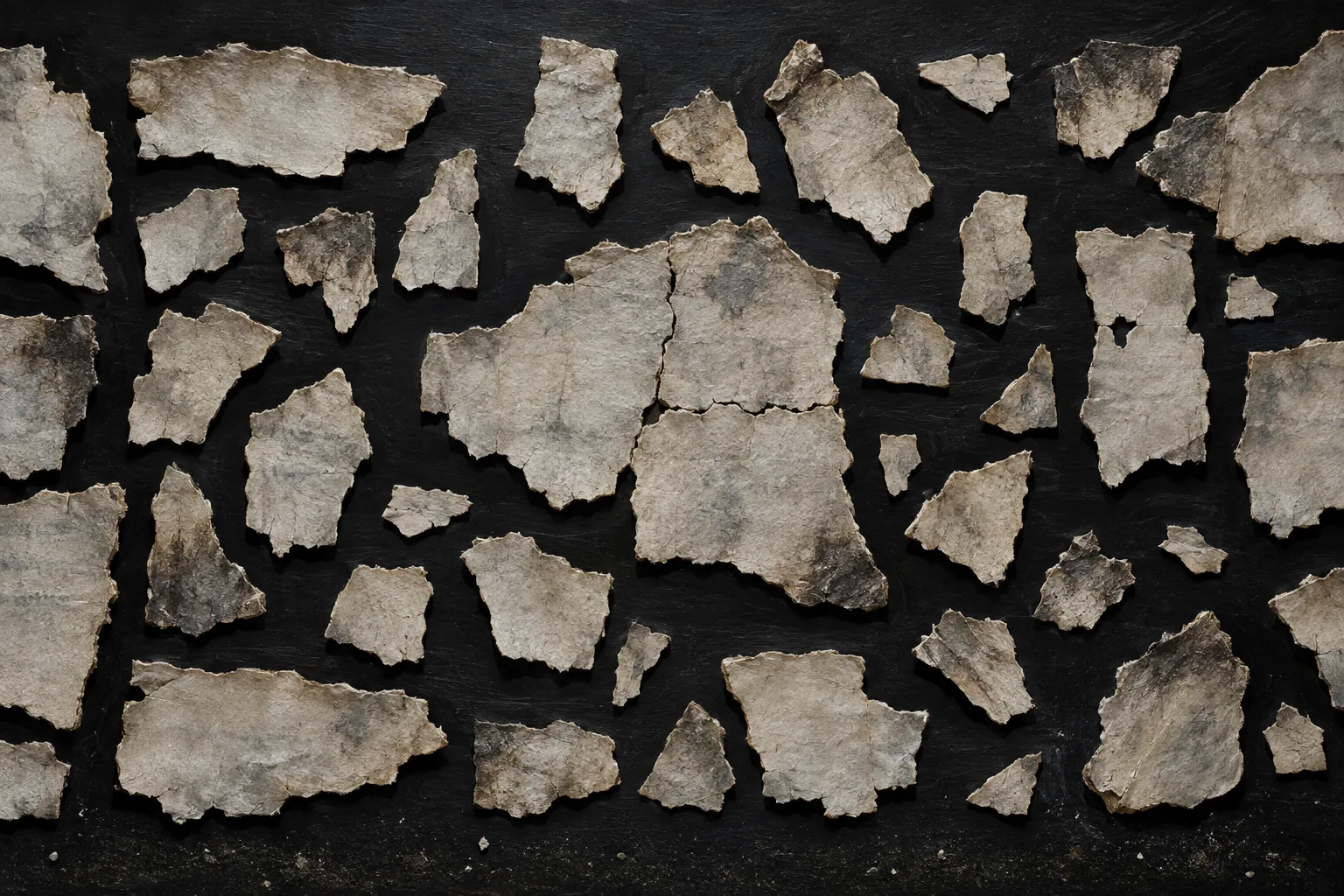
Together the caves held something near nine hundred separate manuscripts. Most of them are scraps rather than whole scrolls.
The contents fall into three uneven groups. Roughly a quarter are copies of books now in the Hebrew Bible, and every book but Esther turns up somewhere. Another quarter belong to the community that kept the library: rules, hymns, commentaries, and a battle plan for a war between light and darkness. That last theme runs through the apocalyptic writing of the period. The rest are Jewish books that circulated widely at the time without ever entering the canon.
The caves were not equal. Cave 1 held the seven whole scrolls that made the find famous. Cave 4 held roughly fifteen thousand fragments from several hundred manuscripts. Most of the work of the last seventy years has gone into that second pile.
The third group is the least discussed and the most telling. It includes the Book of Enoch, Jubilees, Tobit and others. Their numbers suggest the community valued these books rather than merely putting up with them.
The Confirmation Everyone Remembers
The Great Isaiah Scroll is why the discovery entered general knowledge. The reason is sound.
Set it beside the medieval manuscripts behind our printed Hebrew Bibles, and the text agrees to a remarkable degree. Differences exist, and they are real. Almost all of them are matters of spelling or word order rather than of content. A thousand years of copying had changed far less than anyone expected.
That result settled a real worry. Before 1947 a reader could argue that the Hebrew text had drifted badly over the centuries. No evidence existed either way. The Dead Sea Scrolls gave the first hard check on that suspicion, and the copying tradition came out of it well.
The Complication Nobody Expected
Then scholars turned to the other biblical manuscripts, and the picture changed.
Among the Dead Sea Scrolls from Cave 4, copies of the same biblical book do not always agree with each other. Some follow the text that later became standard. Others match the Greek Septuagint where it parts from the Hebrew, and earlier scholars had blamed that gap on loose translators. Others again line up with the Samaritan Pentateuch.
For a simple account, this is awkward. In the first century there was no single Hebrew text of Jeremiah or Samuel that everyone copied. Several forms were in circulation. They sat side by side in the same library, and nobody at Qumran seems to have minded.
One text won later, after the Romans destroyed the Temple. We call that survivor the Masoretic text. The Dead Sea Scrolls preserve the moment before anyone made the choice.
Who Kept the Dead Sea Scrolls
Most answers name the Essenes. That is still the best account on offer, though it remains a guess rather than a fact.
The case for it is respectable. Ancient writers describe a Jewish group living together near the Dead Sea, washing ritually and holding property in common. The Community Rule found in the caves describes a group run on those lines. At Qumran the settlement has cisterns, a large dining room, and a room that may have held writing desks.
There is a case against, and it is real too. The scrolls themselves never use the word Essene. Some scholars read the site as a fortress or a farm, and they argue that somebody carried the manuscripts there from elsewhere, perhaps from Jerusalem, during the revolt of 66 to 70.
The honest position keeps both in view. A community tied to the library almost certainly lived on that shore. Who exactly they were is a question people have spent whole careers on, and it is still open.
How the Dead Sea Scrolls Were Dated
Three separate methods agree here, which is why almost nobody disputes the dates.
Handwriting came first. Hebrew letter forms changed in measurable ways between the third century before the common era and the first century after it. Specialists placed most of the manuscripts inside that span by comparing hands.
Radiocarbon testing followed, first in 1950 on the linen wrappings, then again in the 1990s on the leather itself. The results broadly matched the estimates drawn from handwriting. That is not a small thing, since the two methods share no assumptions at all.
Archaeology supplied the third check. Coins at the settlement run from the second century before the common era down to the revolt of 66. The pottery in the caves matches the pottery in the buildings.
Where three methods meet, the conclusion holds. Some individual manuscripts resist a tidy date, and scholars say so rather than forcing them into line.
The Forty Years of Restricted Access
There is a second story here, and it belongs to modern scholarship rather than to antiquity.
The authorities handed publication to a small international team. For four decades most of the Dead Sea Scrolls from Cave 4 stayed unpublished. Researchers outside the group could not even see photographs, and the team turned down their requests. Anger built through the 1980s, and charges of secrecy went public.
The wall broke in 1991. A computer reconstruction of unpublished texts appeared, then a two-volume facsimile edition. Soon afterwards the Huntington Library in California said it would let anyone consult its full set of photographs. Within months the monopoly was gone.
The affair is worth remembering whenever somebody reaches for the phrase suppressed knowledge. Here the restriction was real and documented, and in the end it gave way. What it hid turned out to be scholarship rather than scandal.
What the Scrolls Do Not Contain
Two expectations dominate popular accounts. Neither one survives contact with the material.
The first is that the Dead Sea Scrolls say something about Jesus. They do not mention him, nor John the Baptist, nor any other figure of the New Testament. The library went into the caves around the time Christianity began, and it reflects a Jewish world without it.
The second is that a hidden gospel lies somewhere in the pile. Nobody has found a Christian text of any kind at Qumran. A few scholars have tried to read a Greek fragment from Cave 7 as a piece of Mark, and they have persuaded almost nobody who looked at it.
What the caves give is context rather than revelation. Context is also what a first-century document can honestly supply. These texts show the Judaism that shaped the first Christians, alongside the apocryphal books of the same centuries. That is a large gift, and it does not need to be more.
The Dead Sea Scrolls for Readers Today
The practical situation has turned right around since the years of restricted access.
High-resolution images are online through the Israel Antiquities Authority archive, where a reader can zoom in on single letters. Translations of the non-biblical texts fill several good editions, and editors keep republishing fragments as the imaging improves.
Two cautions apply to any reading. The material is overwhelmingly fragmentary, so a translation that reads smoothly usually rests on reconstruction. Those brackets deserve attention. The sectarian texts also speak for one group, not for Judaism in general, and popular accounts blur that line constantly.
The One Scroll Made of Copper
The Dead Sea Scrolls run to nine hundred manuscripts of leather and papyrus, and exactly one of them is metal. That one, the Copper Scroll, does not behave like its neighbours.
Cave 3 gave it up, rolled tight and heavily corroded. Conservators had to cut it into strips before anyone could read a word. Its content is unlike anything else in the library: a list of places, each with a quantity of gold or silver supposedly hidden there.
The tone is that of a clerk rather than a priest. There is no prayer here, no doctrine, no commentary. There are only directions and weights, and the weights are enormous.
Its Hebrew is odd too. It sits closer to the language of the Mishnah than to the biblical Hebrew of the scrolls beside it, which points to a different hand and a different purpose.
Opinions divide sharply. Some read it as an inventory of Temple treasure hidden before the Roman assault, which would make it a historical document of real weight. Others take it for folklore that somebody wrote down. Nobody has ever convincingly identified a listed site, and the totals go well past what is plausible.
No dig has settled the matter. That one unresolved scroll is a useful corrective: a library this size holds things that fit nobody’s story about it.
Why the Complication Matters More
Popular accounts usually offer the Dead Sea Scrolls as proof that the Bible has not changed. That description is half right.
The copying was indeed faithful, and the Isaiah scroll shows it plainly. Faithfulness, though, applies to a text once it has settled. These manuscripts also show that the settling had not yet happened. People read, copied and stored several versions of the same book side by side, and they evidently did not think the difference fatal.
Read that way, the Dead Sea Scrolls are more interesting than the headlines of 1947 made them. The question of what the biblical text is has a history. That history has a visible beginning, an argument in the middle, and a resolution that came much later than most readers assume.
Check out the author’s book here: The Complete Apocrypha.

Leave a Reply