
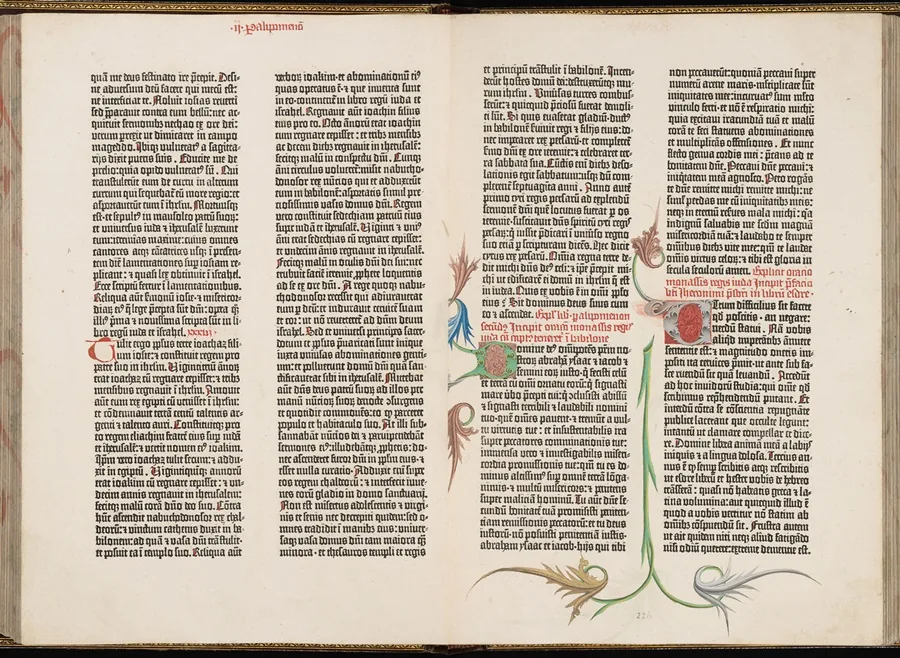
The Bible contains a footnote that sends the reader somewhere else. After describing the repentance of King Manasseh, the Chronicler mentions his prayer and how God heard his entreaty. Both, he says, stand in the annals of the kings and in the records of the seers.
The Chronicler does not give the prayer itself. A book that quotes freely, at length and often, points at this one text and declines to reproduce it. Somebody decided to fill that gap, and the result is the fifteen verses we call the Prayer of Manasseh.
The King the Prayer of Manasseh Belongs To
No king in the Hebrew Bible has a worse name than Manasseh of Judah. The book of Kings gives him fifty-five years on the throne and almost nothing good. The charges are idol worship, child sacrifice, and innocent blood shed across Jerusalem.
Then 2 Chronicles 33 tells a different ending. Assyrian officers take him with hooks, bind him in bronze fetters, and carry him to Babylon. In his distress he humbles himself, prays, and returns to his throne in Jerusalem.
Kings knows nothing of this. The two accounts disagree about whether the worst king in the record ever repented. The Chronicler is the one who says he did.
Who Wrote the Prayer of Manasseh, and When
Nobody knows, and the honest position is to say so before saying what the evidence can narrow. Three things can: the language its author used, the century it belongs to, and the literary habit that produced it. None of the three gives a name.
The Greek of the prayer is fluent and natural. Most scholars therefore judge it a Greek text rather than a translation. Some have argued for a Semitic original, and nobody can rule it out, but the evidence for it is thin.
Datings cluster between the second century before the common era and the first century after it. In those years Jewish writers often wrote prayers for biblical figures. They filled out inner lives scripture had left blank. This prayer fits that pattern exactly.
Why the Chronicler Added a Repentance
The disagreement between Kings and Chronicles is not a copying error. It follows from a problem the Chronicler could not leave alone.
His history works on a principle: obedience brings prosperity and wickedness brings disaster, visibly and within a lifetime. Manasseh breaks that principle badly. He is the worst king in the record, yet he reigns longest of all and dies in his bed.
A repentance solves the difficulty. If the long reign followed a genuine conversion, the principle holds after all. The exile to Babylon then supplies the punishment the scheme requires. Historians differ on whether the Chronicler used a source or supplied the episode himself. Assyrian records neither confirm nor exclude a deportation.
Either way the effect is the same. A gap opened in the story, marked by a pointer to a document nobody had. It stayed open for centuries.
The Other Prayer of Manasseh
There is a second text with the same title, and it is not the one in the Bibles.
Among the Dead Sea Scrolls, a torn manuscript filed as 4Q381 keeps a set of psalms put in the mouths of biblical figures. One of them carries a heading naming Manasseh, king of Judah, when the king of Assyria shut him up in prison.
The Hebrew that survives is broken. Still, enough remains to show that it is not the Greek prayer. Two writers, working apart, had the same idea and wrote different texts.
That coincidence is the most useful single fact about the whole tradition. Filling this particular gap was evidently an obvious thing to attempt, and at least two people attempted it. The version we inherited won by transmission rather than by merit.
How the Text Reaches Us
Its earliest surviving witness is not a Bible at all. The prayer appears in the Didascalia Apostolorum, a Syriac church manual from the third century. There it stands as an example for penitents to follow.
A century later it appears again in the Apostolic Constitutions, this time in Greek and in the same instructional setting. Only afterwards does it start showing up in biblical manuscripts.
When it does, its position is telling. The Codex Alexandrinus, from the fifth century, places it among the Odes, a collection of songs appended after the Psalms. It arrives in the Bible as an appendix, and an appendix is roughly where it stays.
Why It Sits in an Appendix Everywhere
This text has an odd history, because no major tradition either took it in fully or threw it out.
- Jerome left it out of the Vulgate. Copies of the Latin Bible nonetheless carry it in an appendix from the ninth century onward, added by scribes who evidently wanted it available.
- Trent, in 1546, defined the Catholic canon and placed the Prayer of Manasseh outside it, in an appendix after the New Testament, together with 3 and 4 Esdras.
- Orthodox churches include it among the Odes, where the faithful sing it in church rather than argue about it.
- The King James translators printed it in 1611 in the section headed Apocrypha, between the Testaments.
Four different decisions, and none of them is a clean exclusion. A short prayer of repentance proved too useful to throw out. It was also too weakly attested to canonise. So the compromise was to keep it just outside the wall.
What the Prayer of Manasseh Is Doing Historically
Read as a historical object rather than as devotion, the text is evidence of a practice.
Jewish and early Christian writers often wrote speeches and prayers for figures whose words scripture had summed up without quoting. Everyone knew the habit, and nobody called it forgery. Putting a prayer in Manasseh’s mouth claimed a fitting voice, not a real source, exactly as with the Testament of Solomon.
What makes this instance unusual is the explicit invitation. Chronicles did not merely leave a silence; it advertised the existence of a document and gave a reference for it. The writer of the prayer accepted an invitation the Bible had issued.
That sets it apart from the Odes of Solomon and from the texts tied to other biblical names. There no such pointer waits for an answer.
What the Prayer Meant to the Churches That Used It
Before it became a canonical question, this was a pastoral text, and the record shows its uses.
The Didascalia brings it up inside an argument about discipline. A bishop, the manual says, must take a penitent back rather than drive him away. Manasseh is the proof that even the worst sinner can return, and the manual quotes the prayer as its evidence.
The Apostolic Constitutions repeat the argument a century later. By then the church was much larger and faced the same question far more often. Both documents address clergy who had to decide whether to readmit people, and both reach for the same fifteen verses.
Eastern liturgy went further and gave the prayer a place in worship. In the Byzantine rite it is read during Great Compline, in the penitential seasons. There it works exactly as its first users intended.
That history explains the appendix. Nobody can simply drop a text lodged in church practice, not even a tradition that declines to call it scripture. An appendix is what you build when you can neither include something nor throw it out.
Reading It Alongside the Text Itself
The historical question and the literary one pull in different directions, and both are worth asking.
This article has followed the first one: where the prayer came from, how it travelled, and why it ended up in an appendix. The fifteen verses make an argument of their own, and it is sharper than most set prayers of repentance. A close relative of the Prayer of Manasseh is the prayer of the queen in the Additions to Esther, another Greek prayer given to a biblical figure.
A reader coming to the text for the first time can take either route. The full text in English takes about three minutes to read, which is less time than this article about it.
What Cannot Be Established
Three questions about the Prayer of Manasseh have no answer, and a reader deserves to know which they are.
The first is authorship. No name attaches to the text, and no early source proposes one. The link to Manasseh is a literary habit rather than a claim anyone defended.
The second is the language it was written in. Its Greek reads as original. Scholars have argued for a Semitic source, since Hebrew idiom shows through in places. Nobody can settle that without a manuscript nobody has.
Third comes the date, which floats across three centuries. Proposals run from the Maccabean period to the first century of the common era. Each one rests on judgments about wording and theology rather than on outside evidence.
None of this stops anyone from reading the text. Still, any firm claim about who wrote the Prayer of Manasseh, or exactly when, goes beyond what survives.
What Survives the Questions
Take away what nobody can establish and something solid remains. A prayer exists that no canon fully claims, much like 2 Esdras. An unknown author wrote it in Greek, probably before the second century closed. It entered Christian use as a model for penitents before it entered any Bible. Copyists have kept it in circulation for at least seventeen hundred years.
The manuscripts bear that out. It travels in Greek Bibles among the Odes, in Latin ones as an appendix, in Syriac inside a church manual, and in English between the Testaments. In each case somebody had to decide where to put a text nobody would call scripture.
Its survival owes nothing to authority, since no authority ever fully granted it any. It survived because people kept finding it useful. That is a different kind of backing, and in some ways a more interesting one.
Check out the author’s book here: The Complete Apocrypha.

Leave a Reply