
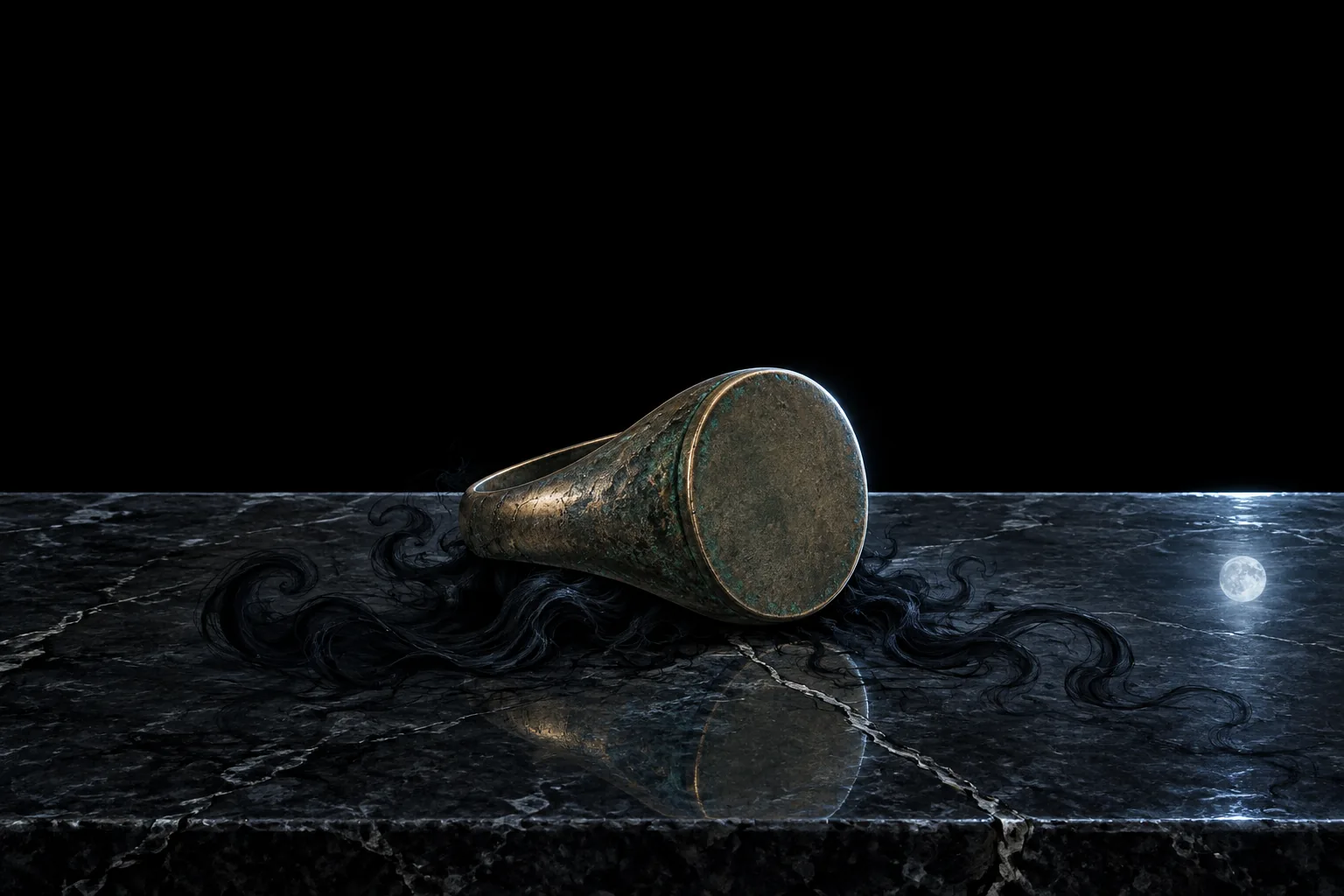
Solomon asked for wisdom and received a reputation instead. In canonical scripture he judges, he builds, and he writes. Outside it he binds spirits, seals jars, and dictates rituals to scribes who lived a thousand years after his death. That second king speaks a vocabulary of his own. The mystical language of Solomon is what the apocryphal and magical books made out of him.
It has names in it, and seals, and a ring. Moreover it has a moral, and the moral is not flattering to anyone who picks the books up for the wrong reason.
Where the Mystical Language of Solomon Began
The canonical king is easy to summarise. He is David’s son, he asks for a listening heart, and he receives more than he asked for. First Kings credits him with wisdom wider than the sand on the seashore. It grants him, further, three thousand proverbs and a knowledge of trees, beasts, birds and fish.
So the seed sits there already. A king who knows the nature of every creature stands one step away from a king who knows their names. And a name, in the ancient world, is a handle. Whoever holds the handle moves the thing.
Later writers took that step and kept walking. Authors went on adding to his file for well over a thousand years, first in Greek and Hebrew, then in Latin and Arabic. They gave him angels, demons, a signet ring, and a temple raised by bound spirits. Consequently the mystical language of Solomon grew by accretion rather than by decree, and no council ever approved a syllable of it.
The Testament and the Ring
The oldest full witness is the Testament of Solomon, a Greek text usually placed between the first and the third century of our era. The article on the Testament and its demonology follows it chapter by chapter. Its plot is plain enough. A demon drains a boy on the building site. Solomon prays about it, and the archangel Michael brings down a ring with a seal cut into the stone.
After that the book turns into an interrogation. Each spirit gives three things: its name, the harm it does, and the angel who undoes it. That third item is the hinge. A name paired with its counter-name becomes a tool, and the book is confident that the tool works.
The mystical language of Solomon is therefore not poetry. It is a list, and the list is the whole invention.
What Pseudepigraphical Actually Means
Scholars file these works under pseudepigrapha, a word that simply means written under a borrowed name. The borrowing is not quite forgery, however. An author who signed himself Solomon was making a claim about where his material came from. He was making it, besides, in an age when novelty carried no authority whatever.
Because of that, dating is hard and provenance is harder still. The Key of Solomon survives in manuscripts from the fifteenth century onward. Parts of it plainly rest on older Jewish and Greek stock, and a few of its prayers look older than the book that carries them. Sorting the layers is the work of a lifetime, and scholars disagree about most of it. Still, the label matters less than the habit behind it. Every generation that wanted a voice for hidden knowledge reached for the same king, and each one left its fingerprints on the text it inherited.
The Key of Solomon and Its Grammar of Ritual
The Clavicula Salomonis, known in English as the Key of Solomon, reads like a manual for a craft. Mathers published his translation in 1889, and the whole of it sits at sacred-texts, so the tone can be checked rather than taken on trust. It prescribes days, hours, metals, colours and words, and it prescribes them in a fixed order.
Before any of that, though, it prescribes the operator. Wash, fast, confess, pray, and begin again if the preparation lapses. The book states flatly that an unready man gets nothing, or something worse than nothing.
In short, this grammar has a subject as well as an object. The spirits are the object. Whoever draws the circle is the subject, and he stands under examination throughout.
The Lesser Key, and Seventy-Two Names
The Lemegeton, or Lesser Key, is a later compilation and a much messier one. Its first part, the Goetia, catalogues seventy-two spirits with their ranks, their legions and their seals. Each entry works as a small dossier. Each seal is a signature waiting to be drawn.
Readers have argued about the thing ever since. Some take the catalogue literally, as a register of real beings. Others read the demons as appetites. On that reading the seals turn into a map of the operator’s own mind, and the conjuring becomes a picture of self-command.
The number itself travelled before the book did. Seventy-two is the count of the nations in Genesis by one reckoning, and of the letters in a divine name by another, so the catalogue arrives with its arithmetic already loaded. Whoever assembled the Goetia inherited that figure rather than choosing it.
Either way the structure holds, and the structure is what the mystical language of Solomon always produces. A name, a mark, a procedure. Nothing in these books is ever left vague except the results.
The Mystical Language of Solomon in Three Faiths
Judaism, Christianity and Islam all kept Solomon, and each of them kept a different one. Rabbinic legend gives him the shamir, the little worm that cuts stone without iron, and a throne that no usurper can climb without injury.
Christian writers kept the temple and kept the fall. They were less comfortable with the rest, and the Catholic Encyclopedia on apocrypha shows how uneasily such books sat beside the canon they imitated.
Islam went furthest in one direction and least far in another. Sulayman is a prophet there, and he rules the jinn. He understands the speech of birds, while the Qur’an rebukes those who blamed sorcery on him. Therefore the same king serves in one tradition as the patron of the grimoires and in another as their chief victim.
Wisdom, Odes and a Quieter Register
Not every Solomonic book deals in seals. The Wisdom of Solomon argues in Greek philosophical terms and summons nothing whatever. In The Psalms of Solomon a voice prays, complains, and waits for a righteous king to arrive.
The Odes of Solomon sing instead, in images of milk, harps and crowns, and they sound nothing like a grimoire. Yet they carry the same signature at the top.
These books share a file for a plain reason. Solomon was the name under which one wrote about knowing more than the surface of things allows. Hence the quiet register and the loud one are two dialects of the mystical language of Solomon rather than two unrelated traditions that happen to overlap.
Pride, and the Power That Lapses
Every one of these works circles the same warning. Authority over spirits is lent, never owned, and the loan can be called in. The Testament ends badly, and it ends the way Kings does. Solomon takes foreign wives, burns incense to their gods, and the whole apparatus goes quiet on him.
The apocryphal writers put the machinery in and then kept the old ending. As a result their Solomon is a cautionary figure rather than a triumphant one. That is exactly what a reader hunting for shortcuts does not want to hear.
The Shepherd of Hermas and its angel of repentance works the same seam from another angle. It assumes, as these books do, that a man once trusted can fall and can still be mended afterwards.
Why the Mystical Language of Solomon Still Travels
Novels, films and games still reach for the ring and the seventy-two names, usually without the fasting. That part drops out first, and it drops out everywhere. Yet the original books spend more pages on preparation than on results, and the ratio was the message.
Read as history, they record a long argument about who may approach power and on what terms. Read as literature, they show how a royal name slowly turns into a genre.
The mystical language of Solomon outlived the man by two thousand years because it handed every later age the same awkward question. Wisdom can be asked for, and the story says it was granted. What a man does with it afterwards is the part nobody could promise.
Check out the author’s book here: The Apocrypha.

Leave a Reply