
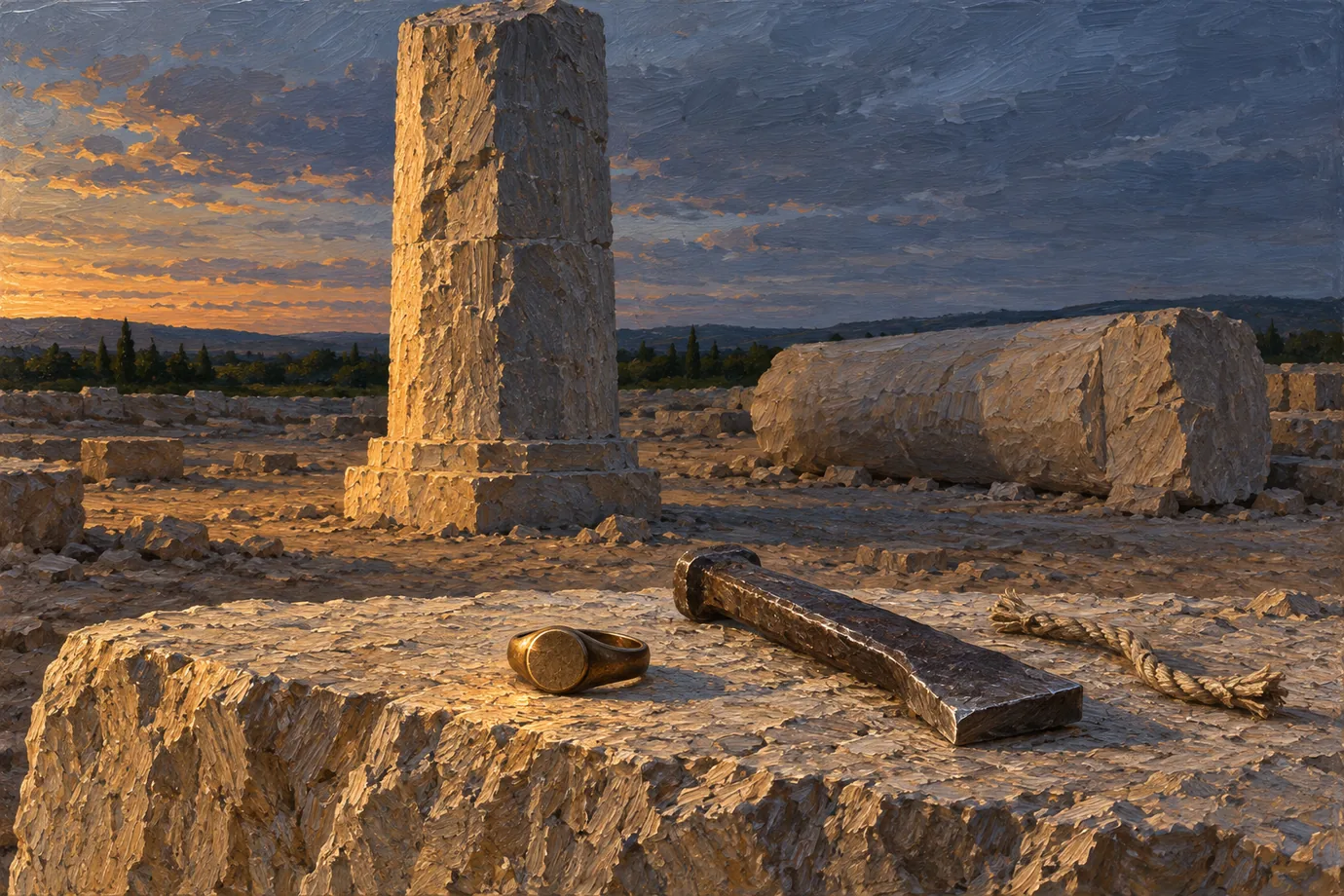
A boy on the temple site was wasting away, and nobody could say why. That small complaint opens The Testament of Solomon, and the rest of the book follows from it. The king asks, an angel answers, and a ring arrives. After that the narrative turns into something far stranger than a court chronicle. It becomes a roll call of demons, each one questioned by name, each made to say what it does and what stops it.
The book is not scripture, and it never was. No council debated it, and no community seems to have read it aloud in worship. Still, few apocryphal works have left a longer trail behind them, and almost none of that trail runs through the church.
Where The Testament of Solomon Came From
The text survives in Greek, in manuscripts that are late and disagree with one another. Scholars place the writing of it somewhere between the first and the fourth century of the common era. Later hands clearly added to it as well. Egypt is the likeliest home, because the demon names borrow from Greek, Jewish and Egyptian stock alike.
The name on the cover is a convention rather than a claim anybody tested. Ancient authors hung books on famous figures as a matter of course, and Solomon attracted more of them than most. The Psalms of Solomon do the same thing in a gentler register, and so does The Wisdom of Solomon.
One strand of the tradition is older than the book itself, however. Josephus already reports, in the first century, that Solomon left behind forms of exorcism still practised in his own day. So the demon-binding king was in circulation long before anyone sat down to compose The Testament of Solomon. Wikisource carries the whole text in Conybeare’s translation of 1898, which anybody can check against the summary here.
The Ring and the Sick Workman
The plot starts with a payroll problem rather than a vision. A favoured young labourer grows weaker every day, and the king learns the cause. A demon called Ornias takes half the boy’s wages and half his strength.
Solomon prays, and the archangel Michael brings him a ring with a seal cut into it. The ring commands spirits, and the boy is the first to use it. He throws it at Ornias, the demon is caught, and the king sends him off to fetch Beelzeboul, the prince of the others.
Because the ring does the work, the wisdom of the king barely enters into it. That detail looks minor here. It matters a great deal by the last page.
The Interrogations
Every encounter afterwards follows one pattern, and the pattern is the whole design of the book. A demon is summoned, gives its name, states the harm it causes, and then names the angel or the formula that defeats it.
The roster is long and vivid. Asmodeus plots against newly married couples. Obyzouth strangles newborn children. Lix Tetrax raises whirlwinds and sets fires, while Enepsigos changes shape and claims three forms. Kunopegos wrecks ships at sea, and Ephippas ends up stoppered inside a flask.
Beelzeboul gets the longest hearing of them all. He calls himself the ruler of the fallen angels, explains what he ruins in a household, and predicts the ruin of the temple itself. Moreover, the questioning has a courtroom rhythm to it, since the king asks and the spirit must answer.
Then come the thirty-six decans, the spirits of the degrees of the zodiac. Each of them brings one specific complaint: a headache, a fever, an obstruction of the throat, a pain in the ribs. Each in turn gives up the name that drives it away.
What The Testament of Solomon Is Actually For
Read as a story, that middle section drags badly. Read as a reference list, it makes immediate sense.
The Testament of Solomon is a handbook of illness wearing narrative dress. In a world without germ theory, a fever needed a cause, and a spirit with a name was a cause that could be addressed. Therefore the answer to each affliction is an answer in the practical sense too, because a formula the sufferer can repeat comes attached to it.
That is why the book names names with such care. Vague demons are useless; a demon with a name, a symptom and a counter-formula is a tool. A similar practical instinct runs through the Apocrypha more widely, where angels and spirits often carry duties rather than titles.
Demons on the Building Site
The framing story returns at intervals, and it has a fine literal streak. Solomon does not merely bind the spirits; he puts them to work on the temple.
They cut and haul stone. Further, they spin glass. One of them lifts a pillar that no crew of men can raise, and another is set to carry the great cornerstone into place. Meanwhile the king watches the structure go up on unpaid supernatural labour.
The joke, if it is one, is sharp. The holiest building in Israel rises in this account through forced demonic work, and nobody in the text seems troubled by the arrangement.
That indifference is worth noticing, because it marks the distance between The Testament of Solomon and the biblical books. Kings and Chronicles care a great deal about who built the temple and with what materials. Here the labour question is settled by a ring, and the narrative moves straight on to the next interview.
The Seal That Is Not in the Book
Medieval lore gave the world the Seal of Solomon, a hexagram or pentagram with power over spirits. Popular accounts read that emblem straight back into the ancient text, and the text does not contain it.
What the book describes is a ring with the divine name engraved on it. Indeed, it draws no diagram, and it describes no figure at all. Afterward, centuries later, illustrators supplied the missing shape, and the shape then travelled back into the retellings.
How The Testament of Solomon Ends
It ends badly, and the ending is the point of the whole exercise. Solomon falls for a foreign woman, and her priests set a price on her. He must offer five locusts to their gods.
Five locusts sound like nothing at all. Yet the king crushes them in his hand, the spirit of God leaves him, and the ring stops answering. Consequently the wisest man in Israel ends his own account as a cautionary tale about himself.
That frame turns a demon catalogue into a warning. Power over spirits came as a loan rather than an achievement, and the loan was recalled. Similar moral reversals drive other apocryphal narratives, including the one behind the woman with seven sons.
What the Grimoires Took
Later magical tradition raided this book thoroughly. The Key of Solomon and the Lesser Key, the medieval and early modern handbooks of ritual magic, both trace their authority to the same king.
The Lesser Key lists seventy-two spirits with seals and offices, in a format that clearly descends from the interrogations. Its debt is one of method rather than of content, though, since the names hardly overlap. Nevertheless the basic idea survived intact: a spirit named is a spirit controlled.
The Catholic Encyclopedia’s article on apocrypha sets out how the church came to treat such writings, and the sacred-texts apocrypha collection gathers many of them in older public translations.
How to Read It Today
Three approaches make sense, and none requires belief in any of it.
As evidence, the book shows how illness, misfortune and shipwreck were explained by people who had no other explanatory frame. As literature, it is an early experiment in the catalogue form, closer to a bestiary than to a gospel. Finally, as history of magic, The Testament of Solomon is the first surviving text in a line that runs for a thousand years.
A fourth reading treats the demons as vices, which is how many devotional writers handled them. That approach is respectable and very old. It also flattens the book, because the original is interested in the mechanics of the cure rather than in the state of anyone’s soul. Readers who prefer the theological questions will find richer ground in The Gospel of Mary Magdalene or in the Proto-Gospel of James.
The strangeness is the value here. A text this odd shows what a corner of the ancient world actually worried about, and worry is usually more revealing than doctrine. The Testament of Solomon worries about sick children, ruined marriages, wrecked ships and a king who threw away the one thing he was given.
Check out the author’s book here: The Apocrypha.

Leave a Reply