
On the night before Halloween, most ghost stories reach for castles and graveyards, but the oldest ghost story in the Bible needs neither. It takes place in a village hut, on the eve of a battle, and it ends with a frightened woman cooking dinner for a king who has just heard his death sentence.
The woman is the Witch of Endor, and the ghost is the prophet Samuel. Their meeting lasts only one chapter of 1 Samuel, yet it troubled Jewish and Christian readers for more than a thousand years, because it seemed to prove something the Law forbade anyone to try: that the dead could be called back to speak.
The Witch of Endor in 1 Samuel 28
At the start of the story Saul is in despair, because the Philistines have gathered at Shunem. When the king sees their camp, he trembles and asks the Lord for guidance, but no answer comes, whether by dreams, by the sacred lots of the Urim, or by prophets. Samuel, the prophet who anointed him, is already dead and buried in Ramah.
There is an irony here that the narrator does not hide. Earlier in his reign Saul had driven the mediums and the spiritists out of the land, and now he asks his servants to find him one. They tell him about a woman at Endor, a village a few miles from the Philistine camp.
Saul disguises himself and goes to her by night with two companions. At first she refuses, because she knows that the king has outlawed her trade. Only when Saul swears that no harm will come to her does he ask her to bring up Samuel. Bible Gateway carries the whole chapter.
What the Woman Saw
The next moment is the strangest in the story. The woman sees Samuel and cries out, and at once she knows who her client is: “Why have you deceived me? You are Saul!” The text never explains how the ghost gave the king away, but the effect is clear: the dead prophet exposes the living king before he says a single word.
Asked what she sees, she answers that she sees elohim coming up out of the earth. The word usually means God or gods, and here it probably means a divine or ghostly being. When Saul asks for a description, she says it is an old man wrapped in a robe, and Saul recognizes it at once. Samuel had worn one all his life, and Saul once tore its hem when the prophet rejected him.
Notably, the woman does all the seeing, while Saul only hears. He bows to the ground before a figure that he cannot see, and the conversation runs through the voice of the dead.
Samuel’s Last Prophecy
The prophet is angry at the summons. “Why have you disturbed me by bringing me up?” he asks. Then he repeats the judgment he gave while he was alive. The Lord has torn the kingdom from Saul and given it to David, because Saul did not obey the command against Amalek.
Then comes the part that no reader forgets. “Tomorrow you and your sons will be with me.” The Philistines will win, and Saul’s line will fall with him.
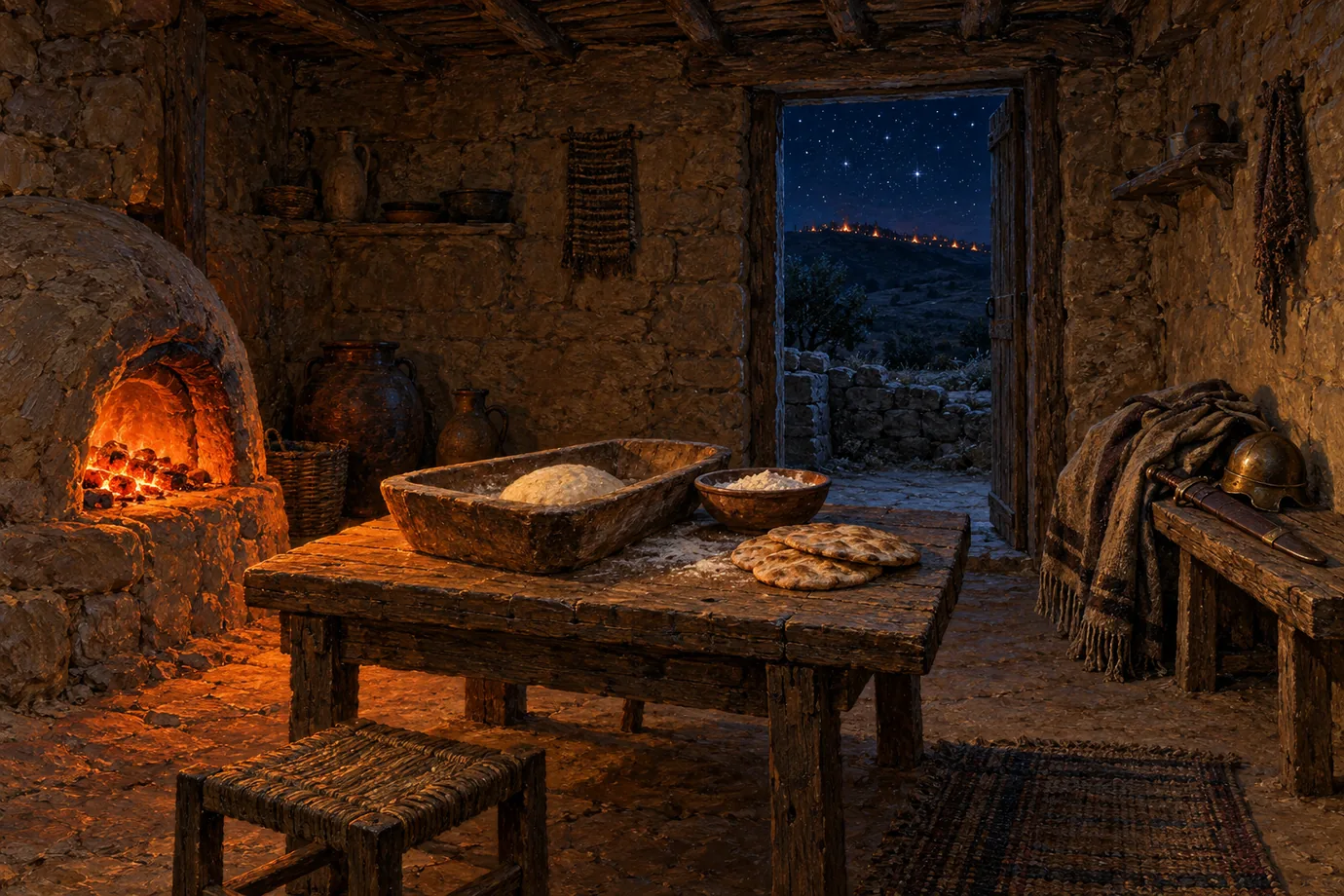
Saul collapses full length on the ground, weak from a day and a night without food. Here the Witch of Endor becomes, unexpectedly, the most humane person in the story. She urges him to eat, kills the fatted calf in her house, and bakes unleavened bread. After the king and his men eat, they walk out into the night. The next day Saul dies on Mount Gilboa, just as the ghost had said.
How Sirach Remembered the Ghost
The first Jewish writer to comment on the scene did not doubt it. Around 180 BCE, Jesus ben Sira closed his long praise of Israel’s heroes with Samuel. In Sirach 46:20 he writes that even after Samuel had fallen asleep, he prophesied and made known to the king his end. He lifted up his voice from the earth in prophecy.
For Ben Sira, then, the ghost at Endor was really Samuel, and the prophecy was a final act of his office. The book of Sirach sits among the Apocrypha today, and its gallery of ancestors is one of its best-known passages. Our overview of the Book of Sirach explains how that gallery works.
Chronicles, on the other hand, drew a harsher lesson. 1 Chronicles 10 says that Saul died for his unfaithfulness. Specifically, he consulted a medium instead of seeking the Lord. Two ancient readers looked at the same night and saw two different things: a prophet’s last word, and a king’s last sin.
The Witch of Endor Gets a Name
The retelling that went furthest is the Biblical Antiquities of Pseudo-Philo, a Jewish work from the first century CE that rewrites history from Adam to Saul. In chapter 64 the Witch of Endor finally receives a name. She is Sedecla, the daughter of Adod the Midianite, a man who had led Israel astray with sorcery.
Pseudo-Philo also adds details that the Bible leaves out. When Saul asks what the figure looks like, Sedecla answers that it is not the form of a man. He is clothed in a white robe with a mantle over it, and two angels lead him. In this version, therefore, the ghost is not a shade from a pit. Instead, angels escort him, and his rest is only briefly interrupted.
Pseudo-Philo’s Samuel even admits his own fear. When he was called up, he thought that the time of judgment had come and that he would have to give an account of his deeds. The idea that the righteous dead wait for a coming judgment is typical of Jewish thought in the late Second Temple period. It appears in many other texts that the rabbis later set aside.
Samuel or a Demon? The Church Fathers Divided
Christian readers inherited the story with its puzzle intact. If a medium could summon a prophet, then necromancy worked, and the Law’s ban made little sense. If she could not, then who had spoken to Saul?
Justin Martyr, writing in the second century, took the story at face value. For him it proved that souls survive death. Origen agreed in a homily on 1 Samuel 28. The text calls the figure Samuel, he argued, and Scripture does not lie. Besides, Samuel’s words were a true prophecy, and no demon could have spoken it.
Eustathius of Antioch answered Origen with a whole treatise. In his view a demon had taken Samuel’s shape to deceive the woman and the king. Tertullian had already said much the same in his work On the Soul, where he treats the apparition as a lying spirit. You can read that passage in the English translation at New Advent, in its final chapters.
Augustine hesitated between the two positions for years. Eventually he allowed that God might have permitted the real Samuel to appear, not by the woman’s power but by divine decision. That compromise shaped much of the later tradition.
Why the Witch of Endor Still Haunts Us
The phrase “Witch of Endor” never appears in the Hebrew text. Instead, the Bible calls her a woman who possesses an ob, a word that may mean a ritual pit or a spirit that speaks from one. Greek translators made her a “belly-talker”, as if the voice came from her own body, and English tradition turned her into a witch. Every generation, it seems, translated her into its own fears.
Other apocryphal books show the same fascination with the unseen world. The Testament of Solomon catalogues demons by name and by the angel who defeats each one. Similarly, the Gospel of Nicodemus takes its readers down into Hades itself.
Yet the tale of the Witch of Endor is different from all of these. It offers no system and no demon list. It simply shows a desperate man doing the one thing he had forbidden, and hearing the one answer he had feared.
Frequently Asked Questions
Who was the Witch of Endor?
She was a medium who lived at Endor during the reign of Saul. In 1 Samuel 28 she summons the prophet Samuel from the dead at the king’s request. Pseudo-Philo later names her Sedecla.
Did the Witch of Endor really raise Samuel?
Ancient readers disagreed. Sirach, Justin Martyr and Origen accepted that the figure was Samuel. Tertullian and Eustathius of Antioch held that a demon had imitated him, and Augustine eventually allowed that God permitted the real prophet to appear.
Is the Witch of Endor in the Apocrypha?
The story itself is in 1 Samuel. The Apocrypha, however, preserve its reception: Sirach 46:20 praises Samuel for prophesying after his death, and Pseudo-Philo retells the night in detail.
Why is the Witch of Endor linked to Halloween?
The scene is the Bible’s clearest ghost story. It features a night visit, a voice from under the earth, and a prophecy of death, so it returns every October in sermons and retellings.
The Kindness at the End of the Story
It is easy to remember only the ghost, but the chapter ends somewhere else. A king who had hunted people like her is lying on her floor, and she decides to feed him. The historian Josephus, retelling the story in his Antiquities, praised her for exactly that generosity. She expected no reward, he notes, and she knew that the man she fed was going to die.
So the oldest ghost story in the Bible closes with a meal rather than a scream. Perhaps that is why it lasts: the dead speak only once, and briefly. The living, meanwhile, still have to decide how to treat each other before morning.
For David’s own voice from the same years, see Psalm 151, the song of the shepherd who replaced Saul.
Check out the author’s book here: The Apocrypha.

Leave a Reply