
Genesis hands its readers a problem and then walks away from it. Pharaoh rewards Joseph with an Egyptian wife: Asenath, daughter of a priest of On. The patriarch marries into the household of an idol priest, and the narrator offers not one word of comment.
For readers who cared about such things, the silence was intolerable. Somebody therefore wrote the missing chapter, at length, and we know the book as Joseph and Aseneth.
It is a romance, a conversion story, and an adventure with an attempted abduction in the second half. Almost nobody has heard of it, and it is one of the strangest survivals of ancient religious literature.
The Verse That Started It
The offending detail sits in a single line, where Pharaoh gives Joseph his new name and his new wife. You can read the passage on Sefaria, where the Hebrew makes the priestly connection unmistakable.
Consider how that lands on a reader committed to endogamy, because Joseph is the model of virtue in the whole cycle. He resists Potiphar’s wife, he keeps faith in prison, and he forgives his brothers. Then he marries the daughter of a man who served the sun cult at Heliopolis.
Later interpreters had three options: they could ignore it, explain it away, or fix it narratively. Joseph and Aseneth takes the third road, and it takes it with unusual confidence.
What Happens in Joseph and Aseneth
The story divides cleanly in two, and the halves feel like different books.
In the first, Aseneth is eighteen, beautiful, and contemptuous of men. She lives in a tower with seven virgin attendants and refuses every suitor her father proposes. When the household announces Joseph, she dismisses him as a foreigner and a shepherd’s son.
Then she sees him, and everything reverses, because Joseph refuses to kiss an idolater and shames her. She retreats to her chamber and throws her idols and her fine clothes out of the window. Then she puts on sackcloth and fasts in ashes for seven days.
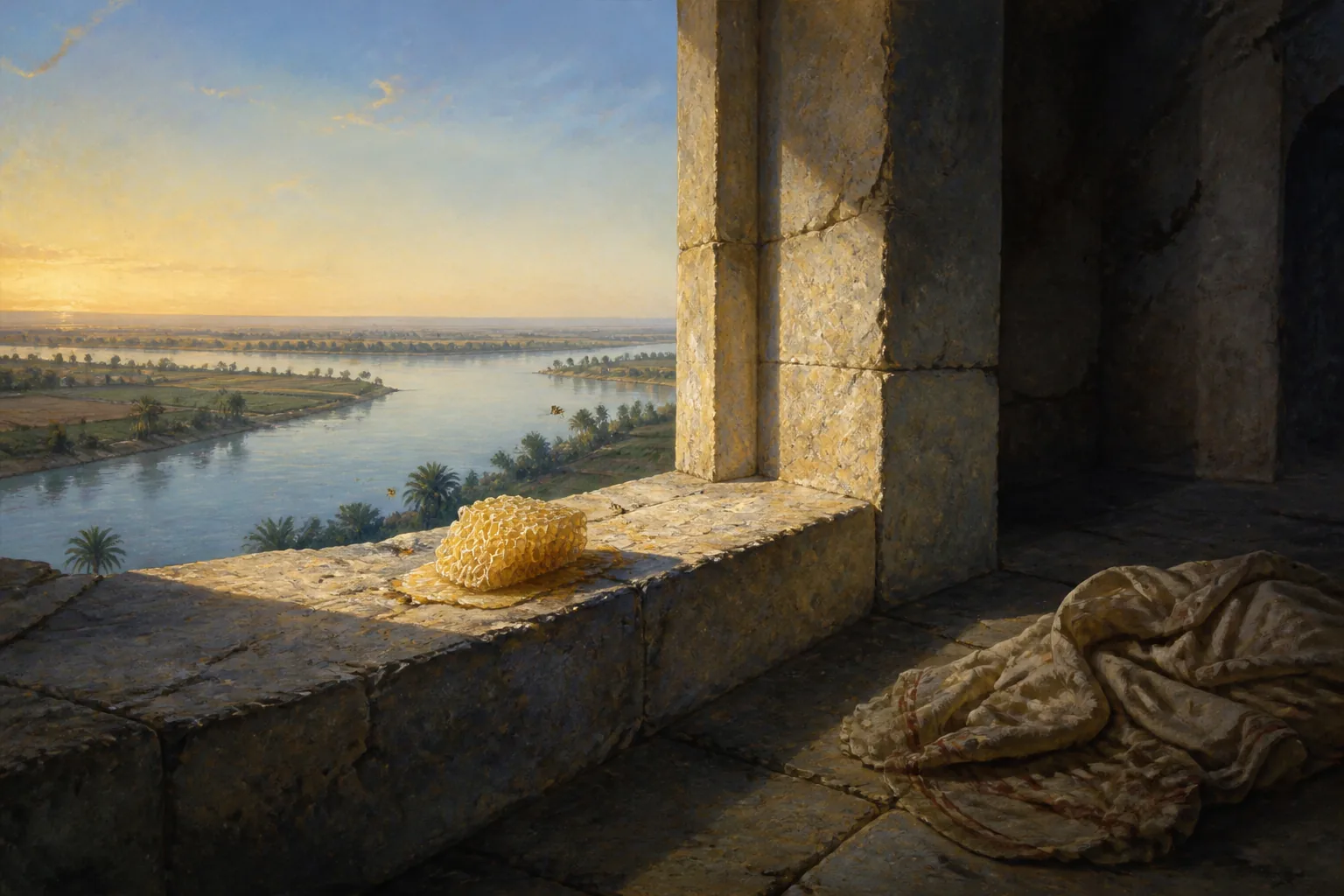
A heavenly visitor arrives on the eighth day and addresses her by name. He tells her that heaven has recorded her repentance, and he gives her a new name: City of Refuge. He then asks for a honeycomb, which appears in her storeroom although she knows it was not there. Bees rise from it, settle on her, and depart unharmed.
The second half turns into an adventure, in which Pharaoh’s son covets Aseneth and recruits some of Joseph’s brothers to seize her. The plot fails, and Levi — who in Genesis is anything but merciful — intervenes to spare the attacker.
The Honeycomb Problem
One passage has generated more argument than the rest of the book combined. When Aseneth eats from the comb, the visitor tells her what she has just received. She has eaten bread of life, drunk a cup of immortality, and taken an ointment of incorruption.
That triad reads, to a Christian ear, like bread, wine, and chrism. Nineteenth-century scholars concluded that Joseph and Aseneth must be a Christian allegory, with Aseneth standing for the church.
Most scholars have since abandoned that reading, because nothing else in the book is recognizably Christian. There is no Jesus, no cross, and no gospel citation. An intense concern with idolatry and table fellowship fits a Jewish setting far better. Most specialists now place the work in the Jewish diaspora of Egypt, somewhere between the first century BCE and the second century CE.
Nevertheless the passage remains genuinely puzzling, because honey carries associations of wisdom and of the food of angels. Several ancient traditions share those associations, and the formula may draw on an initiation vocabulary we no longer possess. Honest scholarship marks the question unresolved and leaves it there.
Why the Book Was Written
Set the novella beside the situation of Egyptian Jews under Greek and then Roman rule, and its purpose comes into focus.
Such a community faced constant pressure on exactly this question, because intermarriage happened and so did conversion. A convert needed to know whether she could ever really belong, and a community needed to decide what it required of her.
Joseph and Aseneth answers both, because the book does not merely permit Aseneth to marry in. It renames her, gives her a role, and tells her that many will shelter in her. Her transformation is total and, importantly, her own doing: nobody instructs her, and nobody administers a ritual.
For related material on how apocryphal texts treat women who act on their own initiative, see the role of women in apocryphal texts. See also the Acts of Paul and Thecla, where another young woman refuses a marriage her family arranged.
A Novel Before the Novel
Form matters here as much as content, because Joseph and Aseneth belongs to a small group of ancient Jewish narratives. Those narratives behave like fiction rather than like chronicle, and the difference shows.
The family resemblance is easy to see in the book of Tobit, which has a journey, a demon, a marriage, and a happy ending. Susanna has a trial, a false accusation, and a clever rescue: see the story of Susanna. Judith, for its part, has a siege and an assassination.
These works share a method, because they take a religious argument and embed it in a plot with suspense. The reader then arrives at the conclusion through the story rather than through instruction.
Greek romance was flourishing in exactly the same period, with its stock ingredients of a beautiful heroine, separation, danger, and reunion. Joseph and Aseneth uses that machinery openly, and it uses it for a purpose the Greek novels never had.
How Other Writers Solved the Same Problem
Joseph and Aseneth was not the only attempt, and the alternatives show how unusual it is.
The Book of Jubilees takes the shortest road: it simply asserts that Asenath became Joseph’s wife. It moves on without raising the difficulty at all, so silence answers silence. Rabbinic tradition chose a bolder fix instead, and in one widespread account Asenath is not Egyptian by birth. She is the daughter of Dinah, born after the assault at Shechem and left exposed as an infant. The priest’s household in Egypt then takes her in and raises her, so the patriarch marries a granddaughter of Jacob and the problem dissolves.
Philo took a third road entirely, because he wrote philosophy rather than narrative. He treats the marriage allegorically, so that the union stands for the meeting of virtue with a soul capable of receiving it.
Compare the four approaches and the novella looks remarkably generous. Jubilees ignores the difficulty, and the rabbis remove it by genealogy. Philo dissolves it into abstraction, and only Joseph and Aseneth accepts the plain sense. She was Egyptian, and the daughter of an idol priest, and the book argues that this settles nothing, because a person can change.
That is a real position, taken in public, about who may join a community. It is also the least defensive of the four, which is probably why it needed a whole book rather than a sentence.
How Joseph and Aseneth Survived
Transmission tells its own story, and no Hebrew or Aramaic version exists. The book comes to us in Greek, and the Greek itself divides into a longer and a shorter recension. Scholars still dispute how the two recensions relate to each other.
Translations then carried it outward: Syriac, Armenian, Latin, Ethiopic, and Slavonic versions all survive, and the Armenian is textually valuable. Medieval Europe knew a Latin form, and a version even reached the Middle English tradition.
Notice what that pattern implies: Christian copyists, who found the book edifying, preserved a Jewish work written in Greek. Britannica’s overview of the apocrypha sets out how ordinary that route was for this whole class of literature.
The book itself was never canonical anywhere, and it survived because scribes liked it. That turns out to be a more reliable mechanism than official approval.
Why Joseph and Aseneth Still Matters
Three reasons stand out here, in ascending order of interest.
- It is early evidence for how ancient writers imagined conversion, before any fixed procedure existed. Aseneth repents alone, in a room, over the course of a week.
- It gives a woman an interior life, at length and with attention. Her pride, her humiliation, and her recovery are the plot, and Joseph mostly stands still.
- It shows a community arguing with its own scripture and winning, by writing the chapter it wished it had.
That last point is the one worth keeping, because Genesis left a gap. Instead of pretending otherwise, an ancient writer filled it in public, at novel length, and the result circulated for centuries in six languages.
Reading it now, the surprising quality is how modern the difficulty feels. Someone marries outside the community, and everybody has an opinion. Somebody writes a book to settle it, and the book is better than the argument.
Frequently Asked Questions
Is Joseph and Aseneth in the Bible?
No, and no tradition has ever counted it as scripture. It belongs to the pseudepigrapha, the wide body of Jewish writings that circulated alongside scripture without ever entering a canon.
Is it Jewish or Christian?
Most specialists now read it as a Jewish work from Hellenistic Egypt that Christians copied and preserved. The eucharistic-sounding formula about bread, cup, and ointment is the main argument on the other side, and nobody has explained it fully.
When was it written?
Estimates range from the first century BCE to the second century CE, with the earlier end favoured. No manuscript is anywhere near that old, so the dating rests on language, setting, and the concerns of the text.
Why is she called Aseneth rather than Asenath?
The Greek text renders the Hebrew name differently, and scholars conventionally cite the book by its Greek form. Both names refer to the same woman that Genesis names.
The Chapter Genesis Did Not Write
A single verse created the difficulty, and a whole novella answered it. That disproportion is the most instructive thing about the book.
Ancient readers did not treat scripture as a closed surface that asked only for admiration. They pressed on the places where it said too little, and when the pressure produced nothing, some of them wrote. Joseph and Aseneth is what that impulse looks like when the writer happens to be good at it.
Check out the author’s book here: The Apocrypha.

Leave a Reply