
Almost everyone has heard the story of Lilith, Adam’s first wife. God formed her from the same earth, and she refused to lie beneath him. She spoke the ineffable name and left the garden on her own terms.
It is a compelling account, and it appears in no ancient text whatsoever.
That statement surprises people, because the Lilith legend feels old and carries the atmosphere of Genesis. The vocabulary of rabbinic argument runs through it too, and the whole thing sounds like antiquity. Trace it carefully, however, and the familiar version turns out to be medieval. The genuinely ancient material tells a stranger and much less tidy story.
The Single Verse in the Hebrew Bible
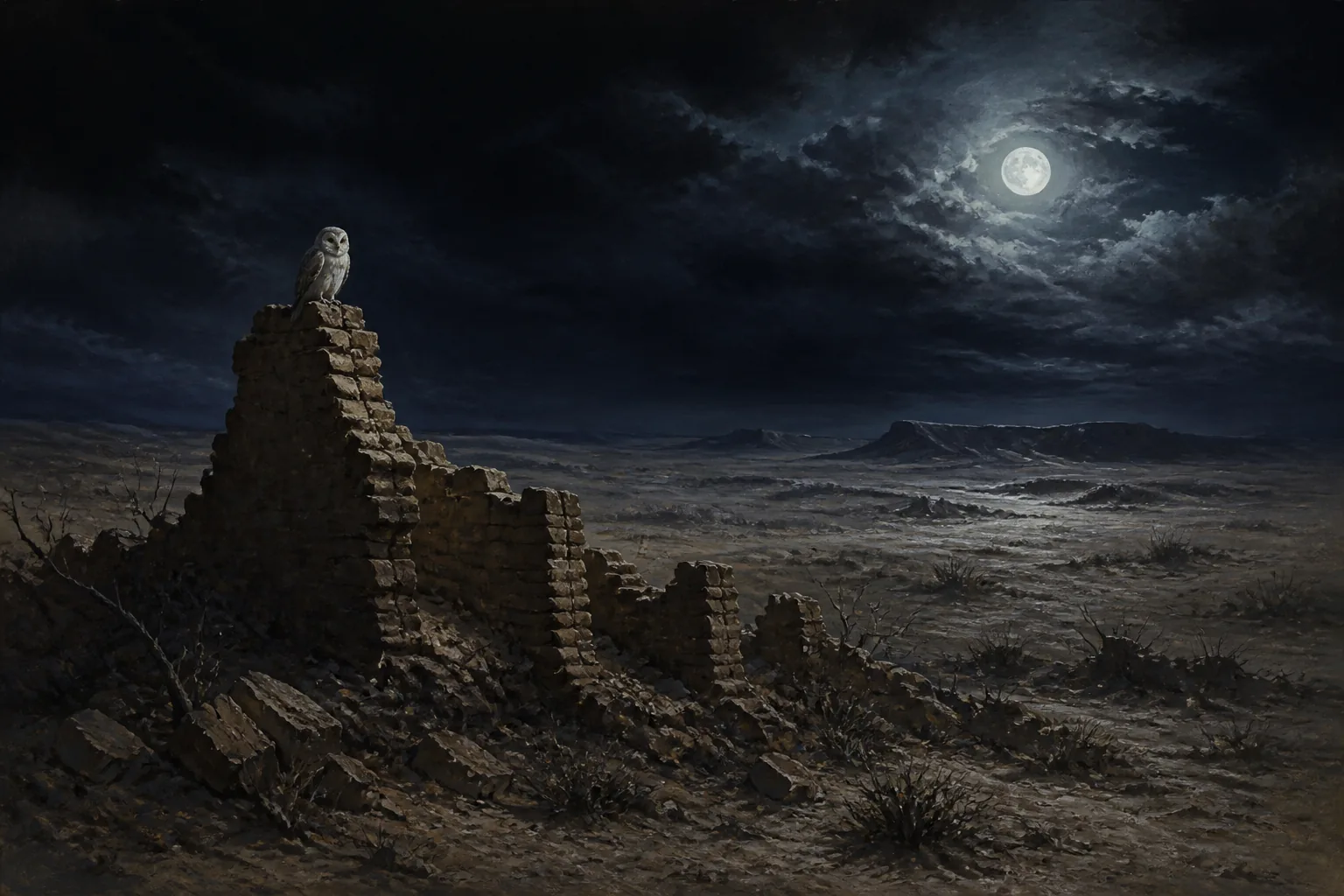
Isaiah describes the ruin of Edom, a land returned to wilderness and given over to wild creatures. Among jackals, ostriches, and night birds, one word appears: lilit.
The wild beasts of the desert shall also meet with the wild beasts of the island, and the satyr shall cry to his fellow; the screech owl also shall rest there, and find for herself a place of rest.
(Isaiah 34:14, King James Version, where “screech owl” renders the disputed term. The Hebrew and alternative renderings are available on Sefaria.)
Translators have never agreed: some read a night bird, some a night demon, and some simply transliterate. The Vulgate chose lamia, a Greek child-stealing monster, which pushed later European readers toward a female figure of horror.
What the verse does not do is connect this creature to Adam, to Eve, or to the garden. Isaiah lists it among the animals of a desolate place, and there the biblical evidence ends.
Lilith Before the Bible
The name reaches back further than Hebrew, into Mesopotamian sources that speak of lilu and lilitu. Those night spirits carry associations with wind, with sexual danger, and above all with harm to mothers and infants. Assyrian and Babylonian incantations aim to keep them out of the birth chamber. This background matters for one reason: the oldest layer of the tradition is not about marriage or rebellion at all. It concerns infant mortality, and it belongs to the world of protective magic rather than the world of theology.
Qumran preserves the same anxiety in Hebrew, among the compositions known as the Songs of the Sage. There a text lists the spirits a singer must ward off, and liliths appear in the plural among them. Evidently the community treated the word as a category of demon, not as an individual with a story.
Babylonian incantation bowls, inscribed centuries later and buried under thresholds, continue the practice. They name the demon, bind her by legal formula, and expel her from the house. Across a very long period, therefore, the concern stays constant: protect the household, protect the newborn.
For a parallel body of ancient demonology, see the Testament of Solomon. The Britannica entry on Lilith sets out the same sequence in brief.
Where the First-Wife Story Actually Begins
The famous narrative comes from a single source, the Alphabet of Ben Sira, an anonymous Hebrew work. Scholars usually place it somewhere between the eighth and tenth centuries of our era. It is a strange book, satirical in places, and scholars have long debated whether its author meant parts of it seriously.
In its account, God forms Lilith from earth as he forms Adam. The two quarrel over precedence in the marriage bed, and she pronounces the divine name and departs. She refuses to return when God sends three angels after her.
Several features of this story deserve a moment of attention.
- It arrives roughly two thousand years after the Isaiah verse.
- It explains a contradiction readers had noticed between the two creation accounts in Genesis.
- It also supplies an origin story for the protective amulets already in use.
In other words, the legend does not descend from antiquity into the Middle Ages. Rather, it assembles older pieces — a demon name, a birth-protection ritual, an exegetical puzzle — into a narrative that had not previously existed.
The name of the book invites a further confusion worth clearing up. It has nothing to do with the wisdom text discussed in the Book of Sirach explained, beyond borrowing its author’s name. Attaching a famous name to a new composition was ordinary practice, and readers still fall for it. See also the Book of Jasher, a title that scripture mentions and that someone else later supplied.
How Lilith Became a Symbol
The Zohar and subsequent kabbalistic literature expanded the figure considerably and paired her with Samael. They also gave her a role in a cosmology of the left side. Folk practice meanwhile kept the amulets going, and the three angel names from the Ben Sira story appear on them for centuries.
Then, in the nineteenth and twentieth centuries, the reception changed direction entirely. Writers began to read the refusal to submit as courage rather than monstrosity, and Lilith became a figure of independence. For a woman whom the apocryphal tradition treated far more kindly, compare the story of Susanna. Whether that reading recovers something or invents something is a fair question. It is worth remembering, though, that the earlier tradition invented her too. The pattern here is instructive, because each era received a name with very little attached to it. Each era then supplied the attachment its own concerns demanded.
Why the Lilith Case Matters for Reading Ancient Texts
This is the clearest example I know of a phenomenon that runs through the whole apocryphal field. A story everybody assumes is ancient turns out to be recent, and it rests on genuinely ancient fragments.
The lesson is not that the medieval version is worthless. It is a real text with a real history, and it shaped a thousand years of practice. The lesson concerns attribution instead: when somebody claims the Bible describes Adam’s first wife, that claim is simply false. That falsehood also obscures a far more interesting sequence of events.
Ancient material rarely arrives intact, because it comes in pieces and later readers reassemble it. The reassembly then travels under the authority of the pieces, and distinguishing the layers is most of the work.
What the Amulets Tell Us About Lilith
The written sources get most of the attention, but the objects deserve more.
Hundreds of incantation bowls survive from Mesopotamia, mostly from the fifth to seventh centuries. They are ordinary clay, inscribed in a spiral, and buried upside down under the floors of houses. The texts inside are legal in form, and they summon the demon and name her. They then issue a writ of divorce or expulsion, which changes what the ritual is. Notice what that implies: the householder is not praying but filing a document, because the demon has standing and the ritual removes it.
Amulets for mothers work the same way: they name the three angels and list the demon’s names. Then they post the warning at the threshold, where the household can see it. Some examples run to dozens of names, on the principle that a demon caught by any one of them is caught.
Here is the point that matters historically: this material is not literature about Lilith. People who expected results produced it as defence against her, over roughly a thousand years and across several languages.
That changes how we should read the legend, because the Alphabet of Ben Sira did not launch a practice. It arrived long after the practice had taken hold, and it supplied a story that explained why the angels’ names worked. Objects, in other words, came first, and the narrative came later to justify what people were already doing. That order is common in the history of religion, and it is easy to miss. The narratives survive in libraries, while the objects sit in storerooms.
Reading the Lilith Tradition Honestly
Three layers stand out, then, and nobody should merge them into one.
The first is Mesopotamian and biblical: a class of night demons, one ambiguous Hebrew word, and a fear centred on childbirth. Next comes the ritual layer: bowls, amulets, angel names, a practice with no story attached. Last arrives the narrative, and it is medieval: the first wife, the quarrel, the flight.
Popular retellings collapse all three into a single ancient tradition, and that is the error worth resisting.
Resisting it costs nothing and gains a great deal, because the genuine history is stranger than the tidy version. It also shows what the tidy version hides: people were frightened long before anyone told them why.
Frequently Asked Questions
Is Lilith in the Bible?
One Hebrew word in Isaiah may name her, and scholars still contest even that. She appears nowhere in Genesis and has no connection to Adam in any biblical text.
Is the Alphabet of Ben Sira a sacred text?
No tradition treats it as scripture, because it is a medieval Hebrew composition, satirical in tone. Its relationship to the earlier wisdom book of Ben Sira is one of name rather than content.
Why are three angels part of the story?
Their names — Senoy, Sansenoy, and Semangelof — appear on protective amulets for mothers and infants. The narrative most likely developed to explain an existing custom rather than the other way around.
Did ancient Jews actually believe in Lilith?
The evidence points to a widespread belief in a class of night demons that threatened newborns, which is not quite the same thing. The individual character with a biography belongs to a much later stage.
A Name in Search of a Story
Lilith travelled a long road for someone who began as a single ambiguous word in a poem about ruins. She acquired a husband, a rebellion, an escape, three pursuing angels, a consort, and eventually a symbolic afterlife she would not have recognized.
None of that makes her unreal in the sense that matters historically. It makes her a record of what successive generations feared and, later, of what they admired. Read that way, the legend becomes a document about its readers, which is often the most an ancient name can give us.
There is a practical test worth applying to any figure of this kind. Ask what the earliest source actually says, and then ask how much of the familiar story survives that question.
With Lilith very little survives: one word in a list of desert creatures, and its meaning disputed. Later hands added everything else, over roughly two thousand years, and we mostly do not know their names. That should not disappoint anyone, since the additions are the interesting part, because they are datable. A demon who threatens newborns belongs to a world with high infant mortality. The rebellious wife belongs to a world arguing about marriage. Independence as a virtue belongs squarely to the twentieth century.
Each version tells us what its makers could not stop thinking about. Read in sequence, they form something close to a history of anxiety.
And the name held all of it, which is the genuinely remarkable fact here. The legend does not need to be ancient in order to say something true.
Check out the author’s book here: The Apocrypha.
Leave a Reply