
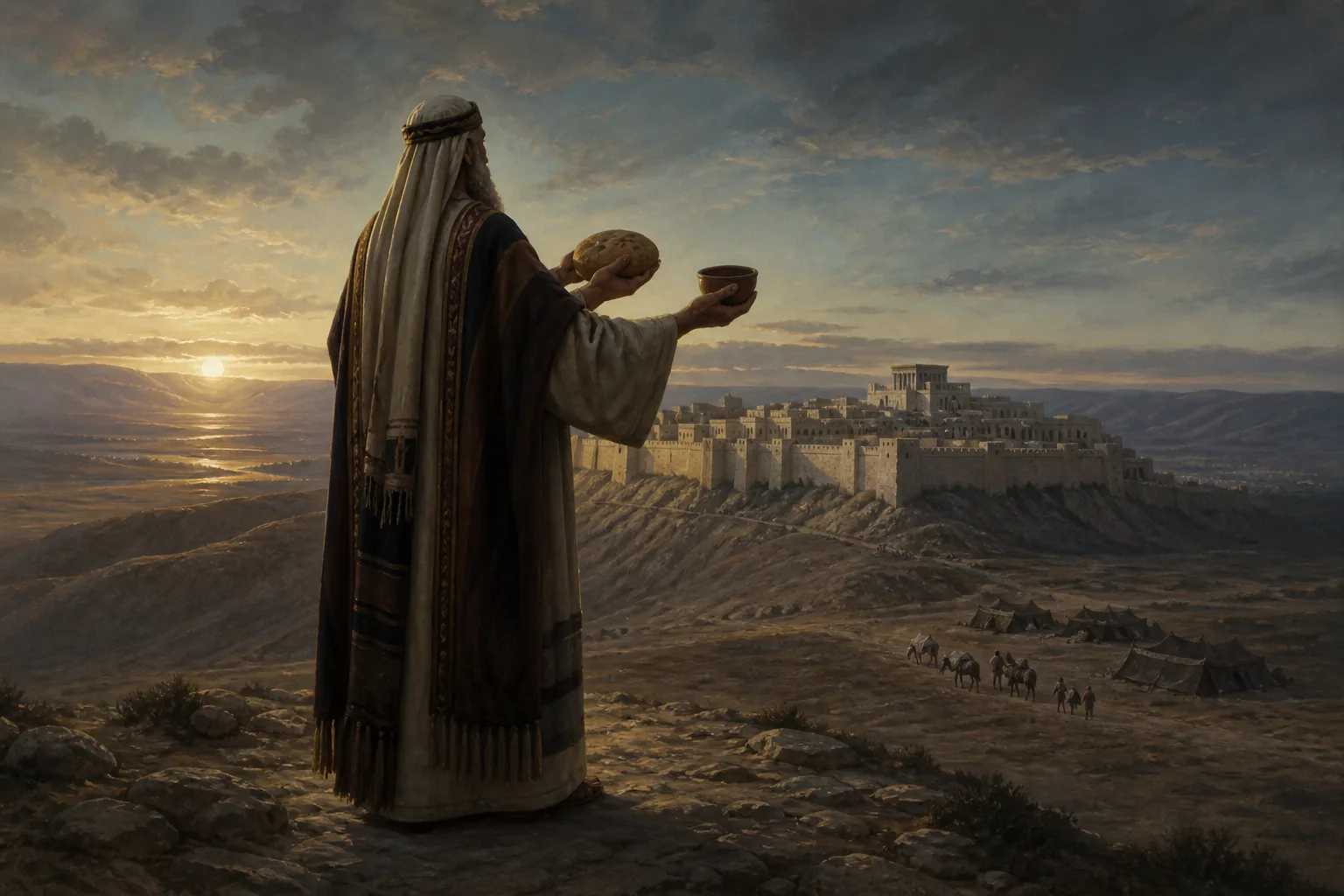
Three verses hold the entire appearance of Melchizedek in the Torah. Those same three verses generated a heavenly deliverer, a Gnostic revealer, a Qumran redeemer, and an argument that reorganized Christian theology.
Genesis introduces him without warning: Abraham returns from battle, and a king of Salem meets him with bread and wine. He blesses the patriarch, takes a tenth of the spoils, and vanishes from the narrative permanently. Nobody explains who he is, and that silence proved productive. Ancient readers noticed the gap, and for two thousand years they filled it.
Who Was Melchizedek in Genesis?
The name means something like “king of righteousness,” and most readers place his city, Salem, at Jerusalem. The details turn peculiar at once: he serves as priest of El Elyon, God Most High, centuries before Israel has a priesthood. That sequence repays attention, because God has just promised Abraham a covenant. Yet Abraham pays a tithe to this Canaanite king and accepts a blessing from him. In the ancient world, whoever gives the blessing ranks above whoever takes it, so Melchizedek outranks Abraham on his own ground.
And Melchizedek king of Salem brought forth bread and wine: and he was the priest of the most high God.
(Genesis 14:18, King James Version; you can compare the Hebrew and several translations on Sefaria.)
No genealogy accompanies him, which in a book obsessed with genealogies is remarkable. He has no father in the text, no mother, and no death notice. Later readers took that literary silence and turned it into a metaphysical claim.
The Psalm That Kept the Name Alive
One further verse mattered enormously, and it comes from a royal psalm. The psalm addresses the king with an oath: a priest forever, after the order of Melchizedek.
That single line did the work of an entire doctrine. It established a priesthood that runs parallel to the levitical one, predates it, and never ends. Moreover, it attached the idea to the monarchy rather than to the temple staff.
Readers in the Second Temple period found this combination irresistible. A priesthood older than Aaron, tied to Jerusalem, held by a figure with no recorded death: the pieces invited speculation. Speculation duly arrived, moreover, in a period already crowded with expectation, as the eschatology of 2 Esdras and the prophetic visions of Baruch both show.
Melchizedek at Qumran: A Heavenly Deliverer
The most startling development turned up in Cave 11 at Qumran, where scholars catalogued a fragmentary Hebrew text as 11Q13. Readers know it simply as the Melchizedek scroll, and it presents him in a role no reader of Genesis would predict. The Israel Antiquities Authority hosts the digital library of the scrolls, where anyone can examine the physical fragments directly.
Here he is not a Canaanite king at all, but a presence in the heavenly assembly. He proclaims liberty to the captives, and he judges Belial and the spirits of his lot. The text weaves together the jubilee legislation of Leviticus, the herald of Isaiah, and the divine council of the Psalms. It places Melchizedek at the center, and the chronology deserves emphasis, because this scroll predates the New Testament. Before any Christian writer took up the theme, a Jewish community in the Judaean desert had already made him an eschatological redeemer.
That expectation of a heavenly deliverer runs well beyond this scroll. It runs through the prophecies of the Book of Enoch and reaches its fullest form in the Similitudes of Enoch.
The Argument in Hebrews
The Epistle to the Hebrews devotes three chapters to him, more than Genesis and the Psalms give him combined. Its argument is bold, and it turns entirely on the absence of a genealogy.
The argument runs across chapters five to seven of that epistle. Because the text records no ancestry and no death, the writer reasons, Melchizedek stands for a priesthood of another kind. That priesthood does not pass from father to son, and it does not end. He becomes the pattern rather than the exception, while the levitical priesthood arrives late, depends on descent, and ends with mortality. The move is audacious: an argument from silence usually counts as weak reasoning, yet here the writer treats the silence as deliberate. The text says nothing about his parents, and that saying-nothing carries the theological weight. Notice what this achieves rhetorically, because a first-century writer needed to explain a priesthood outside the temple system. Genesis had conveniently supplied the precedent, buried in a war story.
Melchizedek in the Apocrypha and Beyond
The trail continues well past the canon, into a Slavonic work of disputed date called Second Enoch. That book supplies him with a birth narrative so extraordinary that it can only answer the missing genealogy. The child arrives already grown and marked, and heaven takes him up to paradise before the flood.
The tradition repeats the move elsewhere: see who is Metatron, another figure who never dies and who rises under a new name. Nag Hammadi preserves a fragmentary tract that carries his name as its title, and there Melchizedek appears as a revealer figure and a heavenly priest. Rabbinic tradition took a different road entirely and identified him with Shem, the son of Noah. That move returns him to a known family tree and removes the problem.
Each solution addresses the same difficulty in a different direction:
- 2 Enoch answers the silence with a miraculous birth and a rescue.
- Hebrews treats the silence itself as the point of the passage.
- Rabbinic tradition fills the silence with an ordinary and familiar genealogy.
- 11Q13 ignores the question of descent and promotes him to heaven.
Four traditions faced one gap and produced four incompatible answers, and the disagreement is more informative than any single solution.
Why the Melchizedek Question Still Matters
Strip away the specifics and a general problem remains: what does a community do with an authority that its own rules cannot account for? Melchizedek is a legitimate priest under no known covenant, blessing the founder of a covenant that God has not yet given.
Every subsequent interpretation attempts to manage that anomaly: some readers absorb him, some elevate him, and some quietly domesticate him. Nobody, however, was willing to let the three verses stand alone.
There is a lesson here about how canons actually work. The material that generates the most commentary is rarely the material that says the most. Far more often it is the material that says too little, in a place where readers expected more.
How Melchizedek Shaped Christian Worship
The influence did not stay theoretical: bread and wine appear in his three verses, and Christian writers noticed that at once.
Cyprian drew the connection openly in the third century: Melchizedek offered bread and wine, and the church does the same. Therefore the priesthood of the altar has a precedent older than Aaron.
The argument spread quickly, because Ambrose used it and Augustine used it after him. Eventually the Roman canon of the Mass named him directly, alongside Abel and Abraham, among those whose offerings God accepted.
That placement has an effect worth measuring, because the central prayer of Western Christianity names him daily, across centuries. A Canaanite king who appears for three verses has done better than most minor characters. Eastern liturgy took a similar road, and Byzantine hymnography treats him as a type. Icons occasionally show him with the bread and cup, and the Ethiopian tradition, which preserved so much else, kept him too. Art followed liturgy, and medieval churches paired his offering with the Last Supper in glass and stone. Chartres has him, and so does the abbey of Saint-Denis. The builders wanted visitors to read the pairing, because the older gift prefigures the later one. None of this was inevitable, because a different reading of Genesis would have left him a footnote. A single detail of provisions made the difference, and later readers found it impossible to treat as incidental.
The Limits of What We Can Know About Melchizedek
Honesty requires marking the boundary: much of the above is reception history, not history.
We do not know whether a priest-king of Salem existed. We do not know when a scribe composed Genesis 14, and scholars have proposed dates centuries apart. The chapter reads oddly against the rest of the Abraham material, and some regard it as an insertion.
We also do not know why the psalmist invoked his name. Perhaps a Jerusalem royal tradition claimed descent from pre-Israelite kings, or perhaps the name was simply available and useful. Both explanations have supporters and neither has proof, so what we can establish is narrower but firmer.
The name circulated, and it attracted speculation in at least four directions. Qumran, 2 Enoch, Nag Hammadi, the rabbinic sources, and the New Testament all document that speculation.
For a historian, that documentation is the real subject, because the figure himself stays out of reach. The uses stay visible, dated, and comparable, and they tell us a great deal about the communities that made them.
Frequently Asked Questions
Was Melchizedek a real historical person?
We have no way to establish that, because Genesis offers no date and no dynasty. No external source corroborates the story, and no inscription mentions him. Historians can say confidently that a priest-king of a Canaanite city fits the setting, but plausibility is not evidence.
Is Melchizedek an angel?
The Qumran scroll treats him as a heavenly figure who presides over judgment, which comes close. Genesis presents him simply as a king, and the two portraits do not sit easily together. Whether one text develops the other, or whether both draw on an older tradition, remains genuinely unsettled.
Why does the tithe matter so much?
Because it establishes rank: Abraham gives a tenth to Melchizedek rather than taking one. Later writers read that transaction as an admission of superior standing, and the whole argument in Hebrews rests on this detail.
Is the Melchizedek scroll part of the Bible?
No: 11Q13 belongs to the Dead Sea Scrolls, the library of a Jewish community, and no tradition has ever treated it as scripture. Its value is instead historical, because it shows what some readers believed before the New Testament existed.
The Man Without a Family Tree
Melchizedek endures for one reason: the record leaves him unfinished. A reader can weigh a figure with a full biography and then set it aside, whereas a figure that the record defines only by its omissions stays permanently open.
Genesis gave him bread, wine, a blessing, and a tithe, then closed the door. Everything else arrived later: the heavenly judge, the eternal priest, the son of Noah, the child in paradise before the flood. Those readers could not accept that Genesis granted so much authority and then explained so little.
Check out the author’s book here: The Apocrypha.
Leave a Reply