
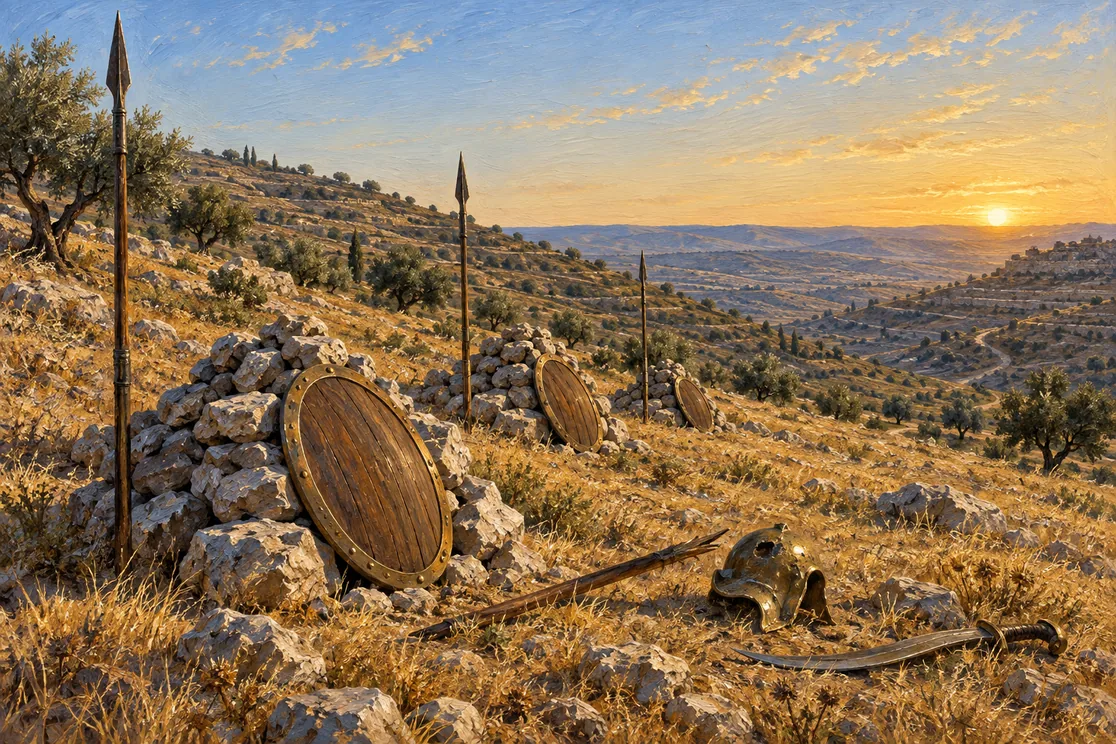
On Veterans Day, and on Remembrance Day across the ocean, nations pause to honor the soldiers who did not come home. The custom feels modern, with its poppies, its minutes of silence and its names carved in stone. Yet one of the oldest written accounts of a commander honoring his dead comes from the Apocrypha, in a book that most Protestant Bibles leave out.
The commander was Judas Maccabeus, the guerrilla leader who drove a Greek empire out of Jerusalem in the second century BCE. After one hard battle he did something that still divides churches today. He gathered his men and took up a collection. Then he sent the money to the Temple to pay for sacrifices for the fallen.
Who Was Judas Maccabeus?
Judas was the third of five sons of Mattathias, a priest from the village of Modein, northwest of Jerusalem. In 167 BCE the Seleucid king Antiochus IV Epiphanes outlawed the practice of Judaism in Judea. His officers banned circumcision and the Sabbath, and they set up a pagan altar in the Temple itself.
When a royal officer came to Modein and ordered the villagers to sacrifice, Mattathias refused. According to 1 Maccabees 2, he then killed a Jew who stepped forward to obey, along with the king’s man, and fled to the hills with his sons. The old priest died within a year, and leadership of the revolt passed to Judas.
The revolt was not only a war against a foreign king. It was also a civil conflict inside Judea. Some priests and aristocrats in Jerusalem had welcomed Greek customs, and they had even built a gymnasium near the Temple. For the rebels, these men were traitors. For themselves, they were modernizers who wanted Judea to join the wider Hellenistic world. That tension between Greek culture and Jewish tradition runs through the whole period, as our study of Hellenistic philosophy in the Jewish Apocrypha shows.
His nickname, Maccabeus, most likely comes from the Hebrew or Aramaic word for a hammer. The title fit his style of war. He struck fast, often at night, and he usually fought against much larger armies.
The Hammer Against an Empire
The early victories read like a short list of impossible odds. Judas defeated the governor Apollonius and took his sword, which he carried for the rest of his life. He then routed a second army at the pass of Beth-horon, where his men attacked uphill against a column many times their size.
At Emmaus his troops slipped out of their camp at night while the enemy’s general went looking for them. When the Seleucid army returned, it found the Jewish force waiting in the plain. A year later Judas held off the regent Lysias at Beth-zur, south of Jerusalem.
The victories opened the road to the capital. In December of 164 BCE, Judas and his brothers cleansed the Temple, built a new altar and relit the lamp. They also decreed an eight-day feast to mark the rededication every year. That feast is Hanukkah, and 1 Maccabees 4 describes its origin. Interestingly, the book says nothing about the famous miracle of the oil. That story appears only centuries later, in the Talmud.
The Prayer for the Fallen in 2 Maccabees 12
The passage that makes Judas Maccabeus a figure for Veterans Day comes later, in 2 Maccabees 12. After a battle against Gorgias, the governor of Idumea, Judas and his men return to collect the bodies of their dead. They intend to bury them with their families.
What they find under the tunics of the slain shocks them. Each dead soldier carries small idols from the pagan town of Jamnia, amulets that the Law strictly forbade. The author concludes that this was the reason they had fallen in battle.
Judas Maccabeus does not curse them, however. Instead, he and his men turn to prayer and ask God to blot out the sin completely. Then Judas collects about two thousand drachmas of silver. He sends the sum to Jerusalem to pay for a sin offering. You can read the whole passage at Bible Gateway.
A Holy and Pious Thought
The author of 2 Maccabees then adds his own commentary, and it is one of the most quoted lines in the whole Apocrypha. In doing this, he says, Judas acted very well and honorably, because he was thinking of the resurrection.
The reasoning is simple. If Judas had not expected the fallen to rise again, praying for them would have been foolish. But he believed that a splendid reward waits for those who fall asleep in godliness. So the thought was holy and pious, and he made atonement for the dead to free them from their sin.
This is one of the clearest statements of belief in bodily resurrection anywhere in Jewish writing before the New Testament. The same book develops the idea in the story of the mother and her seven sons, who die under torture while speaking of the world to come. Our article on the woman with seven sons follows that scene in detail.
Why Judas Maccabeus Divided the Churches
For many centuries the passage raised few questions. However, the Reformation turned it into a battlefield of its own.
Catholic theologians had long read 2 Maccabees 12 as support for prayer for the dead and, by extension, for the doctrine of purgatory. If the living can help the dead by prayer and sacrifice, then the dead must be in a state where such help still matters. The Council of Trent confirmed 1 and 2 Maccabees as part of Scripture in 1546.
Martin Luther and the other reformers answered by questioning the book itself. They pointed out that 2 Maccabees was not in the Hebrew Bible, and that its author even apologizes for his style at the end, which inspired writers do not usually do. As a result, Protestant Bibles moved both books of Maccabees into a separate section of Apocrypha, or dropped them altogether.
Our guide to the Apocrypha Bible meaning explains that sorting. We also trace the longer history of why the apocryphal books left the Bible.
The Orthodox churches kept the books and pray for the dead to this day. So a single paragraph about a battlefield collection ended up marking one of the clearest borders between Christian traditions.
The Last Battle of Judas Maccabeus
The war did not end with the Temple. Judas kept fighting for years, and his family paid heavily for it. His brother Eleazar died at Beth-zechariah. He stabbed a war elephant from below, hoping that the king rode on it, and the falling beast crushed him.
In 161 BCE Judas Maccabeus defeated the general Nicanor at Adasa, and the Jews celebrated the day as a festival. He also sent envoys to Rome and made a treaty with the Senate, as 1 Maccabees 8 reports. Rome, though, sent no help.
The end came the following year at Elasa. A Seleucid army under Bacchides marched into Judea, and most of Judas’s men deserted him. According to 1 Maccabees 9, only eight hundred remained. His officers urged him to retreat and fight another day. Judas refused. If their time had come, he said, they should die bravely for their kindred and leave no stain on their honor.
It is worth noticing what the author chose to record here. The book praises courage, but it does not hide the desertions or the defeat. The same honesty appears in the prayer for the fallen, where the dead are both heroes and sinners at once.
He died on the field. His brothers Jonathan and Simon carried his body home and buried him in the family tomb at Modein. All Israel mourned him, the author says, with the lament: “How is the mighty fallen, the savior of Israel!” Britannica’s entry on Judas Maccabeus sets these events in their wider political history.
Frequently Asked Questions
Who was Judas Maccabeus?
He was a Jewish priest’s son who led the revolt against the Seleucid king Antiochus IV from about 166 to 160 BCE. He recaptured Jerusalem, rededicated the Temple and died in battle at Elasa.
What does Maccabeus mean?
It most likely means “the hammer,” from a Hebrew or Aramaic word for that tool. His family later became known as the Maccabees after his nickname.
Where does Judas pray for the dead?
In 2 Maccabees 12:38-46. After a battle, he sends money to Jerusalem for a sin offering on behalf of fallen soldiers who had carried pagan amulets.
Why are the books of Maccabees not in Protestant Bibles?
They were never part of the Hebrew Bible. The reformers placed them among the Apocrypha, partly because Catholic theologians used 2 Maccabees 12 to defend prayer for the dead.
What the Hammer Left Behind
Judas Maccabeus became one of the great heroes of the Middle Ages. Artists counted him among the Nine Worthies, alongside Joshua, David, Alexander and Charlemagne. Much later, Handel wrote an oratorio in his honor, and its chorus “See, the conquering hero comes” still plays at graduations and sporting events.
Still, the scene that fits Veterans Day best is not a victory. It is a commander standing among his own dead, finding out that they had broken faith, and choosing to pray for them anyway. Whatever one believes about what that prayer achieved, the gesture is recognizable. We still read the names of fallen soldiers aloud, and the living still do what they can for them.
Check out the author’s book here: The Apocrypha.
Leave a Reply