
Around the year 144, the Roman congregation heard a wealthy shipowner out and then expelled him. The church returned his substantial donation, which tells us how seriously they took the disagreement. His name was Marcion of Sinope, and the argument he lost changed Christianity permanently.
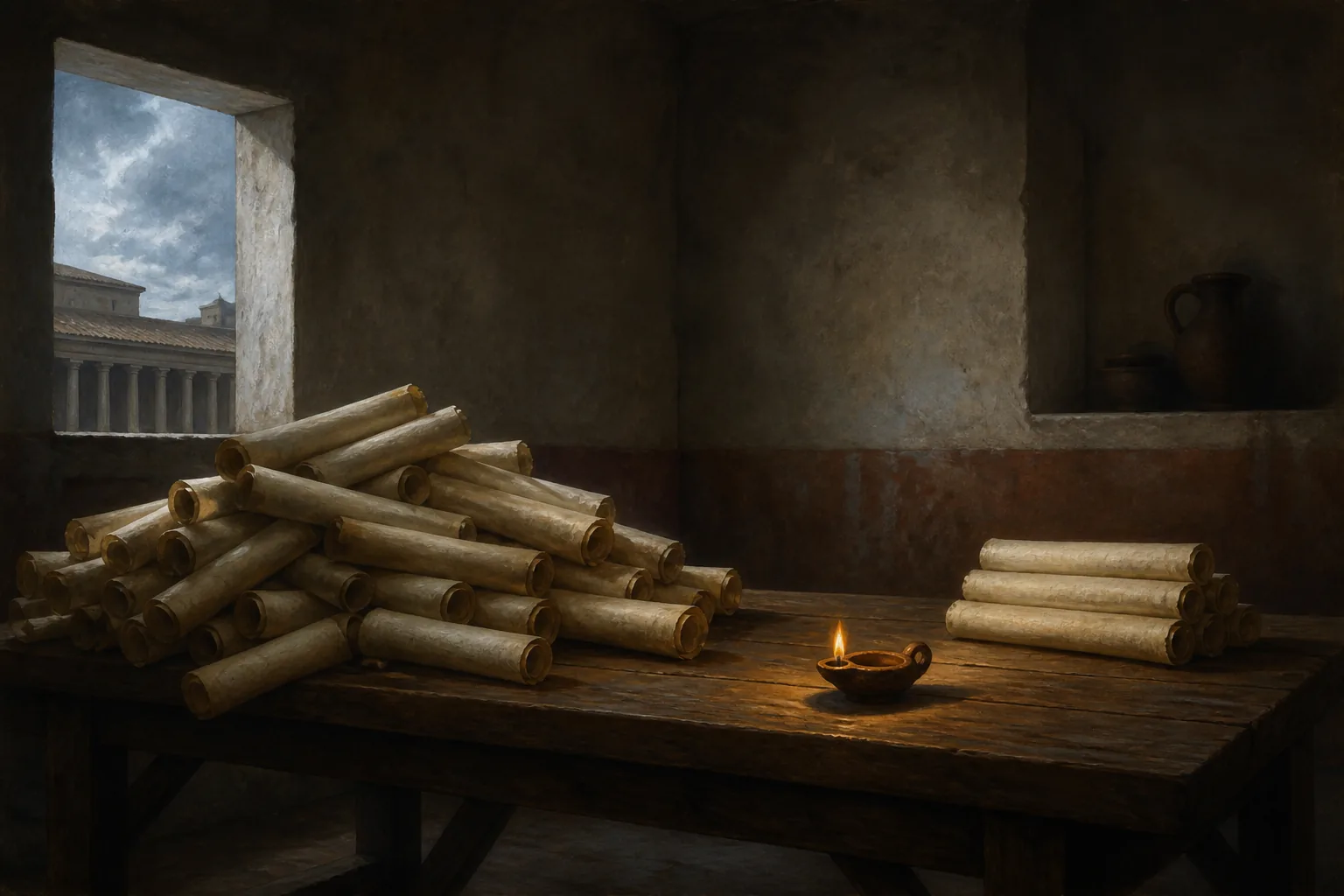
He had proposed something nobody had proposed before, namely a defined list of the movement’s own writings. Everything outside that list, on his account, had to go. The church rejected his list, and within a few generations it had produced one of its own. Britannica’s entry on Marcion of Pontus covers the outline; what follows is the argument underneath it.
The Problem Marcion Set Out to Solve
His starting point was a genuine tension, not an invented one. The God of the Hebrew scriptures commands armies, prescribes law, and executes judgment. The Father whom Jesus proclaims forgives enemies and seeks the lost. Marcion read both bodies of text closely and concluded that they described two different beings.
The lower being, in his account, was the creator: just, legalistic, and responsible for a flawed material world. The higher was an alien God, previously unknown, who had no part in creation and who sent Jesus out of pure mercy rather than obligation.
From that premise everything else follows with an uncomfortable logic of its own. If the creator is not the Father, then the scriptures of the creator are not Christian scripture. Marcion therefore discarded the entire Hebrew Bible, which no Christian teacher before him had contemplated.
The First Christian Canon
Having thrown out one library, he had to specify another, and his collection had two parts.
- The Evangelion, a single gospel, closely related to Luke though shorter, without the birth narrative and without the passages he considered later additions.
- The Apostolikon, ten letters of Paul, likewise edited.
That is the whole of it: one gospel and ten letters. No Matthew, no Mark, no John, no Acts, no Revelation, and nothing from the Hebrew scriptures.
Marcion chose Paul because Paul had argued about law and grace more sharply than anyone else, and because Galatians recounts an open conflict between apostles. Where Paul contrasts law with promise, Marcion read a contrast between two Gods.
The editorial method deserves a note, because he did not think he was cutting but restoring. In his view, scribes who wanted to reconcile Jesus with the creator had corrupted the texts, and his work removed their interpolations.
How We Know Any of This
Not a single line survives from Marcion’s own hand, and everything we possess comes through his opponents. Chiefly it comes through Tertullian, who wrote five books against him some sixty years later, quite deliberately hostile.
That situation demands caution, because reconstructing the Evangelion means reading a lawyer’s polemic backwards. It means noting which verses he says Marcion removed and which he says Marcion kept. Scholars have done this work with great care, and they still disagree about details.
One question has become genuinely lively in recent decades, and it concerns the gospel he used. The ancient writers assumed he had abbreviated Luke, though his text may preserve an earlier form that Luke later expanded. The evidence permits both readings, and the answer would matter considerably for the history of the gospels.
Other early texts met a similar fate without a heresiarch to blame. Among them stand the Gospel of Peter and the Shepherd of Hermas, which many read and which the church eventually set aside.
The Unintended Consequence
Here lies the irony that makes Marcion historically important to us. By publishing a fixed list, he obliged everyone else to say what was wrong with it — and saying what was wrong with it required naming an alternative.
Before him, Christian communities used a fluid body of writings whose boundaries nobody had needed to draw. Afterward, nobody could avoid the question, and the long process began that removed the apocryphal books from the Bible. Within decades, lists began to appear, and arguments about which gospels belonged became common. Writers now reaffirmed the Hebrew scriptures as Christian scripture explicitly, instead of merely assuming it.
Historians differ on how much weight to place on this. Some hold that Marcion effectively forced the canon into existence; others argue the process was already under way and he merely accelerated it. Either way, the church that condemned him ended up doing what he had done first, in a larger form.
His own movement, meanwhile, did not vanish quickly, because Marcionite churches with their own bishops persisted for centuries. They persisted particularly in Syria and the East, which suggests that his reading answered a real difficulty for many people. Those same eastern provinces kept other rejected books in circulation, the Acts of Paul and Thecla among the most popular.
Why Marcion Still Matters
The question he raised has never entirely gone away, because every generation encounters the difference in tone between the two testaments. Every generation must then decide what to make of it. The mainstream answer, which took shape largely in opposition to him, holds that a single God stands behind both. The difficulty, on that account, lies in the reading rather than in the texts.
His case also illustrates something about how orthodoxy forms, because positions rarely take shape in calm conditions. They take shape when someone states the opposite clearly enough that silence stops being an option. The definition then bears the marks of the argument that produced it.
There is a final point worth making about method, because Marcion approached the tradition with a razor. He kept only what fitted a conclusion he had already reached. That procedure did not stay in antiquity, and recognizing it is useful well beyond the second century.
How Marcion Actually Read Paul
The method repays study, because it was not careless at all but systematic.
Paul writes about law and promise, flesh and spirit, the old and the new. Marcion took those contrasts and made them ontological, so that two orders meant two authors, and two authors meant two gods.
Consider Galatians, where Paul rebukes Peter to his face and warns against another gospel. He insists that his own message came by revelation, not from the Jerusalem apostles.
Read one way, that is an argument inside a family. Read Marcion’s way, it is evidence that men who wanted to keep the law had already corrupted the original message.
His Antitheses set the passages in columns, opposing the creator’s commands to the Father’s mercy. The form did the arguing, because two lists side by side make a case that no paragraph needs to state.
That is why the church answered at such length, because a tidy contrast is hard to refute with nuance. Tertullian spends five books insisting that the contrast is false.
What Marcion Got Right
Fairness requires saying that some of his observations were sound.
The tension he identified is real, and readers still feel it. Interpreters had not previously addressed it head-on, and after him they had to. The need to reply sharpened the mainstream answer: one God, one story, a development rather than a rupture.
He was also right that editors change texts over time, because manuscripts vary and additions do occur. His error lay in assuming that every variant favouring his opponents was an interpolation, which made his theory unfalsifiable.
And he grasped, before anyone else, that a movement with no agreed writings has no way to settle disputes. That insight was correct, and the church eventually acted on it.
None of this makes his conclusion right, though it does make him a serious reader rather than a crank. Treating him as a crank obscures why his churches lasted three hundred years.
Frequently Asked Questions
Was Marcion a Gnostic?
Not in the strict sense, because he shared the distinction between a lower creator and a higher God. He had no interest, though, in secret knowledge, elaborate emanations, or a divine spark within the elect. His argument ran on scripture rather than on myth, which sets him apart.
Did Marcion write the first New Testament?
He assembled the first known fixed Christian collection, which is not the same as writing one. The texts already existed, and his contribution was the boundary he drew around them.
Why did he reject the Old Testament?
Because he read its God as a different being from the Father of Jesus: just rather than merciful, and responsible for the material world. Discarding those scriptures followed from that identification, and he saw no other option.
Do any of his writings survive?
None survive, and his main work, the Antitheses, reaches us only through quotations and summaries in opponents, above all Tertullian.
The List That Made a List Necessary
Marcion lost comprehensively: the church expelled him, refuted him at length, and condemned him by name for centuries. His books disappeared so completely that we read him only through his enemies.
Yet the shape of the New Testament owes something to that defeat. Somebody had to ask which writings counted before anyone could answer, and the man who asked first asked it in a form the church found intolerable. The answer it gave still carries the outline of the question.
Look at what the answer included: four gospels, not one, and thirteen Pauline letters, not ten. Then comes Acts, which ties Paul to the Jerusalem apostles he had seemed to oppose, and the Hebrew scriptures remain entire.
Every item on that list answers him, since four gospels refuse a single authorized version. Acts refuses the split between Paul and the rest, and keeping the older scriptures refuses the two gods.
A canon assembled in calm conditions would probably look different. This one bears the marks of a fight, and they stay legible once you know what it denied.
That is worth remembering when somebody describes the New Testament as simply inherited. People chose it under pressure, against a specific alternative, and they knew exactly what they were rejecting.
His churches, meanwhile, kept going, with bishops, liturgy and a scripture of their own. Syriac writers were still arguing with them in the fifth century, which is three hundred years of an idea that supposedly failed at once.
That longevity is the part most summaries omit, because a heresy that lost in Rome in 144 was still a going concern elsewhere. It kept going in other provinces long after everyone involved in the expulsion had died.
Condemnation, it turns out, is not the same as refutation. One is a decision that a body takes, while the other has to persuade individual readers one at a time, which takes considerably longer.
Check out the author’s book here: The Gnostic Gospels.

Leave a Reply