
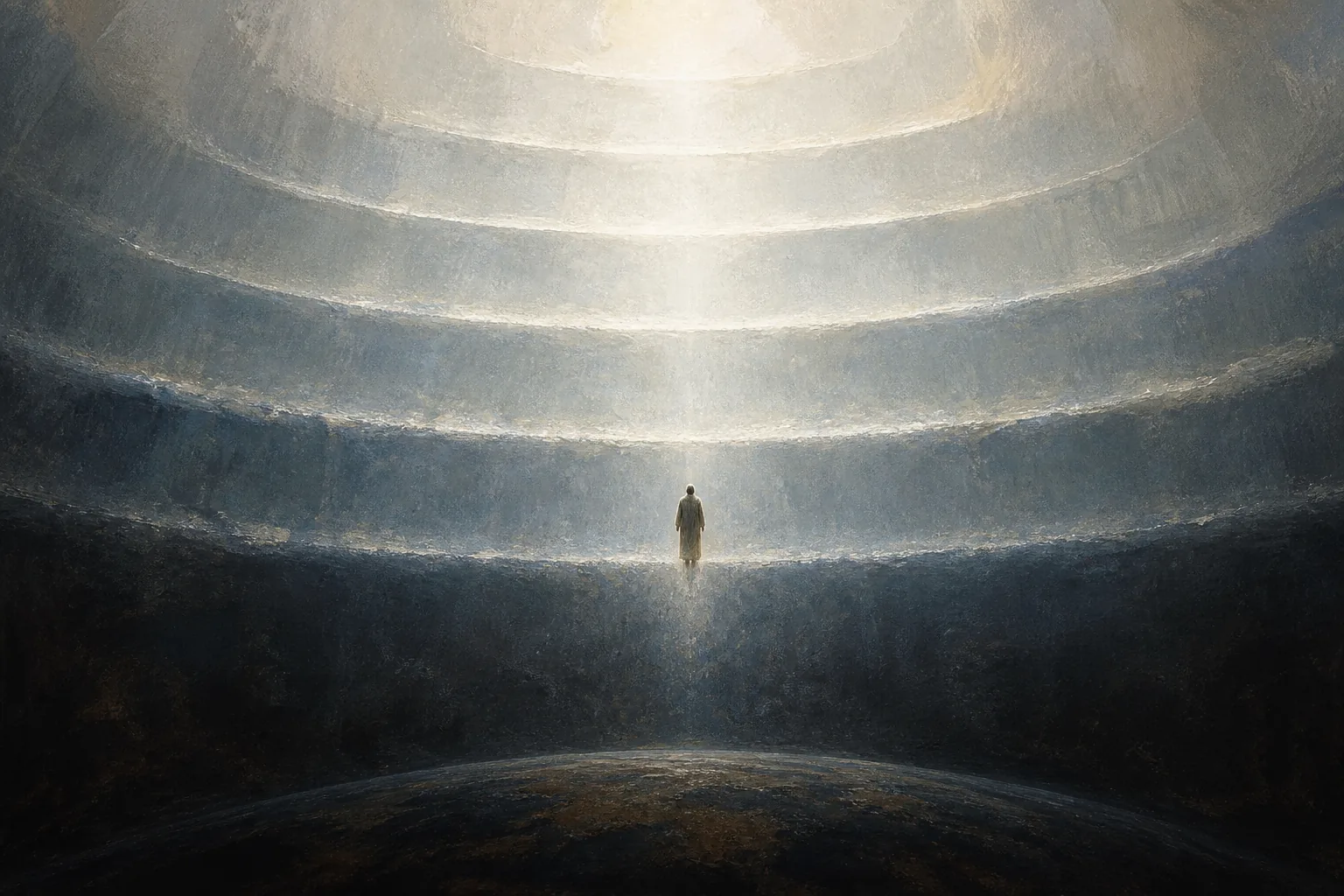
A divine figure travels down through seven heavens, changing his appearance at each level. The powers who live there never know him, and he arrives on earth unrecognized. The beings he passed are the ones who will later kill him.
That is not a summary of any canonical text, but of the Ascension of Isaiah, a second-century apocryphon. It maps the space between God and the world more carefully than almost anything else that survives from the period.
The book has two halves, and the first, the prophet’s death under King Manasseh, is a story of its own. This article follows the second: the ascent, the seven levels, and the strangest descent in early Christian literature.
What the Ascension of Isaiah Contains
The work divides naturally into two movements, and the first is the martyrdom under King Manasseh. The martyrdom of Isaiah tells it at length and treats it on its own terms. This article follows the second, which is where the book becomes genuinely peculiar.
That second movement takes the prophet upward, and an angel conducts him through seven heavens. Each is brighter than the one below, and each has its own thrones, its own angels on the right and the left, and its own degree of praise. Isaiah’s appearance changes as he climbs, until at the sixth level he no longer resembles the man who set out.
At the summit he sees the Beloved, who then descends through the same seven levels. The Beloved changes appearance at each stage, so that the powers of each realm fail to recognize him.
That descent is the theological heart of the book, because the disguise lets the Beloved pass unnoticed through hostile territory. The powers who fail to recognize him are the ones who later destroy him. Read carefully, the vision is not a tour at all, but a reconnaissance report on ground that someone will shortly cross in the other direction.
A Composite Work in Three Languages
Scholars generally treat the Ascension of Isaiah as a compilation, which places it among the pseudepigrapha rather than among unified works. The martyrdom section draws on Jewish tradition about the prophet’s death, which the martyrdom of Isaiah examines on its own terms, and rabbinic sources preserve variant forms of it. The vision section is unambiguously Christian and probably dates to the second century.
Transmission proved nearly as tangled as composition, because only Ge’ez preserves the whole text. That is true of several other important apocrypha, and Ethiopian manuscripts therefore remain the basis of every modern edition. Greek, Latin, Coptic, and Old Slavonic witnesses survive only in fragments, and they do not all agree. Scattered evidence of exactly this kind fills the British Library’s Greek manuscripts collection.
An editor probably joined the two halves rather than writing them together, and the seam shows in the manuscripts. The martyrdom circulated on its own, and so did the vision. What we call one book is a decision that copyists took.
That decision is worth knowing before reading either half, because nobody designed the vision as a sequel. It is a separate composition with its own concerns, and those concerns are cosmological rather than biographical.
The Seven Heavens and the Shape of the Cosmos
Multi-tiered heavens appear across ancient Jewish and Christian literature, though few texts map them as methodically as this one. Each level in the Ascension of Isaiah has its throne, its angels on the right and the left, and its own degree of glory. The prophet’s own appearance changes with every level he climbs.
Such a structure does something specific for a reader, because it converts distance from God into something countable. It also turns the descent of a divine figure into a journey with stages, rather than a single leap.
The firmament below the first heaven is different in kind, because there the text places a struggle rather than a hierarchy. Powers contend with one another, and envy and violence sit directly above the earth. The vision is not of a calm ladder but of a contested border.
Visionaries of the same world mapped their skies with comparable care, as the prophetic visions of Baruch show. The numbering itself carried meaning: seven levels here, and seven seals elsewhere.
Why the Book Made Later Readers Uneasy
Two features of the Ascension of Isaiah sat badly with developing orthodoxy.
- The disguised descent raises a problem: if the Beloved passes through the heavens by concealing his nature, then his humanity risks becoming another disguise. Later readers detected a docetic tendency, whether or not the author intended one.
- The visionary authority raises another: a prophet who reports the arrangement of heaven on his own testimony competes with a settled tradition. Such reports become harder to accommodate once a canon closes.
Consequently the work drifted out of ecclesiastical use in the Greek and Latin worlds. It survived instead where several other rejected books survived: in Ethiopia, in Slavonic monasteries, and in the fragments that scholarship recovered much later.
That pattern holds with unusual consistency across the apocryphal field. Rejection at the center rarely means destruction; it means relocation to the edges, where copying continues quietly for centuries.
The book was never a secret, either, because Origen knew it and Jerome knew it. Epiphanius knew it well enough to complain about it in writing. Rejection was therefore a decision rather than an accident, because the material was available. Readers had it in front of them, and they set it aside. That distinction matters for the whole field, because these works were not lost and later found. Somebody knew, weighed, and declined most of them, and the declining is the part worth studying.
Why the Ascension of Isaiah Still Matters
For historians, the value is precise, because here is a Christian text from a very early period. It shows what some believers thought about the structure of the cosmos, the identity of Christ, and the fate of prophets. All of that thinking predates any agreed answer to those questions.
The seven-tiered cosmos matters for a second reason, because it is a map, and people use maps. Whoever accepted this arrangement had to accept what follows from it: that the space between God and the earth is crowded, ordered, and only partly friendly.
Prophets who suffer and then win vindication recur throughout this literature, and the pattern outlasts the individual texts. Compare the two witnesses of Revelation, whom their enemies kill in the street and God raises three days later.
There is also the plain literary interest, because the vision has a structure most apocalypses lack. It goes up, then it sends someone else down the same stairs, and the second journey reverses the meaning of the first. Ascent reveals; descent conceals.
Few ancient works attempt that symmetry, and fewer still hold it for the length of a book.
Who Actually Read the Ascension of Isaiah
Tracing readership is harder than tracing manuscripts, though some traces survive.
Origen knew a tradition about a prophet sawn in two and referred to it. Jerome knew the story as well, and he dismissed it out of hand. Epiphanius mentions a work of this name among books that groups he opposed used, which tells us it circulated in circles he distrusted.
The Slavonic evidence points elsewhere, because there the vision section travelled on its own, without the martyrdom. Monastic libraries copied it for centuries, so a text can split in transmission, and this one did.
Ethiopia kept both halves together, and that is why modern editions look as they do. Our sense of the book as a single work depends on one branch of the tradition, and other branches disagreed.
Consider what this means for interpretation: scholars who read the two halves as a designed unity are reading the Ethiopian arrangement. Those who treat them as separate compositions are following the Greek and Slavonic evidence. The disagreement is about manuscripts before it is about meaning.
The Ascension of Isaiah and the Problem of Early Belief
Here the book earns its place in any serious reading list. It preserves a stage of thought that later orthodoxy smoothed over.
Second-century Christians disagreed about a great deal, starting with how many heavens there are. Whether the powers above the earth are hostile stayed equally open. Above all, no one agreed on what happened when a divine figure entered the world.
Later creeds settled these matters with careful formulas, and their precision hides the arguments that produced them.
An apocryphon like this one does the opposite, because it shows a writer working without the formulas. He reaches for images instead of definitions, and he arrives somewhere that a later century would call unsafe.
That is not a defect at all, but evidence of the argument in progress. To know what Christians believed before the councils, you have to read what the councils were answering. Much of that material sits outside the canon, and the Ascension of Isaiah is one of the clearest examples. It is early, it is Christian, it is undisguised about its cosmology, and nobody edited it to match a later standard.
Frequently Asked Questions
Is the Ascension of Isaiah in the Bible?
No canon includes it, though Ethiopian tradition preserved the complete text and valued it highly. That is a matter of manuscript transmission rather than scriptural status.
Did Isaiah really die by being sawn in half?
The Hebrew Bible does not say how he died, and the sawing tradition appears in this apocryphon. It appears in rabbinic sources as well, and Hebrews alludes to something similar. That shows the story was old and widespread, not that it was true.
Who wrote it?
Nobody knows, and the martyrdom material likely comes from Jewish tradition. The vision comes from a second-century Christian setting, with an editor joining the two. The attribution to Isaiah is itself a piece of pseudepigraphy.
What is the disguised descent?
The Beloved changes form as he passes through each heaven, so that the powers there do not recognize him. It is an early attempt to describe how a divine figure could enter a hostile world. Later theologians found it uncomfortably close to denying a real incarnation.
The Prophet on Both Sides of the Saw
The Ascension of Isaiah asks its readers to take it as one work, and those who do find something unusual. Its two halves make a single argument: that the worst the world can do to a prophet does not determine where the prophet ends up.
The saw and the seven heavens sit in the same book for a reason. Both describe a passage, and the book insists, without hedging, that the second one is the real journey.
Whether that persuaded anyone in antiquity we cannot say, though someone kept copying it in Ge’ez. That copying went on long after the churches that first read it had moved on, which is its own kind of answer.
Check out the author’s book here: The Apocrypha.

Leave a Reply