
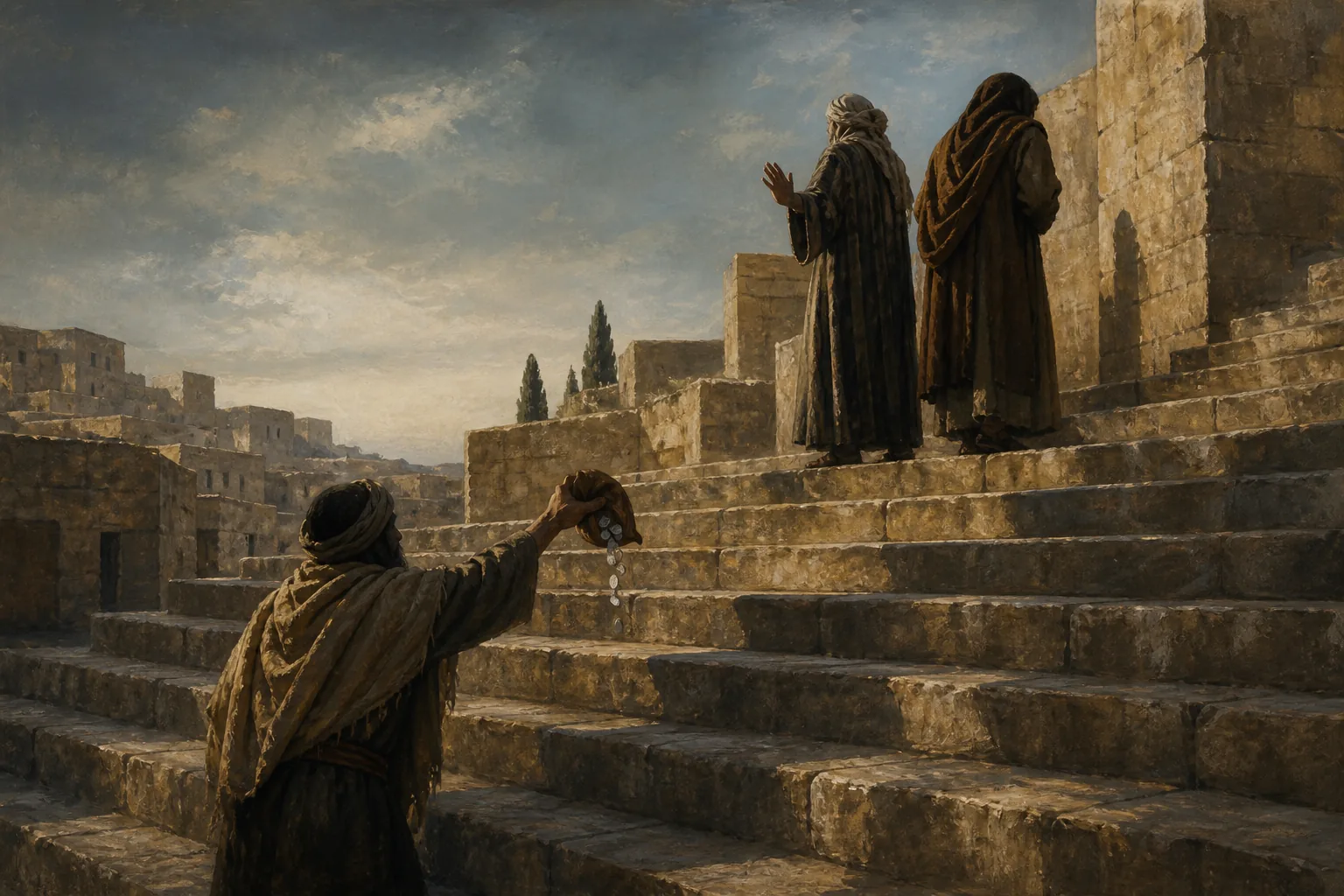
Very few people give their name to a sin, and Simon Magus managed exactly that. The word simony has outlived by nineteen centuries the man who earned it.
His scene in Acts is brief and unforgettable, and it opens with a Samaritan sorcerer already famous locally. He watches the apostles confer the Holy Spirit by laying on hands, and the display impresses him. Then he does the one thing certain to horrify the storyteller: he offers to pay for the ability.
Peter’s reply is furious, and the passage closes with Simon asking the apostles to pray for him. Whether he repents, the text declines to say, and later writers walked straight through that open door.
What Acts Actually Says About Simon Magus
The account is compact, and every detail in it repays attention. Simon has a following in Samaria, and the crowds there call him the great power of God. He hears the preaching, believes, and receives baptism, which places him inside the community rather than outside it.
Only afterward does he make his offer, and the sequence matters for everything that follows. Simon has already believed and received baptism when he blunders, so Acts does not present an enemy of the faith. It presents an insider who misunderstands what he has joined.
Thy money perish with thee, because thou hast thought that the gift of God may be purchased with money.
(Acts 8:20, King James Version; you can read the full episode on BibleGateway.)
What Simon wanted is also worth stating precisely, because he did not ask to buy the Spirit for himself. He asked instead to buy the authority to confer it on others. That is a request about power over a community, not about personal salvation.
How a Minor Character Became the Archetype
Within a century, Simon Magus had grown enormously in the telling. Justin Martyr, himself a Samaritan, reports that his countrymen honored Simon as a god and that a statue in Rome bore his name. Modern scholars think Justin misread a dedication to a Sabine deity, Semo Sancus. That is the sort of error that builds a legend rather than checking one.
Irenaeus went considerably further: in his catalogue of heresies, Simon becomes the fountainhead from which every later error flows. He acquires a doctrine and a companion named Helen, whom he had reportedly redeemed from a brothel in Tyre. He also acquires a cosmology in which she is the fallen First Thought of God.
Why did the tradition need such a figure, and what problem did the second-century church face? Competing teachings were multiplying, and each one claimed apostolic descent, so a single origin for all error solved that difficulty elegantly. If every heresy went back to one baptized man who had wanted power on the cheap, novelty itself became suspect.
For the cosmological ideas attributed to his followers, compare the Secret Book of John.
The Legends: Flying, Falling, and Dying in Rome
The apocryphal Acts of Peter, a second-century narrative, supplies the famous ending, in which Simon Magus flies above the Roman forum. Peter prays, the flight fails, and the sorcerer falls and breaks his legs, dying shortly afterward.
The Pseudo-Clementine literature stages the confrontation differently, as a series of formal debates that run for chapters. There Simon argues, loses, and withdraws, which suits a body of writing more interested in argument than in spectacle.
Neither account is history, and both are excellent evidence of something else: the shape early Christians wanted the story to have. A rival who claims to fly is a rival whose claims are testable, and testable claims can fail publicly. The whole genre works this way, as the apocryphal Acts of the Apostles shows. And the Acts of Paul and Thecla puts the same machinery to a very different purpose.
- Acts gives a rebuke and an ending that resolves nothing.
- Justin gives a cult in Samaria and a statue in Rome.
- Irenaeus gives a doctrine and a whole genealogy of error.
- The Acts of Peter gives a flight and a fall from the sky.
Each layer answers a need of its own moment, and the figure grows to fit.
Was There a Simonian Movement?
Caution matters here, because later heresiologists describe a sect of Simonians with rituals and texts. Yet we possess no writing at all from the group itself. Everything we know arrives through hostile witnesses who had strong reasons to make the movement look coherent and ancient.
Some historians accept that a Samaritan teacher with a following existed and that his ideas fed into later Gnostic currents. Others suspect that the Simonians of the heresiologists are largely a construction, assembled backwards from the need for an origin. The evidence, frankly, does not settle the question either way.
That uncertainty is itself a useful finding, because our picture of early Christian diversity depends on its opponents. Their categories were never neutral descriptions, and they shaped what survived. The same distortion shapes what we can say about the conflict between Mary Magdalene and Peter, where again the surviving accounts come from one side.
Why Simon Magus Still Matters
The word simony entered canon law and stayed there, naming the sale of offices and sacraments. Dante placed the simoniacs head-down in stone holes in the eighth circle, burning at the soles. That punishment shows how thoroughly the medieval church had absorbed the lesson.
Underneath the legend sits a permanent institutional question: what happens when spiritual authority becomes something transferable? Simon assumed that a demonstrable power must have a price, because in his world every skill did. The apostolic answer refused that logic, and every century since has had to refuse it again, usually because somebody had stopped.
His story also demonstrates how a tradition builds its enemies. A few verses supplied a name and an offense, and a growing movement supplied all the rest. The statue, the consort, the doctrine, the flight, the fall: it needed a face at the head of everything it rejected.
How Simon Magus Entered Canon Law
The rebuke in Acts had a long afterlife, because it became legislation and church councils returned to the problem repeatedly. Chalcedon in 451 forbade ordination for money, and later canons extended the ban to offices, relics, burials, and blessings. Each time, the offence carried his name into the text.
Gregory the Great treated it as a plague of the church, and reformers of the eleventh century made it a central charge. Simony and clerical marriage were the two abuses they attacked hardest, and the campaign reshaped the papacy.
Dante placed the simoniacs in the third pouch of the eighth circle, where they stand head-down in stone holes with their feet burning. The punishment inverts a baptismal font, which is a precise and unkind joke. The durability of that is remarkable, since a single failed transaction in Samaria produced a legal category. It also produced a reform movement and a place in hell, and canon law still defines the category in the same terms.
What the Simon Magus Story Reveals About Early Christianity
Set aside the legends and a plainer picture emerges, one that concerns competition. Samaria in the first century held several religious options, and wonder-workers were common. Audiences judged them by results, and in that market apostles and sorcerers looked alike from the outside. Both prayed, both claimed power, and both drew large crowds.
Simon’s mistake makes sense in that setting, because he saw a technique he did not have. He tried to acquire it the ordinary way, because people bought and sold skills, so why should this one differ?
Peter’s answer draws the line that the movement needed: nobody can own the gift, so nobody can sell it. The one who administers it holds no property in it.
That distinction had consequences well beyond the episode, because it separated the Christian holy man from the professional wonder-worker. It did so on economic grounds rather than doctrinal ones. Whether the line held in practice is another question, and the later legislation suggests it often did not.
Frequently Asked Questions
Was Simon Magus a real person?
Probably, in the limited sense that a Samaritan religious figure of that name and period fits the setting. Early sources attest him, though the elaborate biography belongs to later polemic rather than to the record.
Is Simon Magus a Gnostic?
Later writers describe him in Gnostic terms, and the systems attributed to his followers resemble second-century Gnostic thought. Since those descriptions come from opponents writing generations afterward, treating him as the founder of Gnosticism overstates what we can know.
What is simony?
The buying or selling of spiritual goods, ecclesiastical office, or sacraments. Canon law took the name directly from this episode, and the offense remains defined in those terms.
Did Simon Magus really fly?
The flight appears only in the Acts of Peter, an apocryphal narrative written well over a century after the events it describes. It functions as a contest story, of a type common in ancient literature, rather than as a report.
The Man at the Head of the List
Simon Magus occupies a peculiar position: he is the first name on a list that he probably never knew he was on. Acts gives him a bad moment and an ambiguous exit, and the tradition that followed converted the moment into a career.
Reading him carefully means separating those layers rather than collapsing them. What remains, once separated, is a short scene with an uncomfortable question at its center. After it comes a much longer history of people who found that question worth answering again and again.
The separation is worth doing slowly, because Acts gives a name, a place, an offer, and a rebuke. Justin adds a cult and a statue that was probably not his. Irenaeus adds a doctrine, and the Acts of Peter adds a flight and a fall.
Notice the direction of travel: each addition makes him larger and more clearly wrong. Nobody, across three centuries, made him smaller or more ambiguous. That pattern is itself evidence, since it shows a tradition consolidating, and consolidating traditions need boundaries. A boundary requires someone standing on the far side of it, and Simon was available.
Whether the real man deserved the position we cannot say. Acts leaves him asking for prayer, which is not the exit of a villain. The later writers did not find that ending useful, and they replaced it. So the honest summary is short: the sources attest one episode reasonably well. Everything after it comes from people arguing about something else.
Reading him that way costs a colourful biography, and in exchange it gives a clearer view of the second century, which is a fair trade.
Check out the author’s book here: The Gnostic Gospels.

Leave a Reply