
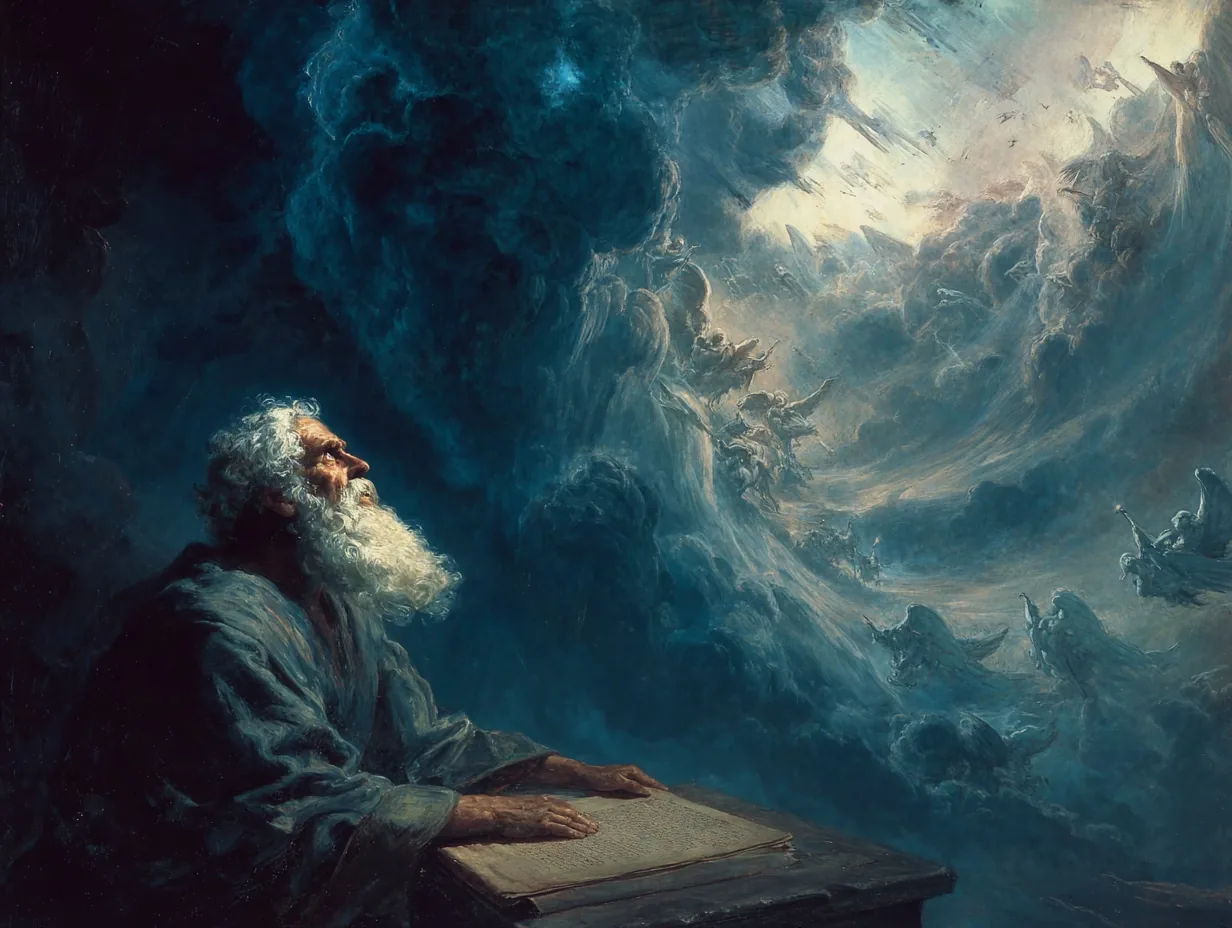
Archangel Uriel is the angel most readers meet in a footnote and nowhere else. His name appears in no book of the Protestant or Catholic Bible. Yet he speaks more than Gabriel in the ancient books that sit around it. He leads Enoch across the edges of the world, and later he argues with Ezra over the justice of God.
So the question is less who he was than where he went. Scribes copied and quoted the texts that gave him his voice, and then quietly dropped them. His name went with them. Following Archangel Uriel through those books shows what the early church kept, what it let go, and why.
The Name and the Missing Verse
The name means God is my light, from the Hebrew uri, my light, and El, God. Some writers render it flame of God instead, since the same root covers fire as well as light. Either way, the name tells you his job, because every text puts him in charge of something that shines.
Uriel never appears in the Hebrew Bible, however, and that absence shapes everything after it. Only Michael and Gabriel appear by name there, both in Daniel, while Raphael appears in Tobit. Archangel Uriel belongs instead to the books outside the canon, above all 1 Enoch and 2 Esdras. His reputation has risen and fallen with theirs.
Archangel Uriel in the Book of the Watchers
The oldest part of 1 Enoch, the Book of the Watchers, dates from the third century BC. Its story begins with angels who leave heaven for human women, a fall told in full in who are the Watchers. Four angels look down on the violence that follows, and chapter 9 names them as Michael, Uriel, Raphael and Gabriel.
In the Greek text of the chronicler George Syncellus, the Most High then sends Uriel to Noah. His message is plain: hide yourself, because a flood is coming to destroy the earth. The Ethiopic copies garble the messenger’s name at this point, yet most scholars accept the Greek reading.
Chapter 20 lists seven holy angels and gives each a task, a scheme traced in the angelic hierarchies of Enoch. Uriel comes first, as the angel set over the world and over Tartarus. Therefore he rules both the ordered cosmos and the prison beneath it, and the book uses him for both.
When Enoch reaches the place that binds the fallen angels, Uriel explains it to him. This place is the prison of the angels, he says in chapter 21. They will stay there for ever. Later he shows Enoch the gates through which the stars come out, and he writes their names down for him.
Archangel Uriel as Guide of the Luminaries
The Astronomical Book, chapters 72 to 82 of 1 Enoch, is even older than the Watchers story. It calls itself the book of the courses of the lights of heaven, which Uriel the holy angel showed to Enoch. The text makes Archangel Uriel the leader of those lights, so the sun, the moon and the stars answer to him.
What follows is an astronomy lesson rather than a vision of doom. Uriel explains the gates through which the sun rises, the waxing of the moon and the length of the year. His year has 364 days, exactly fifty-two weeks, and the reasoning appears in the study of the Enochic calendar.
That calendar mattered because festivals had to fall on the right days. A community that kept a different year from the Temple priests could not worship with them. The Dead Sea Scrolls show that some Jews did exactly that. Uriel, in other words, became the heavenly authority behind a very earthly quarrel about dates.
Near the end of the book, Uriel warns that sinners will not keep to his reckoning. In their days, he says, the years will grow shorter and the moon will change its order. Thus the angel of order also witnesses its breaking, and that dual role made him useful to later apocalypses.
Archangel Uriel and Ezra’s Hard Questions
The second great book of Uriel is 2 Esdras, whose central section dates from around AD 100. By then the Romans had destroyed the Temple, and the author writes as Ezra mourning an earlier ruin. He asks why God lets Babylon prosper while Zion lies waste, a question followed further in the eschatology of 2 Esdras.
God does not answer him directly. Instead the angel God sent to him, whose name was Uriel, replies with three tasks in 2 Esdras 4. He asks Ezra to weigh the fire, measure the wind and call back a day that has gone.
Ezra protests that no human being could do any of these things. Uriel turns the protest into his argument. If you cannot understand the things you grew up with, how could you grasp the way of the Most High? The dialogue runs on for several chapters, and Uriel never pretends that the answers are easy.
What he offers instead is time and patience. The age is hurrying to its end, he says, and the harvest cannot come before the sowing has finished. Later visions in the book, including the famous eagle vision, carry that promise forward into history. Later Ezra cries out, Where is the angel Uriel, who came to me at first? The angel returns and explains what he has seen.
Uriel at the Gates of the Dead
Outside these two books, Archangel Uriel appears in fragments that show how widely his name travelled. In the Greek Life of Adam and Eve, he joins Michael, Gabriel and Raphael at the burial of Adam. The same four names, in other words, guard the first man at his death.
The second book of the Sibylline Oracles gives him a darker task at the end of time. Uriel, the great angel, breaks the bars of the gates of Hades and leads the dead out to judgment. Here the angel set over Tartarus in 1 Enoch opens its doors, a consistent picture across very different authors.
Origen also quotes a lost text called the Prayer of Joseph, where Jacob speaks as an angel himself. In that fragment, Uriel comes out, envies Jacob and wrestles with him at the Jabbok. The idea did not last, yet it shows how freely writers moved Uriel into older stories.
Four Angels Around the Throne
Rabbinic tradition kept the same four names and gave them fixed positions. Numbers Rabbah places Michael on the right of the throne, Gabriel on the left, Uriel in front and Raphael behind. The same order survives in a bedtime prayer that many Jewish homes still recite, with God’s presence above the sleeper.
That prayer is the clearest trace of Uriel in living practice. It mirrors the camp of Israel in the wilderness. Uriel stands in front, where a traveler needs light to see the road ahead. Raphael, the angel of healing whom this blog met in the Book of Tobit, guards the back.
Jewish mysticism later gave the prominent heavenly roles to other figures, especially the transformed Enoch known as Metatron. Uriel remained a name of protection rather than a subject of speculation. His place in the prayer outlived most of the books that first described him.
Why the Western Church Dropped Archangel Uriel
In 745 a Roman synod under Pope Zachary examined a wandering preacher named Aldebert. His prayers invoked Uriel alongside Raguel, Tubuel and several other angels, and the synod condemned him. It ruled that Christians could name only Michael, Gabriel and Raphael, since only they appear in scripture.
The Frankish church repeated the rule in 789, forbidding prayers to angels whose names were unknown. As a result, Uriel vanished from Western liturgy, although he stayed in manuscripts, legends and art. The Catholic Encyclopedia still summarizes this tradition in its article on angels, which treats only the three names as scriptural.
The Eastern churches took a different path. Orthodox calendars count Uriel among the archangels honored on the feast of the heavenly powers in November. The Ethiopian Orthodox Church still reads 1 Enoch as scripture and keeps feasts in his honor. There the angel lives on, because the church never dropped his books.
From Milton’s Sun to Leonardo’s Rocks
Protestant England met Uriel again in poetry, largely thanks to John Milton. In Paradise Lost he is the regent of the sun, one of the seven who stand nearest the throne. Milton calls him the sharpest-sighted spirit in heaven, which is an echo of the Enochic guide of the lights.
Yet Satan fools Milton’s Uriel, disguised as a young cherub who asks the way to Eden. Uriel points him there, and only later sees through the disguise and warns Gabriel. It is a striking choice, since the angel of light becomes the one who cannot see hypocrisy.
Painters kept him as well, sometimes without naming him. Many viewers identify the kneeling angel in Leonardo’s Virgin of the Rocks as Archangel Uriel. A late legend says he guided the infant John the Baptist to safety in Egypt. The Wikipedia entry on Uriel lists it among many later traditions.
Frequently Asked Questions
Is Uriel mentioned in the Bible? Not in the Protestant or Catholic canon, since only books outside it name Uriel. He speaks in 1 Enoch, which Ethiopian Christians count as scripture, and in 2 Esdras, which many Bibles print among the Apocrypha.
What is Uriel the archangel of? In the oldest texts he governs the sun, the moon and the stars, and he stands over Tartarus. His name means God is my light, so later writers made him the angel of wisdom and illumination.
Why does the Catholic Church not recognize Uriel? A Roman synod in 745 allowed prayers only to the three angels that scripture names. Uriel was not one of them, so he dropped out of Western prayer.
How does Uriel differ from Michael and Gabriel? Michael fights and Gabriel announces, while Uriel explains. In both Enoch and 2 Esdras his work is teaching a human being to understand what he sees.
Archangel Uriel: What Remains
What survives of Archangel Uriel is mostly a voice, patient and precise, facing questions with no easy answer. He shows Enoch how the heavens run and shows Ezra how little a human mind can hold. Both lessons point the same way, towards an order larger than the person asking.
That may be why his name outlived the books that carried it. The church could drop the books from its canon and the name from its prayers. It could not easily drop the figure who stands in front, holding the light, while the reader walks through the dark.
Check out the author’s book here: The Books of Enoch.



Leave a Reply