
Around 1904, German explorers dug through the ruins of an old oasis town called Turfan, on the Silk Road in what is now western China. Among the dust, however, they found scraps of paper in several scripts and languages. Some of them told a strange story about giants, angels and a prophet named Enoch. They were pages of the Manichaean Book of Giants.
Scholars later saw that these scraps came from the Manichaean Book of Giants. It was a book of the religion founded by Mani, a prophet from third-century Persia. Its story, though, was much older than Mani. It went back to Jewish writings about the Watchers, the fallen angels of the Book of Enoch. So how did a Jewish tale end up in Central Asia, in Persian dress? Here is the road it took.
Who Was Mani?
Mani was born in 216 CE near Ctesiphon, in what is now Iraq. At the time, the region belonged to the Persian Empire. He grew up in a Jewish-Christian baptist group, and in his twenties he said an angel had shown him a new revelation.
He called himself the Apostle of Light. In his eyes, Zoroaster, the Buddha and Jesus had each brought part of the truth, and he had come to bring all of it. Most founders of religions left the writing to their followers. Mani, by contrast, wrote his own books, so that nobody could twist his message later. The Book of Giants, called Kawan in Middle Persian, was one of them.
At the heart of his teaching lay a sharp dualism. Two powers, Light and Darkness, had always existed. At some point Darkness attacked Light and swallowed part of it. Our world, in Mani’s view, is the result of that mixture, with bits of Light trapped in matter. Salvation means setting that Light free. You can read more about Mani’s religion and how far it spread.
The Jewish Roots of the Manichaean Book of Giants
The story did not begin with Mani. Genesis 6 has four short verses about the sons of God, who took human wives and fathered the Nephilim, the mighty men of old. You can read them in Genesis 6. Yet the passage raises many questions and answers almost none.
Jewish writers of the Second Temple period filled that gap. The Book of Enoch tells how two hundred Watchers came down on Mount Hermon, married women and taught forbidden skills. Their children, in turn, were giants who ate everything in sight and then turned on people. The Enoch-Nephilim connection follows that story in detail.
A separate Aramaic work, now called the Book of Giants, told the same events from the giants’ side. For a long time scholars knew it only through the Manichaean scraps. Then, in the 1970s, the scholar J. T. Milik identified pieces of it among the Dead Sea Scrolls. So Mani had not made the story up. He had taken an old Jewish book and made it his own. The Qumran Book of Giants looks at that earlier version.
Gilgamesh Among the Giants
One surprise in both versions is a familiar name. Among the giants stands Gilgamesh, the king of Uruk and hero of the oldest epic in the world. Next to him is Hobabish, whose name seems to echo Humbaba, the forest monster Gilgamesh kills.
In the Book of Giants, however, Gilgamesh is no hero. He is one of the Nephilim, a son of the fallen angels, and he is afraid. The Jewish authors seem to have borrowed names from Mesopotamian stories that were still well known in their day. Gilgamesh in the Book of Giants explores why they did it.
Two more giants play a leading role. Ohya and Hahya are brothers, the sons of the Watcher Shemihazah. When the story moved east, Persian readers gave them new names. In the Middle Persian fragments they became Sam and Nariman, the names of heroes from Iranian legend.
The Dreams in the Manichaean Book of Giants
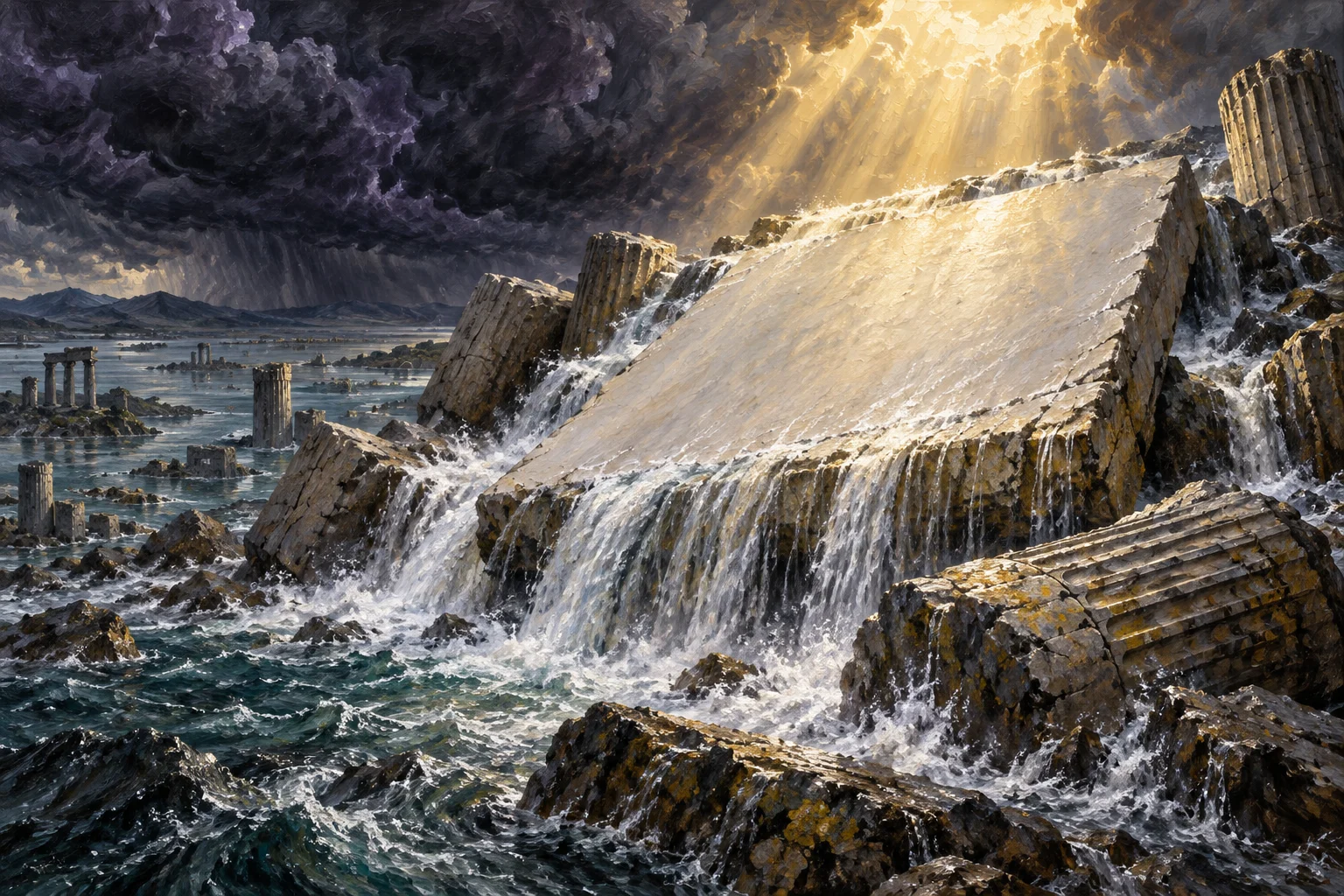
The best-known part of the story is a set of dreams. The giants begin to have nightmares, and they sense that something terrible is coming. In one dream, a great tablet sinks under water. When it rises again, almost every name on it has been washed away.
In another dream, angels come down to a garden and cut down its trees, leaving only one tree with three branches. The giants cannot read these signs on their own. So they send one of their own, a giant named Mahaway, to find Enoch, who lives far away at the edge of the world.
Mahaway flies across the desert to reach him. Enoch then gives a clear and grim answer. The dreams point to the Flood, and it will destroy the giants and punish their fathers. Dreams of the Nephilim looks at each vision in turn.
The giants react in different ways. Some despair, some boast, and some want to fight on. For a moment, readers see them as frightened creatures, not just monsters. That is the most human touch in the whole tale.
How Mani Read the Watchers
Mani kept the plot but changed its meaning. In the Jewish book, the Watchers break the order God set for the world, and the Flood is his judgment. In the Manichaean Book of Giants, the Watchers become demons of Darkness, part of the great war between the two powers.
The giants, in turn, stand for matter at its worst. Their bodies hold trapped Light, and their greed and lust keep it locked away. So when the Flood destroys them, it does more than punish. It also sets that Light free.
This reading had a practical side too. Mani’s religion had two levels of believers. The Elect lived a strict life with no meat, no wine and no sex, while the Hearers supported them. As a result, the giants served as a warning to both. Unchecked desire, the story says, keeps the Light in chains.
From Syria to China
Mani wrote in Syriac, a form of Aramaic. His followers, though, travelled far. They carried the Manichaean Book of Giants and his other works west to Egypt and Rome and east along the trade routes to Central Asia and China.
As the book moved, it changed language. The Turfan finds include pieces in Middle Persian, Parthian, Sogdian and Uighur. Each translator also adjusted the story a little for new readers. That is why Iranian hero names appear where the Aramaic had Jewish ones.
In Central Asia, the religion lasted for centuries. For a time in the eighth century, the Uighur rulers even made it their state faith. So for about a thousand years, people from Egypt to China read the tale of the giants as holy scripture. Few Jewish books ever travelled that far.
What Survives of the Manichaean Book of Giants
No full copy of the book exists today. What we have are torn pages from Turfan, some no bigger than a playing card. Many of them came from monastery libraries that were burned or simply left to the sand. The German teams took them to Berlin, where scholars spent decades sorting them out.
In 1943 the scholar Walter Bruno Henning gathered the known pieces and published them together. For the first time, readers could follow the outline of the Manichaean Book of Giants. Even then, large gaps remained, and the order of some scenes is still a guess.
Meanwhile, a few more clues come from Egypt. Coptic Manichaean texts found there quote the book and mention the Watchers and their sons. Christian writers who attacked Mani also named it among his works. Taken together, these sources confirm that the book was widely read.
Then came the Dead Sea Scrolls. Once Milik matched the Aramaic scraps to the Turfan ones, scholars could compare the two. The Jewish text helps fill holes in the Persian one, and the Persian text helps explain the Jewish one. Each version, in other words, lights up the other.
Why the Manichaean Book of Giants Still Matters
Only fragments survive, so every account of the book is partly a reconstruction. Even so, the scraps teach something important. Stories move. They cross languages, empires and faiths, and each new community retells them for its own needs.
The Manichaean Book of Giants shows this better than almost any other text. A few lines in Genesis grew into a Jewish legend, took in Mesopotamian heroes, and then became part of a Persian world religion. Giants in ancient texts shows how common such stories were across the ancient world.
It also reminds us that the line between scripture and apocrypha has shifted over time. For most Jews and Christians, the Book of Giants never became sacred. For Mani’s followers, it was scripture for centuries. The giants never survived the Flood, but their story did.
Check out the author’s book here: The Book of Giants.

Leave a Reply