
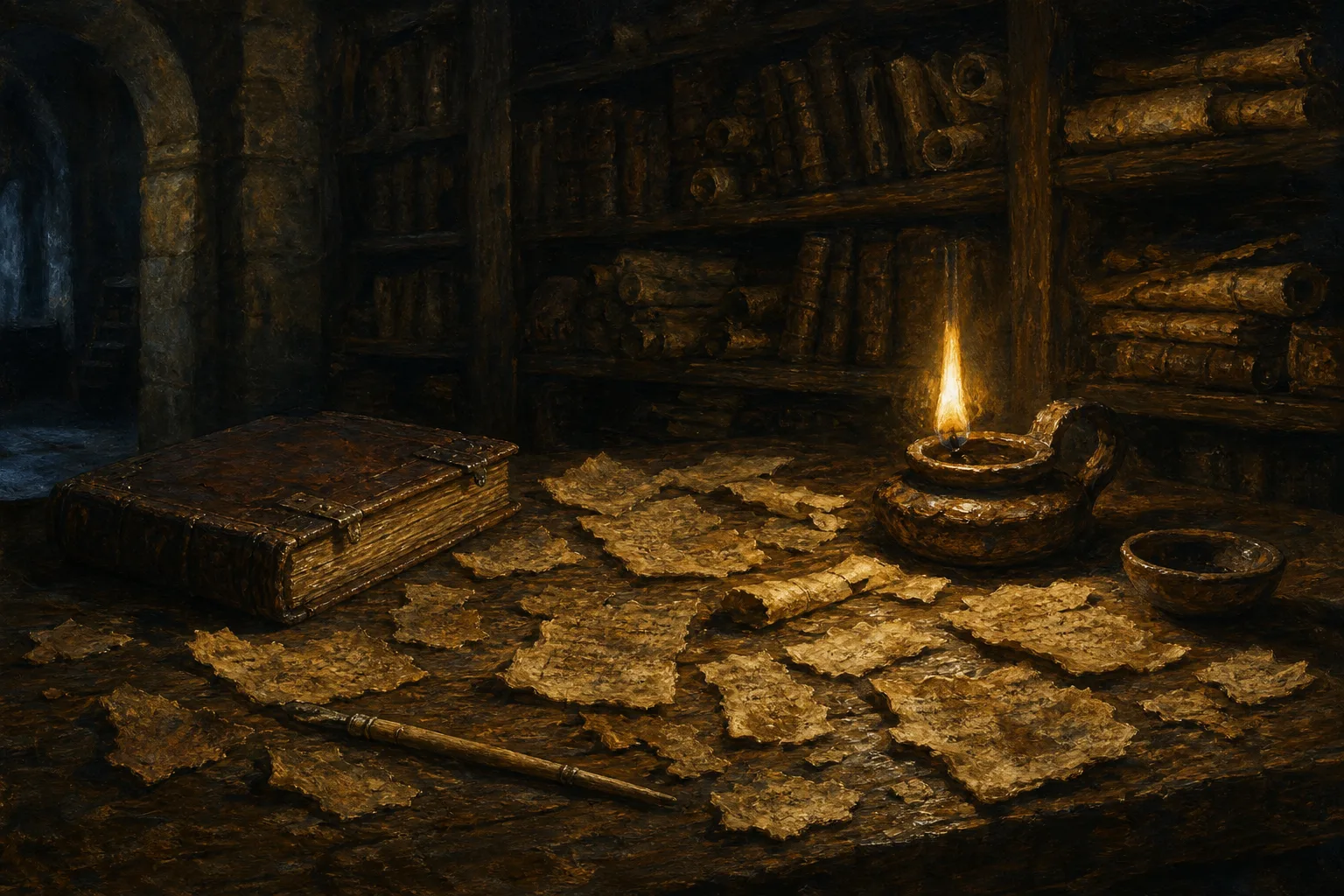
The Gospel of the Hebrews is a book that nobody has read for fifteen hundred years. No manuscript survives, not even a scrap of papyrus. What we have instead is a handful of sentences in the works of church writers. They clearly knew the book and sometimes admired it.
Those sentences are strange enough to matter. In one, Jesus calls the Holy Spirit his mother. In another, the risen Lord appears first to his brother James, not to Peter or Mary Magdalene. And a famous scholar of the fourth century insisted that he had translated the whole book himself.
A Gospel Known Only by Quotation
Like many lost works, the Gospel of the Hebrews lives on only through other books. Clement of Alexandria quotes it around AD 200, and Origen quotes it a generation later. Eusebius mentions it in his history of the church, and Jerome cites it more often than anyone else.
Each of these writers saw the text or knew someone who had. Yet none of them copied more than a few lines, so the reconstruction depends on a small set of fragments. A Byzantine list of books, the Stichometry of Nicephorus, gives its length as 2,200 lines, only a little shorter than Matthew.
Most scholars now date the Gospel of the Hebrews to the first half of the second century. They place it in Egypt, among Greek-speaking Christians of Jewish background. Its name probably marks its readers, not its language, much like the Gospel of the Egyptians, which served another Egyptian community.
The Saying Clement Shared With Thomas
Clement quotes a short saying twice in his Stromateis, and the first time he credits it to this gospel. He who wonders shall reign, it runs, and he who has reigned shall rest. His longer version adds seeking and finding at the start of the chain.
Readers of the Gospel of Thomas will recognize it at once. Saying 2 of Thomas uses almost the same steps: seek, find, be troubled, marvel, and then rule over all. This blog looks at that collection in the sayings of the Gospel of Thomas, and the overlap is striking.
The shared saying does not mean that one gospel copied the other. More likely, both drew on a stock of sayings that circulated orally in the early churches. Still, it shows that the lost gospel belonged to the same world of wisdom sayings, where knowing is a path rather than a creed.
Clement read widely in such material, and he even quoted a longer version of Mark that most churches never saw. That story appears in the Secret Gospel of Mark. His use of Hebrews carries no warning, so he apparently found nothing dangerous in it.
My Mother, the Holy Spirit
The most famous fragment comes through Origen, who quotes it in his commentary on John. Jesus speaks in the first person about a moment of rapture. Even so did my mother, the Holy Spirit, take me by one of my hairs and carry me away to the great mountain Tabor.
The image echoes Ezekiel, whom a hand lifts by a lock of hair. It probably also recalls the temptation on the mountain. What surprises modern readers is the word mother. In Hebrew and Aramaic, the word for spirit, ruach, is feminine. A Jewish-Christian writer could picture the Spirit as a woman without strain.
Origen himself treats the line with care rather than alarm. He explains how the Spirit could count as a mother of Christ, since whoever does the will of the Father is brother, sister and mother. Jerome later quotes the same line in his commentaries on Micah and Isaiah.
The Baptism in the Gospel of the Hebrews
Jerome preserves a second scene that also centers on the Spirit, this time at the Jordan. In this account, the whole fountain of the Holy Spirit comes down and rests on Jesus. Then the Spirit speaks to him directly, calling him her son.
My son, in all the prophets I was waiting for you, that you might come and I might rest in you. The sentence turns the baptism into a homecoming. The Spirit has searched through every prophet and only now finds a place to stay. It reworks the old picture of Wisdom seeking a dwelling.
Here again, the Gospel of the Hebrews sounds closer to Jewish wisdom books than to later creeds. There is no dove and no voice from heaven announcing a beloved son. Instead the Spirit rests, and rest is the same reward that the Clement saying promised to the one who seeks.
James the Just and the First Appearance
Jerome’s most important quotation appears in his Lives of Illustrious Men, in the chapter on James. According to the lost gospel, James had sworn an oath at the Last Supper. He would eat no bread until he saw the Lord risen from the dead.
After the resurrection, Jesus gives his linen cloth to the servant of the priest and goes to James. He calls for a table and bread, then blesses the bread, breaks it and hands it to his brother. My brother, eat your bread, he says, for the Son of Man has risen from among those who sleep.
The scene makes James the first witness of the resurrection, a role the canonical gospels never give him. Paul does list an appearance to James in 1 Corinthians 15, yet he places it later. The fragment therefore reflects a community that looked to James as its leader, much like the Apocryphon of James in a very different setting.
Jerome’s full chapter survives in English on New Advent’s edition of his Lives, and it rewards a slow reading. The meal is also a Eucharist in miniature, since the risen Lord takes, blesses, breaks and gives. Thus the oath, the fast and the bread all tie the family of Jesus to the table of the church.
Why Scholars Doubt Jerome’s Claim
Jerome says he found the book in the library at Caesarea, which the martyr Pamphilus had built up. He adds that the Nazarenes of Beroea in Syria let him copy it. Elsewhere he claims that he translated it into Greek and Latin, and that many people thought it was the original Matthew.
Modern scholars have grown skeptical about each of these claims. Jerome quotes the book in ways that conflict with one another, and some fragments he cites are clearly Greek in origin. He may have seen only parts, or he may have borrowed from earlier writers such as Origen and passed off their notes as his own.
Most specialists now divide the evidence among three separate Jewish-Christian gospels. Alongside the Hebrews gospel, they place a Gospel of the Nazarenes, an Aramaic text related to Matthew. They add a Gospel of the Ebionites, a Greek harmony known from Epiphanius. Jerome, it seems, blended material from more than one book under a single title.
The debate still continues, and the Wikipedia overview of the Gospel of the Hebrews sets out the main positions. Some scholars keep a simpler model with fewer books. Nevertheless, most agree that Jerome’s claim to a full translation is at best exaggerated.
Where the Gospel of the Hebrews Fell Out
Eusebius, writing around 325, sorted Christian books into accepted, disputed and spurious. He noted that some readers placed it among the disputed books. He also remarked that Hebrews who had accepted Christ took special delight in it.
Eusebius also reports that Papias told a story of a woman accused of many sins before the Lord. He adds that the Hebrews gospel contained the same story. Many scholars link it with the woman taken in adultery, the passage that later entered John 8 in many manuscripts.
That means one small piece of the lost book may survive inside the Bible itself. The rest faded with the Jewish-Christian communities that read it. As the church grew more Gentile, these readers became a minority and scribes stopped copying their books, as with many texts discussed in the non-canonical gospels.
Frequently Asked Questions
Is the Gospel of the Hebrews the same as the Book of Hebrews? No. The Letter to the Hebrews is in the New Testament and tells no story of Jesus. The Gospel of the Hebrews was a separate narrative gospel that survives only in quotations.
Who quoted the Gospel of the Hebrews? Clement of Alexandria, Origen, Eusebius and Jerome all refer to it. Jerome cites it most often, although his claims about the book are doubtful.
Why does it call the Holy Spirit a mother? In Hebrew and Aramaic the word for spirit is feminine. A Jewish-Christian author could therefore picture the Spirit as a mother without any sense of novelty.
Is it related to the Gospel of Thomas? The two share at least one saying about seeking, finding and resting. Most scholars think both drew on common oral tradition rather than on each other.
Gospel of the Hebrews: What Remains
What remains of the Gospel of the Hebrews fits on a single page. A mother Spirit lifts Jesus by his hair, rests on him at the Jordan and calls him her son. A brother breaks a vow of fasting over bread that the risen Lord blesses.
Those few lines still change the picture of early Christianity. They show a community that thought of James first and of the Spirit as family. Although their gospel is lost, the scraps other writers kept let readers hear that community speak.
Check out the author’s book here: The Gospel of Thomas.

Leave a Reply