
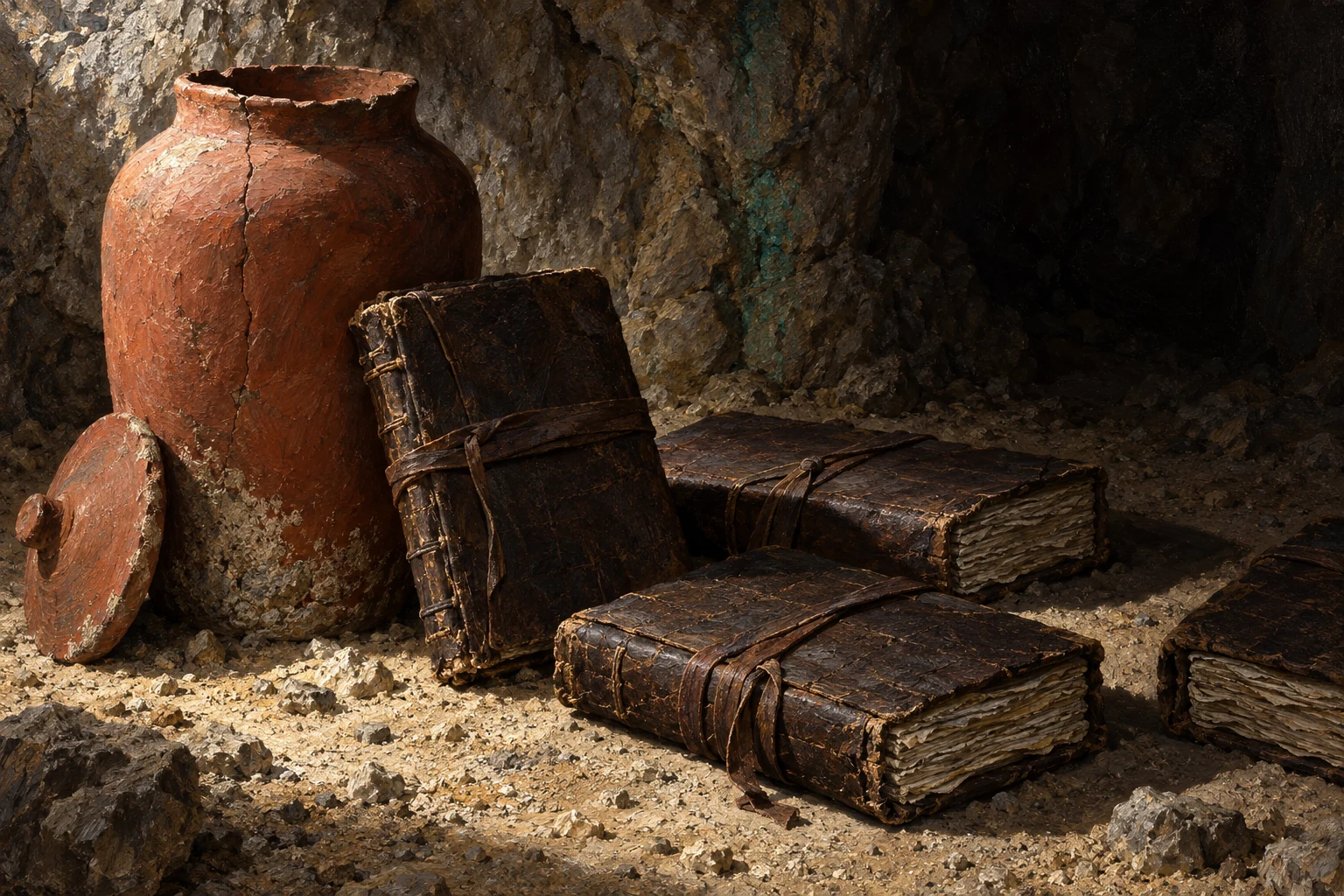
The Gospel of Thomas Sayings preserve 114 cryptic statements attributed to Jesus, without stories of his crucifixion, miracles, or resurrection. Buried in the Egyptian desert for more than 1,600 years, this collection confronts readers with poetic riddles instead of biography. Consequently, the work challenges familiar assumptions about early Christianity while inviting careful interpretation rather than easy certainty.
Scholars and spiritual seekers have called this work a “Fifth Gospel” since the Nag Hammadi discovery in 1945. Unlike canonical Matthew, Mark, Luke, and John, Thomas concentrates entirely on wisdom attributed to Jesus. Therefore, its secret words emphasize inner knowledge, or gnosis, more strongly than external dogma, sacrament, or a continuous account of salvation history.
How the Gospel of Thomas Sayings Reached Modern Readers
The complete Coptic text survives in Codex II from the Nag Hammadi library, which farmers discovered in Upper Egypt in 1945. Earlier Greek fragments from Oxyrhynchus preserve portions of the same collection, although wording and order sometimes differ. For manuscript details and translations, the Gnostic Society Library presents the text alongside information about its recovery.
Scholars generally place the collection’s present form in the mid-second century, yet some individual traditions may reach back into the first century. Consequently, no single date settles the age of every logion, because editors may have gathered older and younger material. Early Christian Writings summarizes the broad dating debate and supplies links to major scholarly positions.
The evidence suggests a complex path through Greek-speaking and Coptic-speaking Christian communities in Roman Egypt. However, scholars also discuss Syrian settings because Thomas traditions held particular importance in Syriac Christianity. Hellenistic philosophy, Jewish wisdom, and Second Temple expectations all shaped the wider culture in which early Christians interpreted Jesus.
The opening attribution names Didymos Judas Thomas, whose titles both carry the sense of “twin” in Greek and Syriac usage. Nevertheless, the attribution does not establish authorship, and scholars do not treat it like a modern signature. Who wrote the Gospel of Thomas? considers the traditional name and the anonymous editorial process behind the collection.
A Sayings Gospel Built Around Hidden Wisdom
Thomas belongs to the genre commonly called a sayings gospel, much like the hypothetical Q source proposed behind Matthew and Luke. It strings together logia rather than arranging a narrative from ministry through death and resurrection. However, the collection’s theology remains distinct, and its terse sequence forces readers to perform much of the connecting work themselves.
The first logion announces that interpretive task immediately. In Thomas O. Lambdin’s Nag Hammadi Library translation, Gospel of Thomas Logion 1 reads:
“And he said, ‘Whoever finds the interpretation of these sayings will not experience death.’” — Gospel of Thomas, Logion 1
Here salvation appears through intellectual and spiritual interpretation, rather than through explicit faith in Jesus’ sacrifice. Therefore, the sayings function as riddles or keys whose meanings promise eternal life to successful seekers. This emphasis resembles gnostic traditions that diagnose ignorance, rather than sin alone, as humanity’s central problem.
Still, calling the whole document “Gnostic” can hide important differences among ancient schools and modern definitions. The text lacks the elaborate creation myths found in several Nag Hammadi works, including rulers, aeons, and a detailed fall from the Pleroma. Accordingly, Is the Gospel of Thomas Gnostic? weighs its affinities without forcing every logion into one system.
Gospel of Thomas Sayings About the Present Kingdom
One revolutionary feature concerns the Kingdom of God and the moment when people may encounter it. Canonical Gospels often portray a future event connected with judgment and the end of time, although they also contain present dimensions. In contrast, Thomas repeatedly directs attention toward a reality already present but commonly unnoticed.
Consider the disciples’ question about timing. In Thomas O. Lambdin’s Nag Hammadi Library translation, Gospel of Thomas Logion 113 reads:
“His disciples said to him, ‘When will the kingdom come?’ Jesus said, ‘It will not come by waiting for it. It will not be a matter of saying “here it is” or “there it is.” Rather, the kingdom of the father is spread out upon the earth, and men do not see it.’”
This answer shifts attention from apocalyptic chronology toward perception, psychology, and spiritual readiness. According to this reading, paradise does not merely await the faithful after death; it resembles a frequency available during life. Consequently, the seeker must cleanse perception and recognize the divinity that already permeates the world.
Yet the contrast with canonical literature should not become absolute. Canonical Luke also places the kingdom among or within its hearers, depending on the translation of Luke 17:21. Nevertheless, Thomas removes that insight from Luke’s narrative setting and lets it stand as a self-contained challenge about seeing.
That editorial choice changes how readers experience the teaching, even when individual words resemble canonical parallels. What is the Gospel of Thomas saying? offers another route through these elusive images. Without an approaching Passion, however, attention falls upon recognition rather than unfolding sacred history.
The Divine Spark, Light, and Inner Transformation
Some famous and controversial passages locate saving possibility within the hearer. While orthodox Christianity usually stresses a distinction between Creator and creature, Thomas sometimes seems to bridge that distance. Therefore, interpreters often connect its inward language with the divine spark and knowledge that liberates the human soul.
In Thomas O. Lambdin’s Nag Hammadi Library translation, Jesus speaks about inner disclosure in Gospel of Thomas Logion 70:
“That which you have will save you if you bring it forth from yourselves. That which you do not have within you will kill you if you do not have it within you.”
The saying never identifies what the hearer has within, so readers may understand it as truth, self-knowledge, divine identity, or moral integrity. However, every option makes transformation depend upon bringing something concealed into conscious life. The aphorism therefore encourages active discovery, while its ambiguity prevents one final explanation from controlling every use.
The language of light makes this inward reading still more expansive. In Thomas O. Lambdin’s Nag Hammadi Library translation, Gospel of Thomas Logion 77 reads:
“It is I who am the light which is above them all. It is I who am the all. From me did the all come forth, and unto me did the all extend. Split a piece of wood, and I am there. Lift up the stone, and you will find me there.”
Some interpreters describe this vision as panentheism, the idea that God dwells in everything while also exceeding everything. Moreover, gnostic readings see divine light trapped within matter and the human soul, awaiting liberation through recognition. Gnostic teachings in the Gospel of Thomas develops that interpretation while acknowledging the text’s resistance to simple labels.
Canonical Parallels and Apocryphal Differences
Matthew, Mark, Luke, and John form the canonical Gospel collection in the New Testament. By contrast, the church did not include Thomas in that canon, so scholars classify it as an apocryphal gospel. The work also uses pseudonymous attribution because its title connects the collection with Thomas, although historians cannot verify that apostle as its author.
Many sayings share images with canonical Matthew and Luke, including seeds, sheep, lamps, and divided households. However, Thomas often changes an emphasis or removes a narrative frame, which can alter a parable’s force. The table preserves three important comparisons and shows why shared imagery does not guarantee identical interpretation.
| Parable / Saying | Canonical Version (Matthew/Luke) | Gospel of Thomas Version |
|---|---|---|
| The Lost Sheep | God leaves the 99 to save the 1 sinner out of love/pity. | The shepherd loves the 1 distinct sheep more because it is “large” (Logion 107). |
| The Sower | Focuses on the reception of the word (soil types). | Focuses simply on the scattering of the seed and the inevitable yield (Logion 9). |
| The Mustard Seed | A symbol of the Kingdom’s growth from small to large. | A symbol of the “unshakeable” nature of the Kingdom rooted in the self (Logion 20). |
In the lost sheep story, a gnostic interpretation treats the single large sheep as an elect person who attained knowledge. That reading differs from the canonical emphasis on rescuing a sinner through divine love or pity. Consequently, critics find elitism here, a feature that also appears in other literature centered on privileged revelation.
Comparison should include more than the canonical Bible, because early Christians produced many apocryphal and pseudepigraphal writings. The Gospel of Mary, the Gospel of Philip, and the Apocryphon of John also explore revelation outside canonical narrative boundaries. However, Thomas remains unusual because it offers almost no plot and no developed myth of heavenly realms.
Apocalyptic texts such as canonical Revelation and pseudepigraphal 1 Enoch disclose cosmic conflict through visions, angels, and final judgment. Thomas instead makes revelation sound like insight hidden inside ordinary speech, bodies, fields, houses, and stones. Therefore, its eschatology often feels realized and inward, even when individual sayings retain urgency about life and death.
Making the Two One in an Ancient Symbolic World
A recurring theme asks hearers to make the two one by overcoming divisions between inside and outside, above and below. Readers often connect this language with non-duality, although ancient symbolism does not map neatly onto modern spiritual categories. The saying links entrance into the kingdom with reintegration and a return toward primordial unity.
In Thomas O. Lambdin’s Nag Hammadi Library translation, Gospel of Thomas Logion 22 presents the exchange this way:
“Jesus saw infants being suckled. He said to his disciples, ‘These infants being suckled are like those who enter the kingdom.’ They said to him, ‘Shall we then, as children, enter the kingdom?’ Jesus said to them, ‘When you make the two one, and when you make the inside like the outside and the outside like the inside, and the above like the below… then will you enter [the kingdom].’”
Here infants symbolize an existence before rigid distinctions fragment experience into opposing categories. Accordingly, an enlightened gnostic seeks an undivided state and a return to the Pleroma, or Fullness. Other readers instead emphasize ethical integrity, since making inside and outside alike can mean ending hypocrisy or divided intention.
Gender makes this theme especially difficult in Logion 114, which speaks about making Mary “male” so she can enter the Kingdom. To modern ears, the language sounds plainly misogynistic and deserves serious criticism. Yet ancient symbolic systems often associated female identity with matter and division, while they associated male identity with spirit and unity.
Why the Collection Remained Outside the Bible
Three related concerns help explain its place outside the canon:
- Although some sayings may reach the first century, scholars generally date the collection’s present form to the mid-second century.
- Church Fathers such as Irenaeus opposed private intellectual salvation that bypassed church authority, sacraments, and the cross.
- Several sayings imply disdain for the physical body, while orthodox Christianity affirms creation’s goodness and physical resurrection.
The first issue concerns authorship as well as date, because apostolic attribution carried greater weight when churches evaluated texts. Therefore, Thomas lacked the secure apostolic pedigree that communities granted the four canonical Gospels. Why the Gospel of Thomas is not in the Bible explains this gradual process without reducing it to conspiracy.
The third issue concerns embodiment and resurrection. In Thomas O. Lambdin’s Nag Hammadi Library translation, the first clause of Gospel of Thomas Logion 112 reads:
“Woe to the flesh that depends on the soul,”
Such language can suggest rejection of the body, especially beside texts that portray matter as a prison for divine light. In contrast, canonical Christian teaching affirms creation and expects physical resurrection, even while Paul also describes conflict between flesh and spirit. Thomas therefore participates in a wider ancient argument rather than presenting an uncontested gnostic formula.
Frequently Asked Questions
Did Jesus really speak these sayings?
Scholars usually see a mixture of potentially authentic early sayings, modified traditions, and later gnostic inventions attributed to Jesus. Therefore, each logion requires separate comparison rather than one verdict for the entire collection.
What does the “solitary” mean in Thomas?
The solitary or single one, monachos, describes someone undivided in heart and mind who achieved internal unity. Moreover, the same Greek term stands behind the English word “monk.”
Does the Gospel of Thomas oppose women?
Logion 114 sounds misogynistic on its surface, although symbolic readings connect “female” with matter and “male” with spirit. However, historical symbolism explains the hierarchy without requiring modern readers to excuse it.
Where can readers find the complete text?
The Gnostic Society Library provides a complete translation online, while manuscript discussions help readers compare Coptic and Greek evidence. Reading the Gospel of Thomas Sayings directly allows the riddles to resist secondhand summaries.
Keep Thinking About the Secret Words
The collection remains a spiritual Rorschach test: some find early mystical teaching, while others hear a distorted Christian echo. Regardless of theology, its contradictions reward patient reading and active inquiry rather than passive agreement. The text also asks why some memories became canonical scripture while other voices survived among the apocrypha.
The search itself appears in one of the collection’s best-known invitations. In Thomas O. Lambdin’s Nag Hammadi Library translation, Gospel of Thomas Logion 2 reads:
“Let him who seeks continue seeking until he finds. When he finds, he will become troubled. When he becomes troubled, he will be astonished, and he will rule over the all.”
Ultimately, unlocking the Gospel of Thomas Sayings involves more than solving an ancient puzzle about the historical Jesus. It also means confronting the mystery of self-knowledge, the limits of institutions, and the meanings readers bring to hidden speech. Finally, these sayings invite continuing thought because their sharpest questions remain open after every proposed answer.
Check out the author’s book here: The Gospel of Thomas.

Leave a Reply