
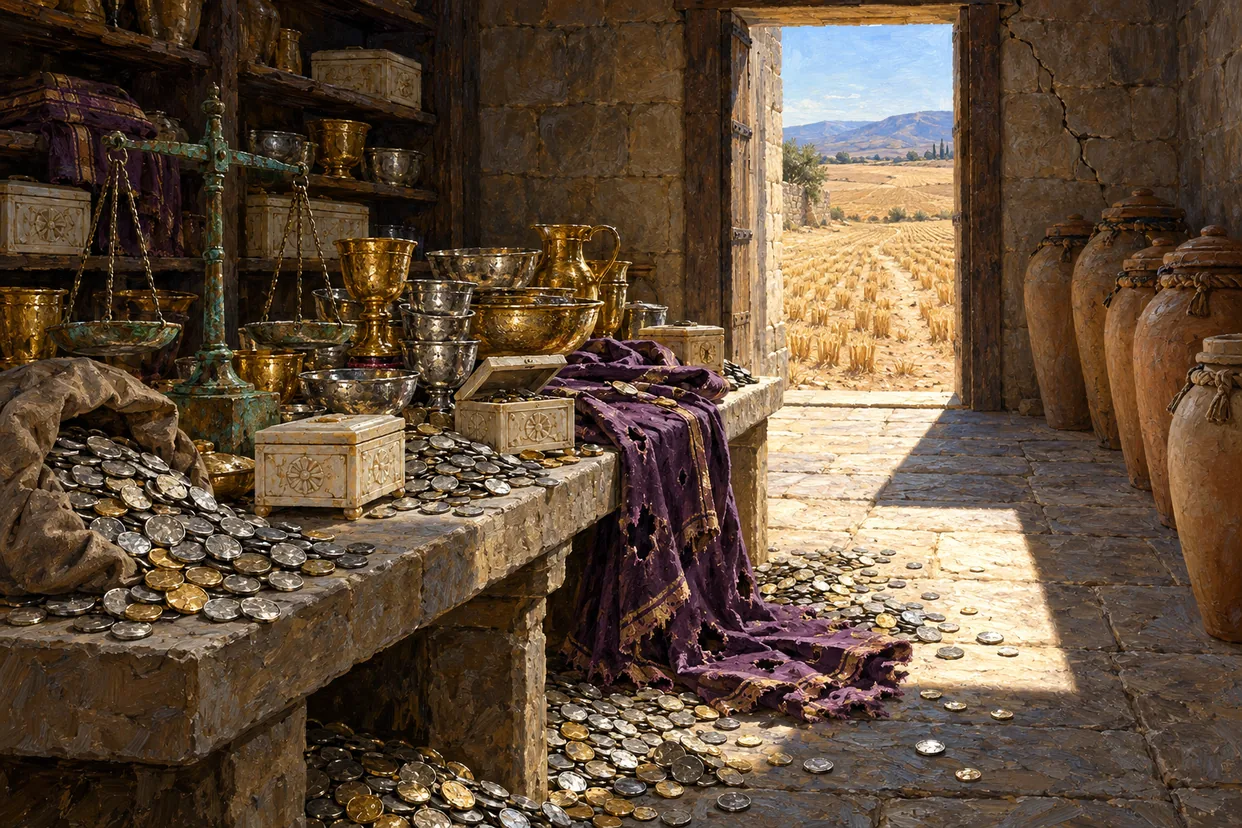
The day after Thanksgiving has become the busiest shopping day of the American year. Stores open before dawn, crowds wait in the cold, and the talk is all of bargains, deals and full carts. It is a strange moment, then, to open one of the angriest texts ever written about wealth.
That text is the Epistle of Enoch, the last major section of the Ethiopic Book of Enoch. It is not a letter in the modern sense. Instead, it is a long speech that Enoch addresses to his children and to the generations after them. At its heart stands a series of woes, blunt curses aimed at the rich and the powerful who grow fat on the labor of others.
What Is the Epistle of Enoch?
1 Enoch is not one book but a library of five, written over several centuries. First comes the Book of the Watchers, with the fallen angels and the giants. After it follow the Parables, the Astronomical Book and the Dream Visions. The Epistle of Enoch closes the collection, and it runs roughly from chapter 91 to chapter 105. Two short appendices about the birth of Noah and a final exhortation complete the book.
The Epistle has a different tone from the rest. There are few angels, no tours of heaven and almost no astronomy. In their place we find ethical preaching, sharp and repetitive, of the kind that a prophet might deliver in a marketplace. Our overview of Book of Enoch Prophecies shows how the five parts fit together.
The Epistle also contains a famous vision of history divided into ten weeks. That passage has its own study in Enoch’s Ten Weeks Prophecy. Here we will focus on the other half of the work, the part that speaks about money.
When and Where It Was Written
Most scholars date the Epistle of Enoch to the second century BCE, before or around the Maccabean revolt. Aramaic fragments of it turned up among the Dead Sea Scrolls at Qumran, so it was certainly circulating in Judea by the first century BCE. Moreover, a Greek papyrus from the fourth century CE preserves a large part of the text, from chapter 97 to chapter 107.
The complete work survives only in Ge’ez, the classical language of Ethiopia. There the Book of Enoch belongs to the Bible of the Ethiopian Orthodox Church. Readers can consult the classic English translation by Robert Henry Charles, chapter by chapter, on Wikisource.
The social world behind the text is easy to imagine. Judea in this period lived under foreign rulers, first the Ptolemies of Egypt and then the Seleucids of Syria. Consequently, a small class of landowners, tax farmers and officials grew rich, while many small farmers lost their land. The author writes for those who have lost, and he speaks for them with fury.
The Woes Against the Rich in the Epistle of Enoch
The woes begin in chapter 94 and return again and again until chapter 100. Their form is simple: a curse, a description of the sin, and a threat of judgment. Some of them target violence or false teaching, yet the most memorable ones concern wealth.
“Woe to you, ye rich,” says Enoch, “for ye have trusted in your riches, and from your riches shall ye depart.” The problem is not simply that these people own things. Rather, the text says, they have not remembered the Most High in the days of their riches. Their wealth has taken the place of God.
Another woe condemns those who build their houses with sin. A later one goes further and curses those who build their houses through the grievous toil of others. In this picture, every brick and stone of the rich man’s home carries the sweat of someone he has not paid.
The Epistle of Enoch also mocks the luxury that wealth buys. It speaks of those who devour the finest of the wheat and drink wine in large bowls, while they tread the lowly underfoot. Elsewhere it complains that men now wear more jewelry than women and more colored garments than a young bride. Silver, gold and purple, it says, will be poured out like water.
The Rich Man’s Boast
The most vivid woe, in chapter 97, lets the rich speak for themselves. They say, in effect: we have become rich with riches and we have possessions. We have acquired everything we desired, and now let us do what we planned. After all, our silver is gathered, our servants are many and our granaries are full to the brim.
Enoch replies with a play on the image of water. Your granaries are full as with water, he says, but like water your lies will flow away. Your riches will not stay with you, because you acquired them all in unrighteousness.
Many readers will recognize this scene. In Luke 12, Jesus tells the parable of the rich fool, who fills his barns and tells himself to eat, drink and be merry. That very night, God demands his soul. The resemblance is so close that many scholars think the Gospel writer knew the tradition of the Epistle of Enoch, directly or through a shared stock of Jewish preaching.
Enoch’s Woes and the Gospel of Luke
The parallels do not stop with the rich fool. In Luke’s Sermon on the Plain, Jesus pronounces blessings on the poor and woes on the rich. “Woe to you who are rich, for you have received your consolation,” he says, as you can read in Luke 6:20-26. The form and the target are the same as in Enoch.
Similarly, the Letter of James tells the rich to weep and howl for the miseries coming upon them. Their gold and silver have rusted, and the wages they withheld from their workers cry out. The language would fit perfectly inside the Epistle of Enoch.
None of this means that Jesus or James quoted Enoch word for word. Nevertheless, it shows that the Enochic woes belonged to a living tradition of protest. Jewish sages used it as well, as the sayings on wealth in the Book of Sirach show. The book of Revelation carries the same protest into its lament over Babylon, discussed in What Does Babylon Represent in Revelation?
Why the Wicked Seem to Prosper
The Epistle of Enoch does not pretend that the wicked always suffer in this life. On the contrary, it faces the problem head on. In chapter 103 the sinners praise their dead friends: blessed are the sinners, they say, for they saw all their days. They died in prosperity and in honor, and no judgment touched them while they lived.
Meanwhile, the righteous complain bitterly. They toiled and found no satisfaction, and they hoped to be the head but became the tail. They cried to the rulers against those who devoured them, but nobody listened.
Enoch answers both groups with a promise about the life after death. The souls of the sinners will go down into Sheol, into darkness, chains and burning flame. By contrast, the spirits of the righteous will live and rejoice. They will shine as the lights of heaven, and they will become companions of the hosts of heaven. In fact, all the sins of the rich are written down every day in heaven, and none of them will be forgotten.
This answer mattered. It moved justice from the present world to a future judgment and to life beyond the grave. The same hope appears in Daniel and in later Jewish and Christian writing. For the world of angels behind it, see Who Are the Watchers.
What the Epistle of Enoch Says About Books
The Epistle ends with a curious passage about writing. Enoch predicts that sinners will alter the words of righteousness and write books full of lies. However, he also foresees another mystery: books will be given to the righteous and the wise, and they will rejoice over them.
The author clearly means his own book. In a world where the powerful controlled the courts and the markets, the poor still had one weapon. They could copy and read a text that told the truth about injustice, and that promised them a future.
Frequently Asked Questions
What is the Epistle of Enoch?
It is the final major section of 1 Enoch, roughly chapters 91 to 105. It contains Enoch’s moral exhortations to his children, the Apocalypse of Weeks and a long series of woes against the rich and the wicked.
When was the Epistle of Enoch written?
Most scholars date it to the second century BCE. Aramaic fragments were found at Qumran, and a fourth-century Greek papyrus preserves much of its later chapters.
Does the Epistle of Enoch condemn all wealth?
It condemns wealth gained through injustice and wealth that replaces trust in God. Its targets are those who oppress the poor, withhold wages and build their homes on the labor of others.
Is there a link between Enoch and the Gospel of Luke?
The woes against the rich in Luke 6 and the parable of the rich fool in Luke 12 closely resemble passages in the Epistle. Many scholars see a shared tradition behind them.
A Warning for a Season of Shopping
The Epistle of Enoch was not written for shoppers, and it would be unfair to turn it into a sermon against every purchase. Its author faced landlords who seized fields and officials who crushed the poor. His targets were injustice and greed, not ordinary people buying gifts for their families.
Still, his questions travel well. Where does our wealth come from, and who paid for it with their labor? Do we trust in what we own, or in something beyond it? On a day devoted to buying, those old woes offer a quiet test. Anyone can pass it, but only by remembering the Most High in the days of their riches, as Enoch put it long ago.
Check out the author’s book here: The Books of Enoch.

Leave a Reply