
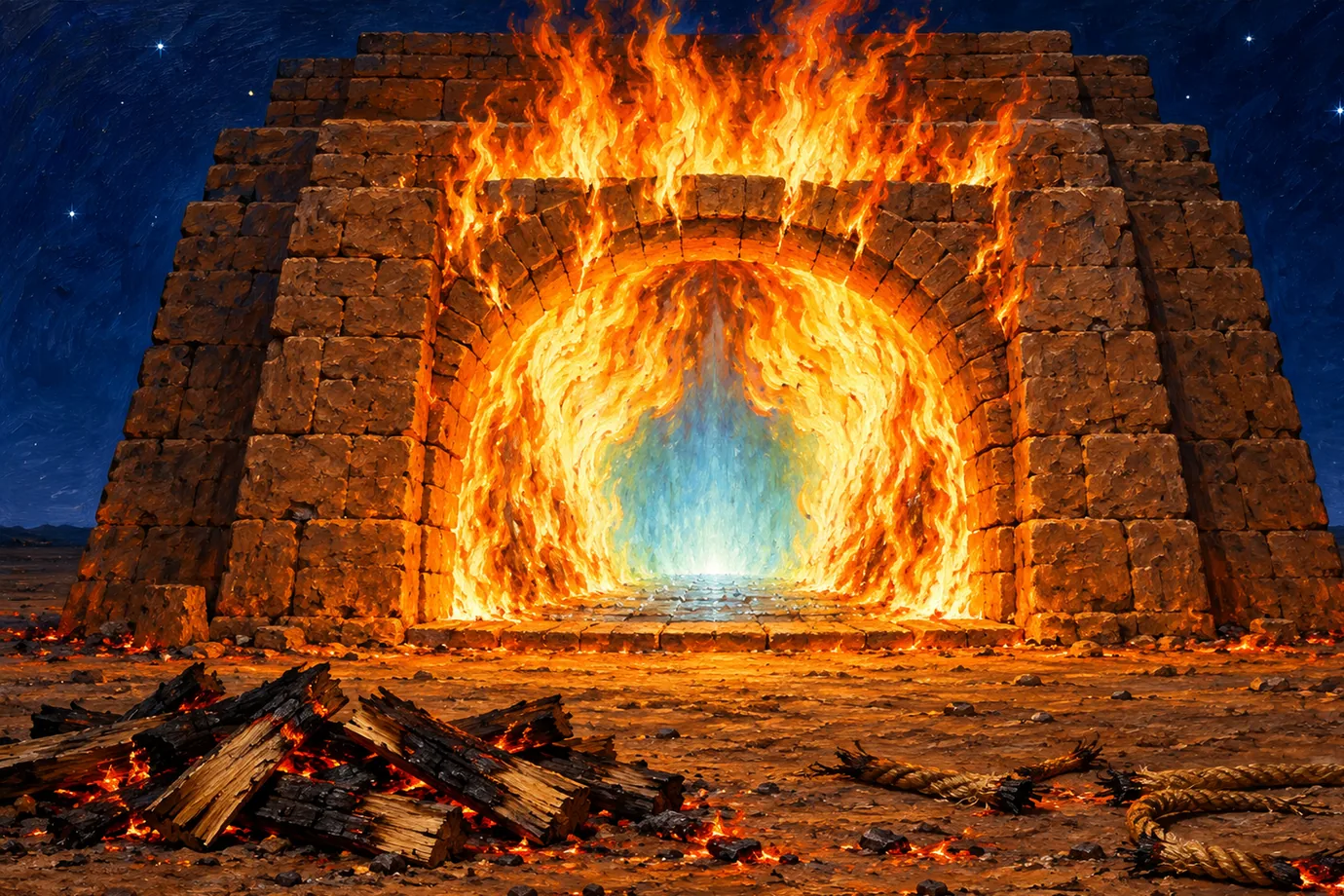
Most hymns of thanksgiving are sung after the danger has passed. The harvest is in, the war is over, the sick child has recovered, and then people gather to give thanks. One of the oldest thanksgiving hymns in the Bible breaks that pattern. It is sung from inside a furnace, by three young men whom a king has just thrown into the flames.
That hymn is the Song of the Three Young Men, one of the Greek Additions to the Book of Daniel. Protestant readers rarely meet it, because their Bibles usually leave it out. Yet Catholic, Orthodox and Anglican Christians have sung it for centuries, often without knowing where it came from. On Thanksgiving Day, when so many families pause to count their blessings, it is worth hearing again.
The Story Behind the Song of the Three Young Men
Daniel 3 tells the famous story, and it begins with pride. King Nebuchadnezzar sets up a golden statue, sixty cubits high, on the plain of Dura. He then orders every official in Babylon to bow down before it whenever the music plays. Three young Jews refuse: Shadrach, Meshach and Abednego, whose Hebrew names were Hananiah, Mishael and Azariah.
The king flies into a rage and orders the furnace heated seven times hotter than usual. His strongest soldiers bind the three and throw them in. The heat is so fierce that it kills the soldiers themselves. A moment later, however, Nebuchadnezzar looks into the fire and sees four men walking loose in the flames, unharmed. The fourth, he says, looks like a son of the gods.
In the Hebrew and Aramaic text, the story jumps straight from the fall into the furnace to the king’s astonishment. The Greek version fills that gap: between verses 23 and 24 it adds sixty-eight new verses, and they tell us what happened inside the fire.
The Prayer of Azariah
The addition opens with a prayer, as Azariah stands among the flames and speaks for the nation. Surprisingly, he does not complain about the king. Instead, he confesses that Israel has sinned and deserves its exile, and he admits that God’s judgments have been just.
His prayer contains one of the most moving passages in the Apocrypha. At this time, Azariah says, there is no prince, no prophet and no leader, no burnt offering, no sacrifice and no place to bring first fruits. Therefore, he asks God to accept instead a contrite heart and a humble spirit, as if they were thousands of fat lambs.
The idea anticipates a theme that later Jewish and Christian writers developed at length. When the Temple is lost, prayer itself becomes the offering. The Analyzing the Prayer of Manasseh, another short penitential text of the Apocrypha, works in the same spirit.
The Angel and the Dew
Next comes a short narrative bridge, which returns us to the world outside the fire. Meanwhile, the king’s servants keep feeding the furnace with naphtha, pitch, tow and brushwood. The flames rise forty-nine cubits above the mouth of the furnace, and they burn the Chaldeans who stand nearby.
At that moment the angel of the Lord comes down into the furnace, next to Azariah and his companions. He drives the flames out and makes the middle of the furnace like a moist wind whistling through it. As a result, the fire does not touch the young men at all, nor does it cause them any pain.
This detail answers a question that readers of Daniel 3 have always asked. Who was the fourth man in the fire? The Greek addition answers plainly and identifies him as an angel of God. Christian interpreters later went further and saw in him Christ himself, a reading that shaped much early Christian art.
The Song of the Three Young Men Itself
Then the three begin to sing, “as with one mouth.” The Song of the Three Young Men falls into two parts.
The first part blesses God directly: blessed are you, O Lord, God of our ancestors, and blessed is your glorious and holy name. After each line comes the same refrain, “to be praised and highly exalted forever.” The repetition gives the hymn a steady, almost hypnotic rhythm.
The second part is the one that became famous, because it turns to the whole creation. It calls on every part of the world to join the praise. First come the heavens and the angels, then the waters above the sky. After them, the sun and moon, the stars, the rain and dew, and the winds are summoned in turn. Fire and heat follow, then cold and frost, ice and snow, nights and days, light and darkness, lightning and clouds.
Afterward the song comes down to earth: mountains and hills, springs, seas and rivers, whales, birds and wild animals. Finally, it reaches human beings, Israel, the priests and servants of the Lord, the souls of the righteous, and the humble of heart. In its closing lines it even names the three singers: “Bless the Lord, Hananiah, Azariah and Mishael.”
A Hymn of Thanks From the Fire
The ending of the Song of the Three Young Men explains why it fits Thanksgiving so well. The last verses give the reason for all the praise: God has rescued the singers from Hades, saved them from the hand of death and delivered them from the burning fiery furnace.
Then comes the final call: “Give thanks to the Lord, for he is good, for his mercy endures forever.” These words echo Psalm 136 and the great thanksgiving psalms of the Temple. Readers can find the entire passage, with both prayer and song, at Bible Gateway.
The order of events deserves attention, because the young men do not wait to leave the furnace before giving thanks. They sing while the flames still roar around them. Their gratitude does not depend on the danger being over. Instead, it rests on the presence of the one who stands with them in the fire.
Where the Song of the Three Young Men Is Sung
Few texts from the Apocrypha have had a longer life in worship. Ancient Greek Bibles already copied the song twice: once inside Daniel and once in a small collection of biblical canticles, called the Odes, that followed the Psalms. The same Greek Psalter also preserved an extra psalm attributed to David, which we explore in Psalm 151. Together, these additions show how freely the Greek-speaking synagogue gathered its favorite prayers into one book.
In the Byzantine liturgy, the eighth ode of every canon at Matins still draws on the song of the three youths. In the West, the Latin version, known by its first word as the Benedicite, became part of Sunday morning prayer.
When the Church of England produced its first Book of Common Prayer in 1549, it kept the Benedicite as a canticle for Morning Prayer. Anglicans still sing it today, as the Church of England’s canticles show. So a hymn from a book that most Protestants reject remained in daily use in one of the great Protestant churches.
In or Out of the Bible?
The Song of the Three Young Men was probably composed in the second century BCE, possibly in Hebrew or Aramaic, although only Greek and later versions survive. Early Christians read it as part of Daniel without much hesitation. When Jerome made his Latin translation, he included it but marked it as absent from the Hebrew text.
Catholic and Orthodox Bibles print it within Daniel 3, as verses 24 to 90. Protestant Bibles follow the Hebrew canon and either leave it out or place it among the Apocrypha. There, the King James Version called it the Song of the Three Holy Children. The other Additions to Daniel share the same fate. Our articles on the Story of Susanna and Bel and the Dragon cover the rest.
Frequently Asked Questions
What is the Song of the Three Young Men?
It is a hymn from the Greek Additions to Daniel, sung by Hananiah, Mishael and Azariah inside Nebuchadnezzar’s furnace. It calls on all creation to bless God and ends with a call to give thanks.
Is the Song of the Three Young Men in the Bible?
It is part of Daniel 3 in Catholic and Orthodox Bibles. Protestant Bibles leave it out or print it among the Apocrypha.
What is the Benedicite?
The Benedicite is the Latin name for the second part of the song, which begins “Bless the Lord, all works of the Lord.” It is still used in Catholic, Orthodox and Anglican worship.
Who was the fourth man in the furnace?
The Greek addition says that the angel of the Lord came down into the furnace and cooled the flames. Many Christian interpreters later identified this figure with Christ.
Giving Thanks in the Furnace
The early Christians painted the three young men on the walls of the Roman catacombs. They stand in the flames with raised hands, dressed in Persian caps and trousers. For believers who faced persecution, the image meant that God could save his people even in the worst place imaginable.
The Song of the Three Young Men carries the same message in words. Its gratitude is not the easy kind that follows good fortune. It is the harder kind that looks around, sees fire, frost, darkness and whales, and still finds reasons to bless. For a holiday built around giving thanks, it may be the most demanding hymn of all.
Check out the author’s book here: The Apocrypha.

Leave a Reply