
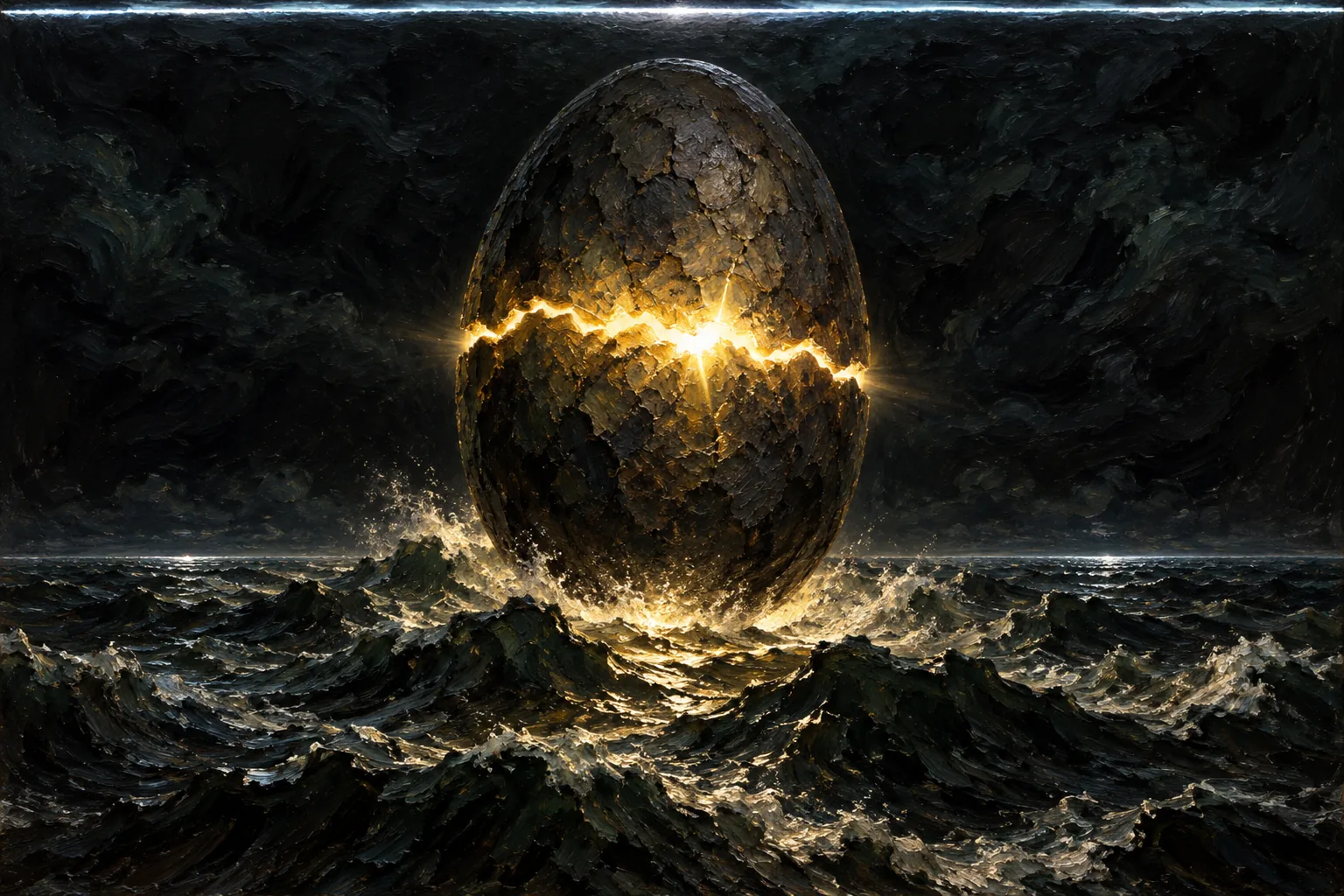
In 1945, farmers near Nag Hammadi in Egypt found a jar full of old books. One of them held a text with no title, which scholars now call On the Origin of the World. It tells the story of creation in a way that turns Genesis upside down. Here the world does not begin with a good God who speaks light into being. Instead, it begins with a shadow, a dark sea of chaos, and a proud ruler who thinks he is the only god. This guide to Origin of the World Gnosticism explains that story, from the chaos to the end of time. It also looks at the cosmic egg, an old image that helps to read this myth.
What Is On the Origin of the World?
The text survives in Coptic, in Codex II of the Nag Hammadi library, with a few lines also in Codex XIII. It was first written in Greek. Most scholars think it was composed in Alexandria near the end of the third century. The author mixes many sources: Jewish scripture, Greek philosophy, Christian ideas and Egyptian lore. For a short overview, see the Wikipedia article on On the Origin of the World.
The writer seems to speak to outsiders. In other words, the book is a kind of lesson for people who do not yet know the Gnostic view of how the world came to be. That makes it one of the clearest ways into Origin of the World Gnosticism. It sits right after a closely related text, the Reality of the Rulers, and the two share many scenes. To see where it fits among the other finds, read our Nag Hammadi library summary.
Origin of the World Gnosticism and the Shadow Before Chaos
The book opens with a challenge. “Seeing that everybody, gods of the world and mankind, says that nothing existed prior to chaos,” the author writes, “I in distinction to them shall demonstrate that they are all mistaken.” Greek poets such as Hesiod had taught that Chaos came first. Genesis, too, begins with a dark and formless deep. But this author says there was something before it.
According to the text, a divine being called Pistis Sophia, “Faith Wisdom,” lived in the realm of light. From her came a likeness, and a wish of that likeness cast a shadow. That shadow is where darkness begins. As a result, chaos is not the first thing in the universe. On the contrary, it is a late and lesser thing, the by-product of an event in a higher world.
This is the key to Origin of the World Gnosticism. Matter, darkness and the lower heavens are real, but they are not the source of all things. Behind them stands a realm of light that they cannot see. For a gentle first step into these ideas, read our guide What Is Gnosticism?.
The Cosmic Egg in Origin of the World Gnosticism
Many ancient peoples pictured the first moment of the world as an egg. In the Greek Orphic hymns, a shining god named Phanes bursts out of an egg that floats in the dark. In India, the Vedas speak of a golden womb or golden egg from which the cosmos unfolds. The Wikipedia article on the Orphic Egg traces this image across cultures.
On the Origin of the World does not use the word “egg.” Still, its story has the same shape. There is a dark, closed world of chaos. Then something breaks open, and a new power steps out to rule. In the Orphic myth, that power is a god of light. In the Gnostic myth, however, it is a god who knows nothing of the light.
So the egg is a helpful lens for Origin of the World Gnosticism. It shows how the Gnostic author took a familiar picture of beginnings and gave it a dark twist. The shell of chaos does not hatch a savior. Instead, it releases a blind ruler.
Yaldabaoth Rises From the Waters
Out of the dark waters, the text says, a ruler appears. He looks like a lion and is both male and female. Pistis Sophia names him Yaldabaoth. He has great power, but he has no idea where it came from. He sees only the waters and the darkness around him.
Soon Yaldabaoth begins to build. He makes heaven and earth, and he forms three sons, Yao, Eloai and Astaphaios, along with a host of powers. Then he looks at what he has made and boasts, “I am God, and no other one exists apart from me.” Readers of the Bible will know that line. It echoes the words of God in the book of Isaiah. In Origin of the World Gnosticism, that line belongs to a proud and ignorant creator.
At once, Pistis answers him from above. “You are mistaken, Samael,” she says, which means “blind god.” She shows her image in the waters, and the ruler finally sees that a higher power exists. For more on this figure, see the Wikipedia article on Yaldabaoth. Our essay on the Archons in Gnosticism explains the rulers who serve him.
Sophia and the Seven Heavens
Yaldabaoth and his powers build seven heavens above the earth. Each one has its ruler, its throne and its angels. In Origin of the World Gnosticism, these heavens are not a ladder up to God. Rather, they are walls that keep the soul away from its true home.
Not every ruler stays in the dark, though. One of the sons, Sabaoth, hears the voice of Pistis and turns toward the light. He condemns his father and praises Sophia. In reward, she raises him above the chaos to a throne of his own. There he builds a great chariot of cherubim, with angels, Jesus and the virgin of the holy spirit beside him.
Meanwhile, Sophia keeps working quietly inside the world. Her daughter, Sophia Zoe, “Wisdom Life,” carries light into the lower realm. The story of her mother’s fall and rescue appears in many texts. Our article on the myth of Sophia follows that thread.
Adam, Eve and the Instructor
The rulers decide to make a human being who will serve them. But Sophia Zoe is one step ahead. First, she creates her own human, an androgynous figure whom the text calls the instructor. The Jews, it says, call this being “Eve of life.”
Then the rulers mold Adam from the earth. At first he lies without life, like an empty jar. Next, Sophia Zoe breathes into him, and he begins to move. The rulers are alarmed, so they place him in paradise and forbid him to eat from the tree of knowledge.
Here the old story turns around. A wise instructor, in the form of a beast, comes to Eve and tells her to eat. She does, and so does Adam. Their minds open. They see that they are naked, and they also see that their makers are beasts. In Origin of the World Gnosticism, the fruit does not bring a fall into sin. It brings a first spark of knowledge. The Secret Book of John tells a close version of the same scene.
Genesis and Origin of the World Gnosticism Side by Side
Set beside Genesis 1, the Gnostic story reads like a mirror image. In Genesis, the creator is good, and he calls each day of his work “good.” In the Gnostic text, the creator is proud and blind, and his work is a trap. Likewise, in Genesis the serpent deceives. In the Gnostic text, the one who urges Eve to eat is a teacher.
Why would anyone tell the story this way? Many Gnostics felt that the world was full of pain and injustice. For that reason, they found it hard to believe that the highest God had made it just as it is. So they drew a line between the true God of light and a lower maker of matter. Plato had already spoken of a divine craftsman, or demiurge. The Gnostics took that name and gave it a darker meaning.
Seen this way, Origin of the World Gnosticism is not a random fantasy. It is an answer to an old question: if God is good, why is the world so broken?
The End of the World and the Return to Light
The book closes with a vision of the end. Before the end, the author says, the whole place will shake with thunder. The sun will grow dark, and the rulers will turn against one another. Then the light will cover the darkness and wipe it out. Yaldabaoth and his powers will fall into the abyss.
In the end, everything returns to where it came from. The light goes back to its root in the realm above. Darkness sinks back into nothing. The text puts it simply: “everyone must go to the place from which he has come.” For the Gnostics, the souls that carry a spark of light will go home. Our article on Gnostic beliefs about salvation looks at how they hoped to make that journey.
That is why Origin of the World Gnosticism still speaks to readers today. It is a myth about feeling like a stranger in the world, and about the light that waits beneath the dark. Whatever we make of its answers, it takes the pain of the world seriously and still dares to hope.
Check out the author’s book here: The Gnostic Gospels.

Leave a Reply