
Most readers who hear about the Book of Enoch think of one text: the Ethiopic book of the Watchers, the giants and the coming flood. But there are three books that carry Enoch’s name, and the middle one has the strangest history of all. It survives only in Old Slavonic, the church language of medieval Russia and the Balkans, and Western scholars did not know it existed until the end of the nineteenth century.
That text is 2 Enoch, also called the Book of the Secrets of Enoch. It takes the patriarch who “walked with God” through seven heavens, sits him down to write hundreds of books, and sends him back to earth to teach his sons before he leaves for good.
What Is 2 Enoch?
Genesis 5 gives Enoch only a few lines. He lived 365 years, he walked with God, and then “he was not, for God took him.” Those few words invited endless speculation. If God took Enoch without death, where did he go, and what did he see?
1 Enoch, preserved in Ge’ez in Ethiopia, answers with the fall of the Watchers and a series of cosmic tours. 3 Enoch, a Hebrew work of the rabbinic period, turns Enoch into the angel Metatron. 2 Enoch stands between the two in content and, probably, in date. It keeps the heavenly journey but drops most of the Watchers story. In its place it adds a long creation account and a set of moral teachings.
The three books are related, but they are not three volumes of one work. Each comes from a different community and answers different questions. Our comparison in 3 Enoch Hidden Realms sets out the differences, and the legacy of Enoch follows the figure across both Jewish and Christian traditions.
A Book That Survived Only in Slavonic
No Hebrew, Aramaic or Greek copy of 2 Enoch has ever turned up. The book reached the modern world through about twenty Slavonic manuscripts, the oldest from the fourteenth century. It exists in a longer and a shorter form, and scholars still disagree about which one is closer to the original.
The Russian scholar Andrey Popov published the first edition in 1880. In 1896 R. H. Charles and W. R. Morfill brought out an English translation, and their version is still freely available online at Pseudepigrapha.com.
The date and origin of the text remain open questions. Many scholars place it in the first century CE, before the destruction of the Temple in 70, because it seems to assume that sacrifices are still offered. Others suggest a Jewish author in Alexandria, since the book mixes biblical ideas with Egyptian and Greek ones. A minority argues that it is a much later Christian composition. The Jewish Encyclopedia article from 1906 shows how early that debate began.
The Seven Heavens of 2 Enoch
The story opens on Enoch’s 365th birthday. He is asleep on his bed when two enormous men appear, with faces shining like the sun. They tell him that the Lord has summoned him, and they carry him upward.
The journey through the heavens follows a clear order. In the first heaven Enoch sees a great sea, the storehouses of snow and dew, and the angels who govern the stars. In the second he finds a prison of darkness where rebellious angels hang in chains. They beg him to pray for them, and Enoch replies, sadly, that he is only a man.
The third heaven holds Paradise, with the tree of life at its center, and four rivers flowing from it. Yet in the northern part of that same heaven lies a place of cruel darkness, prepared for the wicked. In the fourth heaven Enoch watches the courses of the sun and the moon, attended by strange flying creatures that the text calls phoenixes and chalkydri.
The fifth heaven holds the Grigori, the Watchers who went down to earth. Their faces are downcast, and they are silent. Enoch tells them about their imprisoned brothers and urges them to begin their liturgy again. After that, they sing once more before the Lord.
The sixth heaven is a place of archangels who regulate the seasons, the rivers and the lives of men. Finally, in the seventh, Enoch sees the Lord on a throne, surrounded by the ranks of fiery hosts. Some manuscripts go further and speak of an eighth, ninth and tenth heaven. For another tour of the heavens, see the angelic hierarchies in Enoch.
Enoch Transformed and the 366 Books
At the throne Enoch falls on his face in terror. The Lord tells Michael to take off his earthly garments, anoint him with a sweet oil and clothe him in glory. When it is over, Enoch looks at himself and sees that he has become like one of the glorious ones. There is no difference between him and them.
This scene prepares the ground for the later Metatron tradition, where the transformation goes much further. In 2 Enoch, however, Enoch remains himself. He becomes a heavenly scribe rather than a second power in heaven. Our article Who Is Metatron explains how 3 Enoch pushed the idea to its limit.
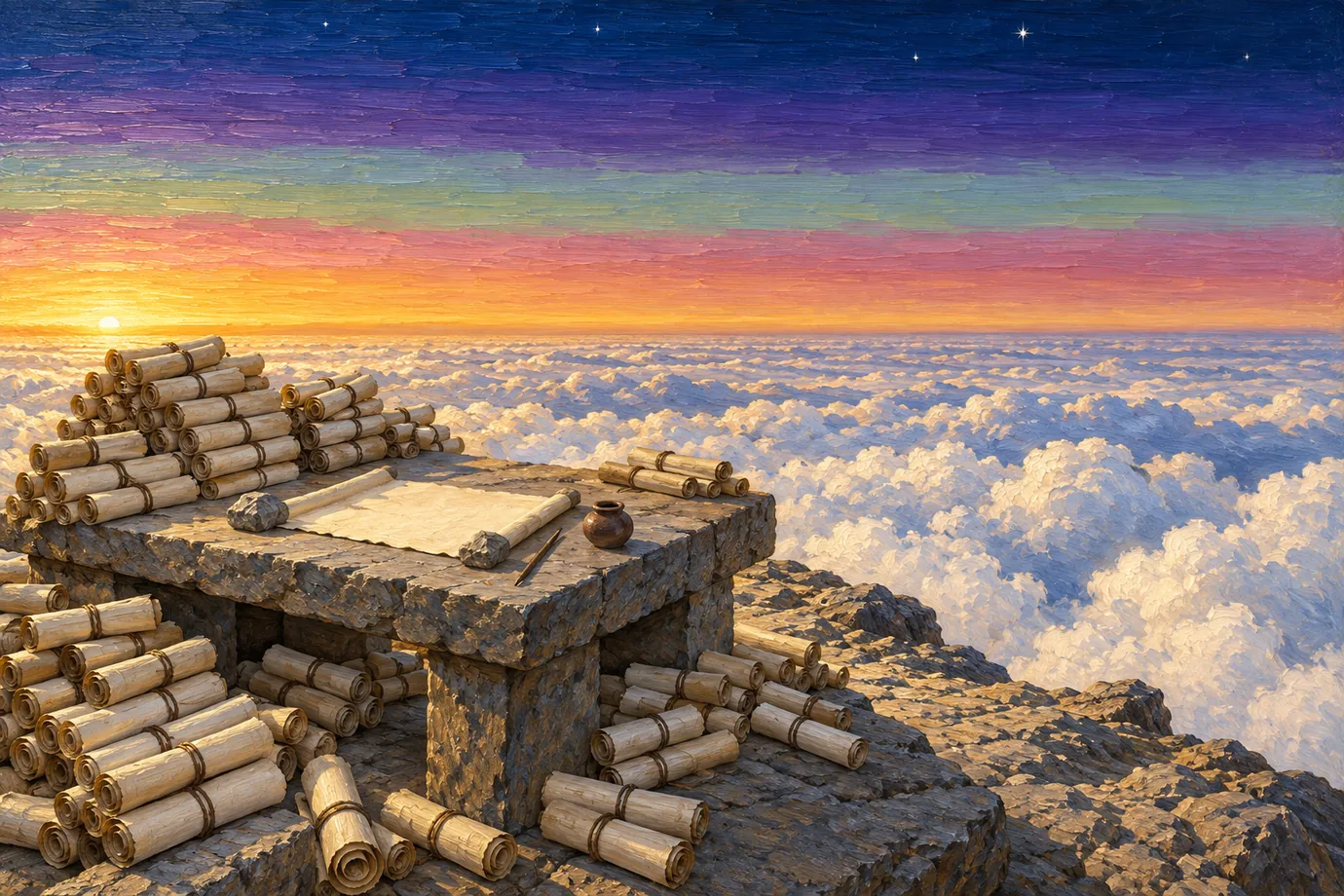
An archangel named Vrevoil then brings him books from the heavenly library and a quick pen. For thirty days and thirty nights he writes down everything about heaven, earth, the seas, the stars and the souls of men. At the end there are 366 books.
The Creation Story in 2 Enoch
Then God tells Enoch something that he has not revealed even to the angels: how the world was made. This is the most unusual part of the book.
Before anything existed, God says, he commanded the invisible to come into view. A being named Adoil descended, with a great light in his belly. When he burst open, the light came out, and from it God formed the upper foundation of creation. Next he called a second being, Arukhas, firm and heavy and dark. From him came the lower foundation. The names are strange and have no parallel in Genesis. Scholars have tried to explain them through Hebrew, Greek and even Egyptian roots, without agreement.
The account of the second day includes a rebel. One of the angelic orders, led by Satanail, conceives an impossible thought: to set his throne above the clouds and become equal to God. God throws him down with his angels, and he flies in the air above the abyss. The idea recalls the fall of the Watchers, but it moves the rebellion back to the dawn of creation.
The creation of Adam is equally striking. God makes him from seven substances: his flesh from earth, his blood from dew, his eyes from the sun, and so on. His name comes from the initials of the four directions in Greek: Anatole, Dysis, Arktos and Mesembria.
What Enoch Taught His Sons
After the revelation, God sends Enoch back to earth for thirty days so that he can pass the books to his children. His son Methuselah gathers the family, and Enoch teaches them in a long series of sermons.
The teaching is practical and surprisingly modern in tone. Enoch tells his sons that every soul, human and animal, will stand before judgment. He warns them against mistreating animals, because even the souls of beasts will accuse a person who harms them without reason. Blessed, he says, is the one who clothes the naked, feeds the hungry and lifts up the fallen.
When the thirty days are over, darkness falls on the earth, and the angels carry Enoch back up to the highest heaven. The people who were speaking with him realize only afterward that he is gone.
Frequently Asked Questions
What is 2 Enoch?
It is a Jewish apocalypse about Enoch’s journey through seven heavens, his transformation before God’s throne and the 366 books he writes. It survives only in Old Slavonic manuscripts and is also called the Book of the Secrets of Enoch.
How is 2 Enoch different from 1 Enoch?
1 Enoch focuses on the Watchers, the giants and the coming judgment. 2 Enoch keeps the heavenly journey but adds a detailed creation account and moral teaching, and it treats the Watchers only briefly.
When was 2 Enoch written?
Most scholars date it to the first century CE, possibly in Alexandria and before 70 CE. A minority considers it a later Christian work, and no original-language manuscript has been found.
Is 2 Enoch in the Bible?
No church includes it in its canon. It was copied and read in the Slavonic Orthodox world, but always outside the official Scriptures.
Why 2 Enoch Still Matters
The Book of the Secrets of Enoch sits at a crossroads. It inherits the heavenly journeys of 1 Enoch and anticipates the angelic transformation of 3 Enoch. Its seven heavens have close parallels in early Christian texts, and its creation story shows Jewish writers talking with Greek philosophy on their own terms.
The book also contains an extra chapter about the miraculous birth of Melchizedek, the priest-king who appears in Genesis and Hebrews. That episode deserves its own study, and our article on Melchizedek takes it up.
Above all, 2 Enoch reminds us how much of ancient religious literature survived only by accident. A Jewish book about heaven, perhaps written in Egypt, lived on for centuries in the monasteries of Eastern Europe. It waited there, in a language its author never spoke, for modern readers to find it again.
Check out the author’s book here: The Books of Enoch.

Leave a Reply