
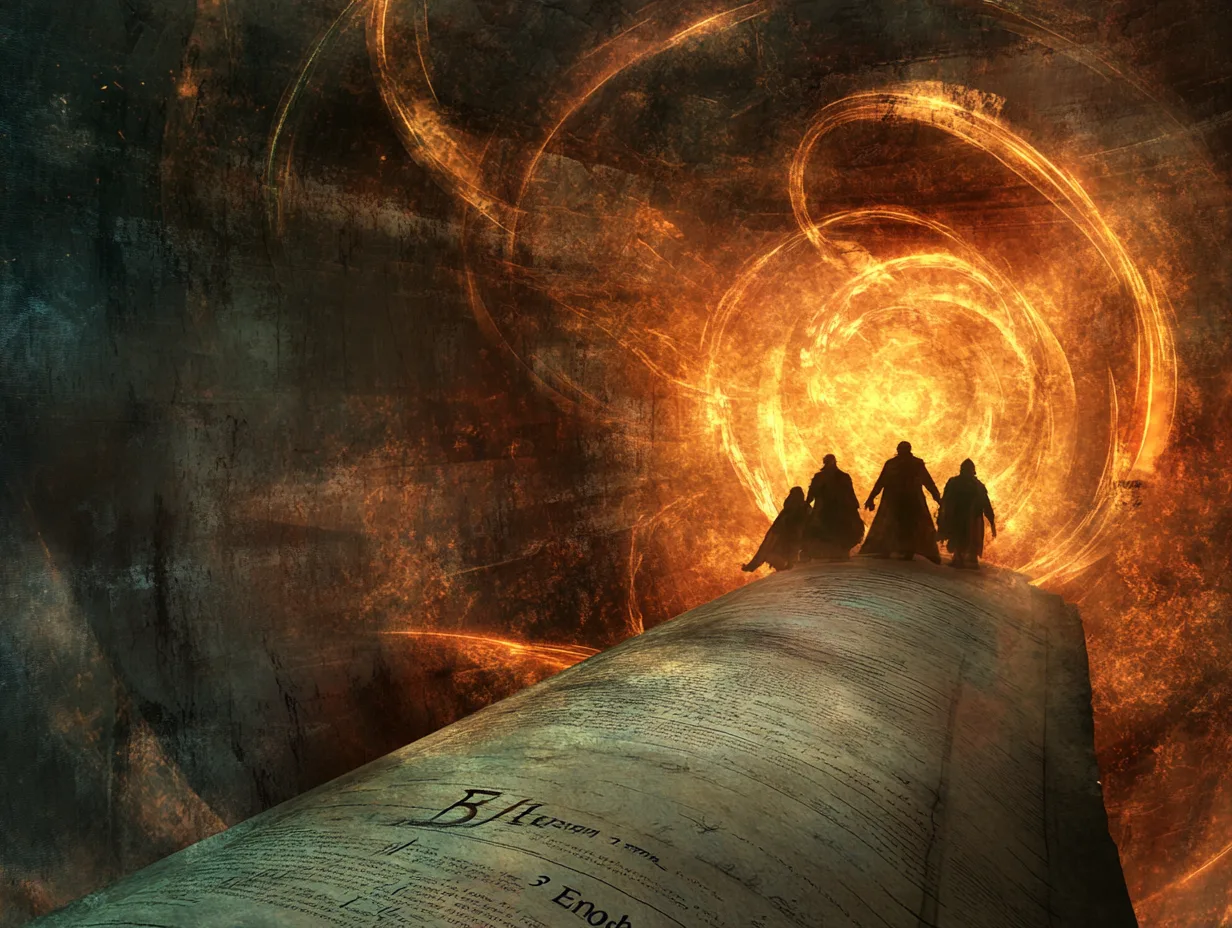
3 Enoch Hidden Realms in Historical Context
3 Enoch Hidden Realms invites readers into a late antique Jewish cosmos filled with palaces, guardians, fire, and divine names. The work follows Rabbi Ishmael as Metatron explains heavenly order and recounts his former human life as Enoch. However, the book belongs outside the Jewish and Christian biblical canons, so scholars read it as pseudepigraphal Hekhalot literature, not lost canonical scripture.
Although the book remembers the biblical Enoch, its language and concerns point toward Jewish culture in late antiquity. Scholars commonly place its surviving form around the fifth or sixth century CE, probably after earlier traditions had circulated orally. Consequently, the work stands well beyond the Second Temple period, although its apocalyptic imagination develops themes earlier Jewish writings had attached to Enoch.
The title Sefer Hekhalot, or Book of Palaces, links the composition with Jewish throne and palace mysticism. Moreover, its Hebrew manuscripts preserve variants because scribes transmitted and reorganized this fluid material across generations. The Gnostic Society Library provides useful orientation to related mystical texts, yet 3 Enoch reflects Jewish Hekhalot culture rather than Christian Gnosticism or a simple quest for gnosis.
Earlier apocalyptic traditions supply the wider background for its angels, judgments, and journeys beyond ordinary sight. During the Second Temple era, Jewish authors expanded biblical hints into intricate accounts of cosmic rebellion and heavenly government. Therefore, readers can begin with the Book of Enoch explained before approaching this later work, because the comparison reveals both continuity and dramatic religious change.
Rabbi Ishmael, Enoch, and Metatron
The narrative frames Rabbi Ishmael as an ascending visionary who enters the heavenly palaces and meets Metatron. Metatron then identifies himself with Enoch, the righteous figure from Genesis, and narrates his elevation. In other words, the ancient patriarch becomes an angelic prince, heavenly scribe, and guide, creating the book’s central tension between human origins and superhuman authority.
Genesis offers only a compressed account, leaving later interpreters ample room for speculation about Enoch’s fate. Genesis 5:24, in the King James Version, reads:
And Enoch walked with God: and he was not; for God took him.
Because the canonical verse never describes celestial offices, 3 Enoch supplies an elaborate answer through imaginative exegesis. The Bible Gateway text of Genesis 5:24 confirms the brief scriptural foundation. Meanwhile, the later book turns divine removal into enthronement, instruction, and angelic service, so its hermeneutics enlarge a biblical silence without entering the canon itself.
Metatron receives robes, a crown, wisdom, and authority among the heavenly hosts within the narrative. Moreover, the provocative title “lesser YHWH” marks delegated status, not a second independent deity. Other angels challenge his elevation because they remember his human ancestry. Thus, the account explores whether transformed humanity can approach divine glory without collapsing the distinction between Creator and servant.
The story also makes Metatron a celestial scribe who records deeds and communicates hidden knowledge. Accordingly, his authority joins administration, revelation, judgment, and worship within one disputed figure, while this focused discussion of Metatron examines that transformation further. However, 3 Enoch never presents his power as self-created or equal to God’s sovereignty.
3 Enoch Hidden Realms and the Heavenly Palaces
The heavenly ascent unfolds through guarded halls rather than through a modern map of separate spiritual dimensions. Each threshold dramatizes distance from ordinary human life and proximity to the divine throne; therefore, palace imagery supplies both architecture and theology. The visionary advances only because heavenly permission, ritual knowledge, and angelic guidance overcome the danger surrounding sacred space.
Later summaries sometimes number a first palace, intermediary palaces, and a highest palace for easier explanation. However, the manuscript tradition does not always support one neat itinerary with identical stages, since gatekeepers, seals, prayers, and divine names matter more than a tourist’s sequence. Consequently, the hidden realms resemble a liturgical court whose protocols express holiness, hierarchy, and peril.
Several recurring features organize the visionary world:
- Gatekeeper angels challenge ascent and protect the boundaries surrounding divine glory.
- Heavenly scribes record deeds while princely angels administer worship, judgment, and cosmic order.
- Fiery rivers, brilliant light, and trembling hosts signal the throne’s overwhelming holiness.
- Secret names and seals authorize movement, although divine permission remains decisive.
- Palaces mark increasing proximity to the King rather than measurable astronomical distances.
The divine throne anchors every level, even when Metatron occupies the narrative foreground. Fire can suggest purification, danger, or the energy of divine presence within this symbolic world. Likewise, brilliant light exceeds normal perception and warns against reducing vision to physical description. Enoch’s safe approach therefore announces extraordinary favor, while the surrounding terror preserves God’s unapproachable majesty.
The gates also connect ethical readiness with ritual competence, although the text never offers a simple spiritual technique. A mystic may recite names or display seals, yet success still depends on authorization from above. Thus, ascent combines discipline and grace rather than promising automatic control, and modern readers should resist turning these literary protocols into a meditation manual detached from Jewish tradition.
Angelic Hierarchies, Watchers, and Divine Glory
3 Enoch Hidden Realms fills heaven with named princes whose duties maintain worship and cosmic government, while Metatron holds the highest narrative position and Anafiel appears as a powerful guardian. Moreover, Princes of the Presence enter especially sacred regions, proclaim divine will, and attend the throne. Their ranked offices make the cosmos resemble an immense royal court with carefully guarded access.
The book’s principal angelic roles include:
- Metatron, the transformed Enoch, serves as prince, scribe, teacher, and attendant.
- Anafiel exercises authority among heavenly hosts and assists the visionary’s passage.
- Princes of the Presence stand near the throne and carry exceptional responsibilities.
- Gatekeepers test authorized travelers and defend the borders between heavenly palaces.
- Angelic scribes preserve records that connect earthly conduct with celestial judgment.
Earlier Enochic literature tells a different angelic story through the Watchers who descend and rebel. In 1 Enoch, their transgression produces violence, giants, forbidden instruction, and coming judgment, whereas 3 Enoch concentrates on obedient hierarchy, heavenly liturgy, and Enoch’s exaltation. The Enoch and Nephilim connection clarifies why the rebellious Watchers dominate the earlier apocalypse.
Nevertheless, both works imagine heaven as a moral government whose decisions affect earthly communities. Angels possess immense power, yet they remain accountable within a larger order; consequently, angelology becomes a language for justice, mediation, and the limits of authority. This shared framework matters more than forcing every named angel into one perfectly consistent system.
The throne vision also resembles canonical Revelation through radiant majesty, heavenly worship, and assembled angelic hosts. However, Revelation belongs to the Christian New Testament, whereas 3 Enoch remains Jewish pseudepigrapha outside both major canons. Their parallels do not prove direct borrowing by either author; instead, both works draw from a broad apocalyptic vocabulary shaped by scripture, worship, and ancient Near Eastern royal imagery.
Canonical Scripture and the Enochic Pseudepigrapha
The three books called Enoch do not form one continuous trilogy from a single author. Instead, modern labels group distinct compositions that arose in different languages, periods, and religious settings. All three stand outside most Jewish and Christian canons, although the Ethiopian Orthodox Tewahedo Church preserves 1 Enoch canonically; therefore, readers should distinguish shared characters from shared authorship.
A short chronology helps locate their major emphases:
- Genesis, canonical for Jews and Christians, briefly describes Enoch’s walk with God.
- 1 Enoch, ancient Jewish pseudepigrapha, develops the Watchers, judgment, and cosmic secrets.
- 2 Enoch, Jewish pseudepigrapha preserved in Slavonic, presents ascent and ethical teaching.
- 3 Enoch, later Hebrew Hekhalot literature, centers Rabbi Ishmael and the exalted Metatron.
- Revelation, canonical Christian apocalypse, portrays judgment, worship, and renewed creation.
1 Enoch survives complete in Ethiopic Ge’ez, though Aramaic fragments from Qumran confirm much older Jewish forms. The Sacred Texts edition of 1 Enoch offers an accessible historical translation. Meanwhile, 2 Enoch survives mainly through Church Slavonic witnesses, despite proposals for an earlier underlying language. These manuscript histories show why “Enoch” names a tradition before it names a single book.
3 Enoch differs by joining Enoch directly with Metatron and placing Rabbi Ishmael inside palace mysticism. Although 1 Enoch stresses fallen angels and impending judgment, 2 Enoch combines a cosmic tour with moral instruction, whereas the third work expands angelic ranks, divine names, and throne liturgy. Even so, every version asks how righteous knowledge crosses the boundary between earth and heaven.
Apocryphal does not mean worthless, fraudulent, or secretly canonical within historical study; rather, the term identifies writings outside a canon, while pseudepigraphal authorship invokes an ancient authority. Therefore, 3 Enoch deserves careful reading without claims that institutions suppressed a biblical book. Its value lies in the Jewish questions, practices, and imaginative interpretations that its manuscripts preserve.
Revelation, Gnosis, and Mystical Reception
The secret wisdom of 3 Enoch Hidden Realms resembles apocalyptic revelation because a privileged visionary receives knowledge beyond ordinary access. However, its gnosis remains embedded in Jewish scripture, angelology, liturgy, and reverence for the divine King. The work does not simply teach that hidden information saves an isolated soul. Instead, revelation creates responsibility, humility, and awareness of cosmic judgment for both individuals and communities.
Hekhalot literature later informed discussions of merkabah mysticism, named after the divine chariot in Ezekiel’s canonical vision. Scholars also compare palace ascent with developing Kabbalistic systems, though direct lines of influence require caution. Medieval and early modern mystics, including circles associated with Safed, refined different symbolic structures around divine attributes. Therefore, similarities with the Sephirot should not turn 3 Enoch into a premature Kabbalistic handbook.
Christian readers also encountered Enochic traditions, while early Church writers debated the authority of writings attributed to Enoch. Yet 3 Enoch’s late Jewish setting differs from the older Enochic works those writers knew. Later Christian esoteric and monastic readers could still find its angelic world suggestive. Consequently, reception history demands distinctions among textual contact, broad similarity, and direct theological influence.
Modern esoteric movements sometimes adapt the palaces, names, and ascent of 3 Enoch Hidden Realms into personal ritual or meditation. However, historical reading asks first what those images meant within late antique Jewish culture. The legacy of Enoch in Jewish and Christian traditions offers a broader reception history. Such context keeps spiritual curiosity from erasing the communities that transmitted these difficult manuscripts.
For contemporary readers, the book offers no simple proof about the physical structure of heaven. Instead, its guarded thresholds expose questions about authority, purity, knowledge, and human transformation. The cosmic court also challenges modern individualism because revelation serves communal order rather than private status. Finally, its contradictions invite patient interpretation instead of either literal certainty or casual dismissal.
Frequently Asked Questions
How does 3 Enoch differ from 1 and 2 Enoch?
1 Enoch emphasizes Watchers, giants, cosmic secrets, and judgment, while 2 Enoch presents ascent alongside ethical teaching. By contrast, 3 Enoch identifies Enoch with Metatron and develops Jewish palace mysticism. The books share a patriarchal figure, but different communities composed and transmitted them. Therefore, readers should treat them as related works rather than consecutive volumes.
Does any major Jewish or Christian tradition treat 3 Enoch as canonical?
No major Jewish or Christian canon includes 3 Enoch. Instead, scholars classify it among Jewish Hekhalot writings and pseudepigrapha. Its noncanonical status does not erase its historical importance for angelology and mystical hermeneutics. However, readers should not grant it the scriptural authority that communities assign to Genesis, Ezekiel, or Revelation.
What language and date belong to the surviving work?
The work survives in Hebrew manuscripts, and scholars usually associate its present form with late antiquity. Many place it around the fifth or sixth century CE, while recognizing earlier traditions and later scribal changes. Consequently, one exact composition date remains difficult to prove. Its manuscript variation reflects transmission through several Jewish mystical circles.
Why does Metatron matter so much in 3 Enoch Hidden Realms?
Metatron embodies the transformed Enoch and connects human righteousness with angelic service near the throne. Moreover, his disputed elevation lets the narrative examine delegated power without making him equal to God. His offices unite revelation, record keeping, and cosmic administration. Therefore, he becomes the book’s chief interpreter of heaven and its most challenging theological figure.
Keeping 3 Enoch Hidden Realms Open to Question
3 Enoch Hidden Realms rewards readers who hold historical distance and imaginative sympathy together. Its palaces can inspire wonder, while its manuscript setting prevents easy claims about timeless spiritual geography. Likewise, its exalted Enoch encourages reflection on human possibility while preserving sharp boundaries around divine sovereignty. The text matters because it makes those tensions visible rather than resolving them neatly.
Further reading may connect its angelic court with Book of Enoch Prophecies. Yet the most productive questions remain open: who may receive knowledge, what authority follows revelation, and how should communities test visionary claims? These hidden realms still reward curiosity grounded in history. They also invite readers to keep thinking beyond familiar canonical borders.
Check out the author’s book here: The Books of Enoch.

Leave a Reply