
Most ancient religious texts open with a warning, a law or a family tree. The Gospel of Truth opens with joy. This Gospel of Truth summary explains what that strange and hopeful book says, who probably wrote it, and how it came back to light after sixteen centuries in the sand. It is not a story about Jesus in the way the Bible Gospels are. Instead, it reads like a sermon about waking up from a bad dream.
How the Book Was Found at Nag Hammadi
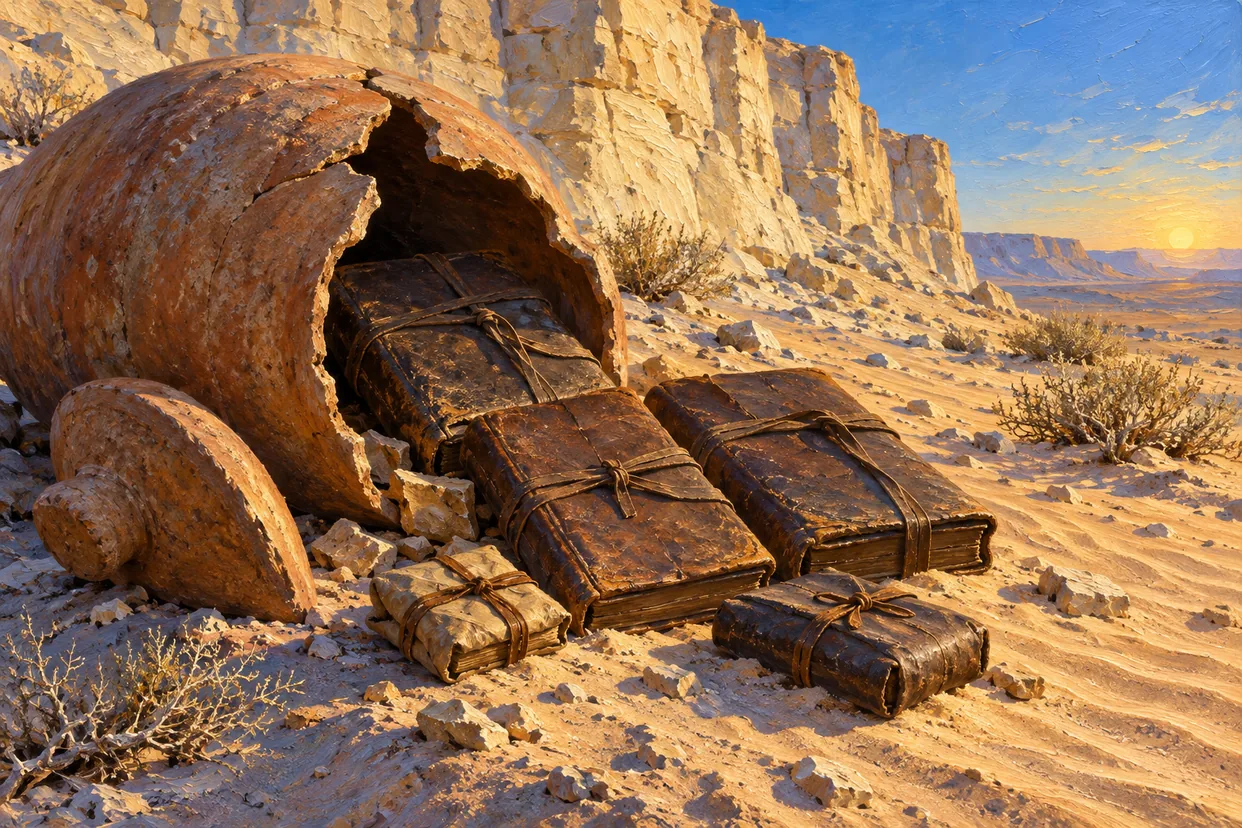
In December 1945, a farmer named Muhammad Ali al-Samman was digging for fertile soil near the town of Nag Hammadi in Upper Egypt. His spade hit a sealed clay jar. At first he feared a demon might lurk inside, but he broke it open anyway. Instead of gold, he found thirteen old books bound in leather.
Those books held more than fifty texts, most of them lost for about 1,600 years. Scribes wrote them in Coptic, the last stage of the Egyptian language. Today scholars call the find the Nag Hammadi Library, and it changed how we see early Christianity. For an overview of all thirteen books, see the Nag Hammadi Library Summary.
Two copies of the Gospel of Truth survived in that jar. The full one sits in Codex I, often called the Jung Codex. A second, broken copy sits in Codex XII. Both are Coptic translations of a lost Greek original. So every modern reader, and every Gospel of Truth summary, meets the text through at least two layers of translation.
Who Wrote the Gospel of Truth?
The book never names its author. Even so, many scholars link it to Valentinus, a gifted Christian teacher from Alexandria. He moved to Rome around 136 CE and drew a large following there. Some reports even say the church in Rome nearly made him its bishop. Later, however, church leaders branded his ideas as heresy.
A key clue comes from Irenaeus of Lyons, a bishop who wrote against the Valentinians around 180 CE. In Against Heresies, Book 3, he complains that they had a recent writing they called “the Gospel of Truth.” For centuries that title was all anyone knew. Then the Nag Hammadi find gave us a text that seems to match it.
Most experts date the work to around 140 to 180 CE. Whether Valentinus wrote it himself is still an open question. What is clear is that it comes from his circle. Any honest Gospel of Truth summary should say so, because it shows his school at its most poetic.
Gospel of Truth Summary: The Problem of Error
At the heart of the book is a figure called Error. Error is not a devil with horns. Rather, it is what happens when people do not know God, whom the text simply calls the Father. From that ignorance come fear, confusion and anguish, like a thick fog.
In this Gospel of Truth summary, the key point is that Error builds a false world to fill the gap. It works hard to make a copy of the truth, and the copy looks real enough to trap people. As a result, human beings live as if they were lost, even though they have never truly left home.
The text compares this state to a nightmare. In a bad dream, people run from danger, fall from heights or fight enemies who are not there. Then they wake up, and the terror is gone at once. That, says the author, is what knowing the Father feels like. Salvation here is not mainly about paying for sin. Instead, it is about waking up.
Jesus as Teacher and Light
So who wakes people up? In a Gospel of Truth summary the answer is simple. For the author, it is Jesus Christ, called the Word. He comes as a teacher and a guide into a dark world. He shows people the Father, and in doing so he shows them who they really are.
The book does speak of the cross, but in its own way. It says that men nailed Jesus to a tree and that he became a fruit of the knowledge of the Father. In other words, the cross is where hidden truth goes on public display. Whoever “eats” that fruit does not die, but finds joy in the discovery.
This picture is quite different from Paul’s letters, where the cross deals mainly with sin and guilt. Still, the Gospel of Truth is not cold or cruel about the body or about other people. In fact, it urges those who know to help the weak, feed the hungry and wake the sleepers. For another gnostic view of Jesus, read Is the Gospel of Thomas Gnostic?.
Gospel of Truth Summary: The Father and the Name
The Father in this book is warm, not angry. He is the source that all things come from and the home they all return to. He wants every lost child back, the way a shepherd wants every sheep. Indeed, the text retells the parable of the lost sheep, leaving the ninety-nine to find the one.
Another theme is the Name. The author says the Name of the Father is the Son. That may sound odd, but in the ancient world a name meant much more than a label. It carried the presence and power of the one who bore it. So to receive the Name is to be drawn into a living bond with God.
Some other gnostic books tell long myths about a flawed creator god and a fallen figure named Sophia. By contrast, this one stays calm and simple. It focuses on the Father, the Son, Error and the return home. That is a good reminder that “gnostic” never meant one single system, and that a Gospel of Truth summary should not borrow myths from other books.
Gospel of Truth Summary Next to the Bible Gospels
Matthew, Mark, Luke and John tell the story of Jesus. They follow him through towns, meals, miracles, arguments and finally the cross and the empty tomb. The Gospel of Truth does almost none of that. It rarely names a place or tells a scene from his life.
For that reason, a fair Gospel of Truth summary has to start with its genre. It is a sermon, a long meditation, not a biography. Its questions are different too: why do people feel lost, and how can they find their way back? Comparing it to Mark as if both were trying to write history would miss the point of each.
The closest Bible book in tone is John. John also speaks of the Word, of light and darkness, and of knowing the Father. Yet John still tells a real story with real events in Galilee and Jerusalem. The Gospel of Truth takes some of John’s words and turns them into pure reflection. You can go deeper in Gospel of Thomas vs Gospel of John.
Where It Sits Among the Lost Gospels
A Gospel of Truth summary must also be clear about status. The book is not in the New Testament. Scholars place it among the Christian apocrypha, the many early writings that the church did not include in its canon. However, it is not a fake either. It never claims an apostle as its author, so it is not what experts call a pseudepigraphal work. You can explore the wider group in Non-Canonical Gospels: Exploring the Forbidden Texts.
Its neighbours in the jar were very different books. The Gospel of Thomas is a list of sayings of Jesus. The Gospel of Philip is a loose set of thoughts about rituals and symbols. Other texts tell visions of heaven. Sharing a jar does not mean they share an author or teach the same things. For a good general guide, see the Wikipedia entry on the Gospel of Truth.
Why the Gospel of Truth Still Matters
First, the book lets us hear a Valentinian voice directly. For centuries, we knew these Christians only through their enemies. Now we can read their own words. That makes the story of early Christianity richer and more varied than it once seemed.
Second, its main idea still rings true for many readers. Fear grows when people forget who they are and where they belong. Knowledge, in this sense, is not a pile of facts but a return home. You do not have to accept the whole Valentinian system to feel the force of that thought. For more on why these texts speak to readers today, read The Relevance of the Nag Hammadi Library Today.
Finally, it opens with a line that sums up its whole message. In George MacRae’s translation, it begins: “The gospel of truth is joy for those who have received from the Father of truth the grace of knowing him.” A short Gospel of Truth summary could end right there. The book lay in the sand for sixteen centuries, and when it came back, the first word it offered was joy.
Check out the author’s book here: The Gnostic Gospels.

Leave a Reply