
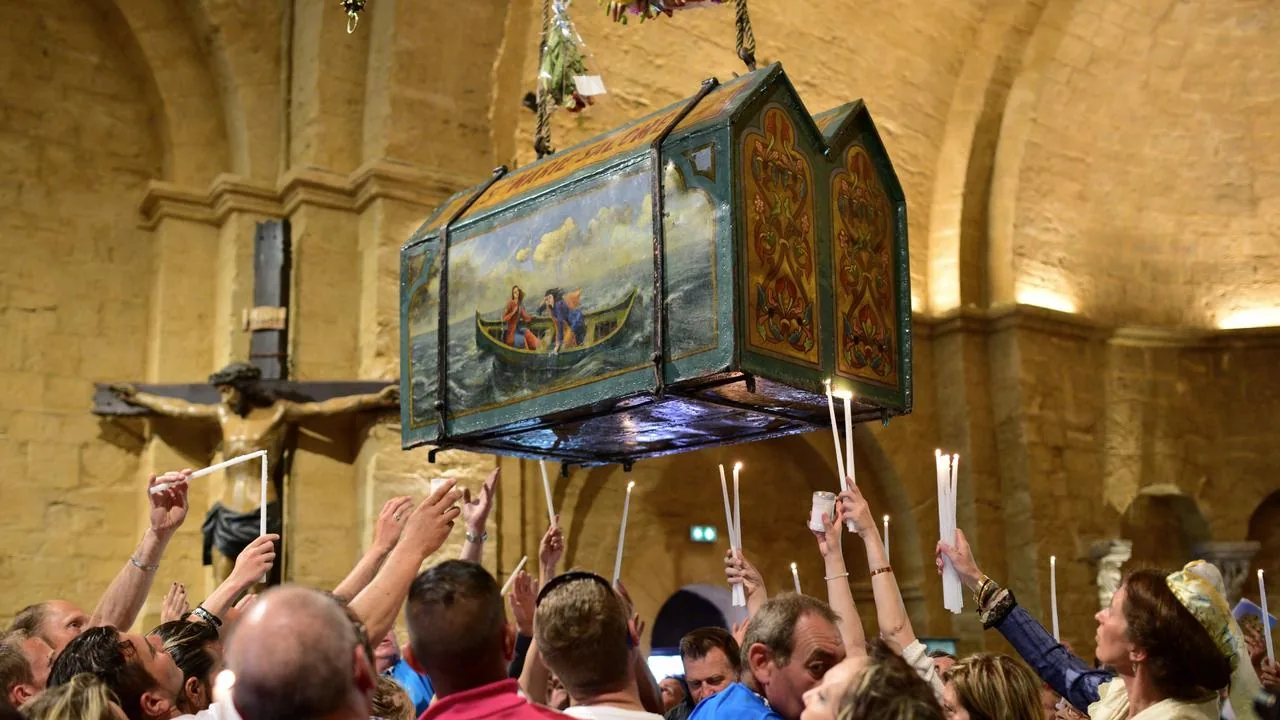
A Pilgrimage to Vézelay ends in a crypt under a Burgundian hill, in front of a casket said to hold Mary Magdalene. However, nobody can prove that it does. Yet the interesting part is that this never stopped anyone.
For four hundred years this was one of the great destinations of Christian Europe. Kings came. Indeed, Bernard of Clairvaux preached a crusade here. Then the claim collapsed, and the town emptied out. So the hill is worth walking up for the history of a belief, whatever you decide about the bones.
Why a Pilgrimage to Vézelay Starts with a Doubt
Start with what the earliest sources say about Mary’s later life. They say nothing at all.
In fact the Gospels leave her at the empty tomb, and then she vanishes from the record. No first-century writer says where she went, how long she lived or where she was buried. Every later account fills that silence, and the fillings disagree with each other.
Vézelay’s answer is that her body came north. By contrast, Provence says it stayed south. Both stories appear a long time after the fact, and neither has a document behind it. So a Pilgrimage to Vézelay is not a walk to a proven grave. It is a walk into the question of how a place becomes holy.
What the Gospels Actually Say About Mary
All four Gospels agree on a short list, though it is very short. Mary Magdalene followed Jesus, stood near the cross and came to the tomb. John then gives her the moment that matters most:
“Mary Magdalene came and told the disciples that she had seen the Lord, and that he had spoken these things unto her.” — John 20:18 (KJV)
In short, that is the whole canonical portrait. Notably, no Gospel calls her a prostitute. That idea comes from a sermon by Gregory the Great in 591, which fused three separate women into one. Our piece on the misconceptions around Mary Magdalene takes the three apart again.
Other books do give her more. The Gospel of Mary, a second-century text surviving in a torn Coptic copy, has her comfort the frightened disciples and report a vision. Peter objects that the Savior would not speak privately to a woman. Levi answers him. We follow that scene in gospel of mary magdalene and the quarrel itself in the dispute between Mary and Peter.
Even so, none of this is biography. These are second-century arguments about authority, wearing first-century clothes, as gospel of mary magdalene shows across the whole shelf. They tell us what some Christians wanted Mary to be. They do not tell us where she died.
How the Abbey Got Its Bones
The Burgundian story runs like this. In the ninth century, Saracen raids threatened Provence. So a monk named Badilus travelled south, opened Mary’s tomb and carried the relics back to safety in Burgundy.
However, the trouble is the dates. Vézelay was founded around 860, and for two centuries nobody there mentioned Mary Magdalene at all. The claim surfaces only in the eleventh century, and it surfaces loudly. Papal confirmation followed, and so did the crowds.
Afterwards the growth was enormous. The abbey grew rich, the town filled with pilgrims, and a great church went up to hold them. The abbey’s own history records the building campaigns that the relic paid for.
Then it ended. In 1279 monks at Saint-Maximin in Provence announced that they had found Mary’s real tomb, untouched. This time the pope backed them. Vézelay’s income fell away, and the town shrank to what it is now, which is a village.
The relic did come back, in a way. In 1876 the archbishop of Sens brought a fragment north from Provence and placed it in the crypt, where it still sits. So a modern Pilgrimage to Vézelay ends in front of a bone that the rival shrine gave away. The gesture was generous and slightly pointed, which is very much in character for the whole affair.
The Rival Claim in Provence
Meanwhile, the southern legend is older in one sense and younger in another. It says Mary sailed to Gaul after the resurrection, preached in Marseille and spent her last years in a cave at La Sainte-Baume.
That story is medieval too. However, it has a useful advantage: it explains why her body would be in Provence in the first place, which the Burgundian version has to borrow. The Provençal basilica still shows a skull in a gilded reliquary, and pilgrims still come.
There is a third possibility that both sides ignore. The name Magdalene points to Magdala on the Sea of Galilee, and a woman from a fishing town in Galilee most likely died somewhere in the eastern Mediterranean. No shrine there ever claimed her, because no shrine there needed to. Instead, the relic trade ran west.
Neither claim survives a historian’s questions. Both, though, did real work for the people who made them. A relic tied a remote town to the beginnings of the faith. Moreover, it brought money, protection and standing. Understood that way, the rivalry is not a scandal. Rather, it is simply how sacred geography grew.
The Church a Pilgrimage to Vézelay Walks Into
Whatever the crypt holds, the building above it repays a Pilgrimage to Vézelay on its own terms. It is one of the best Romanesque churches anywhere. Twelfth-century masons raised the nave with alternating light and dark stone in the arches, so the rhythm pulls the eye forward before you take a step.
Meanwhile, above the inner doorway sits the great carved tympanum, with Christ sending the apostles out to the nations. Around it the sculptors set the peoples of the world, some of them frankly monstrous. That, too, is evidence. It shows what twelfth-century Burgundy imagined lay beyond its own roads.
Then there is the light. The builders laid the nave out so that at midsummer a line of round pools of sun falls down the central aisle. Scholars still argue about how exactly they meant it. Nevertheless, the effect is real either way.
UNESCO lists the church and hill among the world’s significant cultural sites. That recognition is about the architecture and the pilgrimage history. It settles nothing about the relics, and it does not try to.
The Hill in 1146
One more thing happened here, and it is not comfortable. On Easter in 1146, Bernard of Clairvaux stood on the slope below the town and preached the Second Crusade to a crowd too large for the church.
The king of France took the cross that day. That campaign ended in disaster, and the harm it did is still being counted. The same hill that drew penitents also launched an army.
Bernard chose the spot deliberately. Mary Magdalene’s shrine gave the sermon its weight, since the crowd had come for her and stayed for him. In fact the relic and the war effort ran on the same fuel, which was the belief that this hill stood close to holy things.
A visit that leaves this out is a tour, not a pilgrimage. Consequently, the honest version holds both: a church built for prayer, and a slope where a war was sold.
Planning a Pilgrimage to Vézelay
In short, the practical notes are few. First, the town sits about two hours from Dijon by road, and the last stretch to the basilica is steep cobblestone, so bring shoes that grip.
Besides, the crypt is small, and it opens with the church. Go early if you want it quiet. The 22nd of July, Mary Magdalene’s feast, brings processions and a full town, which is either the reason to come or the reason to pick another week.
One warning about the church itself. It was wrecked in the Wars of Religion, then left to rot, and by the 1840s the vaults were close to falling in. Viollet-le-Duc rebuilt it, and he rebuilt with a free hand. So a Pilgrimage to Vézelay today looks at a nineteenth-century idea of a twelfth-century church, which is worth knowing before you admire a carving.
Vézelay is also a starting point for the Way of Saint James, and the path out of the town is marked. An hour on it, downhill through the vineyards, does more for the visit than another guidebook chapter. After all, the whole place grew around walking.
Read the canonical accounts before you go, then read the Gospel of Mary after. Above all, the order matters. You will see, standing in the crypt, how much of what surrounds this woman was built by people who needed her, long after anyone could check.
Check out the author’s book here: The Gospel of Mary Magdalene.
Leave a Reply