
Some names survive long after the systems that produced them have disappeared. Abraxas is one of them. It began as a word in the teaching of a second-century Christian philosopher in Alexandria, and it ended up carved on thousands of magical gems, quoted by Carl Jung and printed on a famous rock album.
The name has a trick hidden inside it. Written in Greek letters and read as numbers, as the Greeks often did, it adds up to 365, the number of days in the solar year. For the teacher who first used it, that was not a coincidence. It was a key to the structure of the whole universe.
Who Was Abraxas?
The earliest reports place Abraxas in the system of Basilides, a Christian teacher active in Alexandria around 120 to 140 CE. However, none of his own writings survive except a few quotations. We know his ideas mainly through his opponents, above all Irenaeus of Lyon, who described them in the first book of Against Heresies around 180.
According to Irenaeus, Basilides taught that an unbegotten Father stood at the top of reality. From him came Mind, and from Mind came Word. After them came Prudence, Wisdom and Power, and from these came a first heaven with its angels. Those angels produced a second heaven, and the process went on and on. In the end there were 365 heavens, one stacked below another.
The ruler of all these heavens, Irenaeus says, bore the name Abraxas. The text is freely available in the New Advent translation of Against Heresies I.24.
Why 365? The Number in the Name
In Greek, every letter also served as a number. Alpha was 1, beta 2, rho 100, sigma 200 and xi 60. Spelled in its original form, Abrasax, the name gives 1 + 2 + 100 + 1 + 200 + 1 + 60. The total is exactly 365.
The Greeks had a word for this kind of number play: isopsephy. Lovers scratched it on the walls of Pompeii, and poets used it to hide names in their verses. Jewish and Christian writers knew it too. For instance, the number of the beast in Revelation works on the same principle, as our article on Mark of the Beast 616 explains. Basilides simply applied the method to the whole cosmos.
Later, Jerome noticed the connection in the fourth century. Basilides, he wrote, called the almighty God by the strange name Abraxas and claimed that its letters matched the circuit of the sun. In other words, the ruler of the heavens was also the ruler of the year.
Even so, the spelling itself changed along the way. Greek sources and the ancient gems usually write Abrasax. The form Abraxas appears to come from Latin writers, who may have confused the two sibilant letters. Scholars today often use both, but the older form is the one the Gnostics knew.
Abraxas and the World of Basilides
Basilides built a cosmos of great distance between God and humanity. In his view, the unbegotten Father was so far above the world that even the highest angels could not reach him. Meanwhile, the lowest heaven, the one we see, belonged to angels who had made the earth and divided the nations among themselves.
Moreover, the chief of those lowest angels, in this account, was the God of the Jews. He wanted to put all the other nations under his own people. Naturally, the other angels resisted, and the conflict spilled into human history. For a wider view of that idea, see our article on the Gnostic Demiurge and the God of the Old Testament.
Into this divided world the Father sent his Mind, whom Basilides identified with Christ. Irenaeus reports one of the most notorious claims of the school. When Christ went to his crucifixion, he took on the form of Simon of Cyrene, who carried his cross. The soldiers crucified Simon in his place, while Christ stood by and laughed before he rose invisibly to the Father.
Was Abraxas the Highest God?
The ancient reports do not agree on where Abraxas stood. Irenaeus places him at the head of the 365 heavens, which makes him a very great power but not the unbegotten Father. Jerome, in contrast, calls him the almighty God of Basilides. Pseudo-Tertullian, an anonymous list of heresies from the third century, says that Basilides called the supreme God Abraxas.
Hippolytus of Rome, on the other hand, who had access to other Basilidean writings, describes a quite different system. His version speaks of a Great Archon and a lesser one, ruling over separate spheres, and it hardly mentions Abraxas at all. The ruling powers of Gnostic thought appear in more detail in our study of the Archons in Gnosticism.
In fact, the confusion may reflect real diversity. Basilides had a son and a disciple named Isidore, and his followers developed his ideas over several generations. By the time the Church Fathers wrote about them, “Basilidean” may have covered several teachings.
Abraxas in the Nag Hammadi Texts
The name also appears outside the reports of the Fathers. In the Nag Hammadi library, discovered in Egypt in 1945, Abrasax shows up in a very different role.
The Gospel of the Egyptians lists him among the great ministers who serve the heavenly luminaries. The Apocalypse of Adam names him together with Sablo and Gamaliel as angels who descend to rescue the chosen ones from destruction. Here, then, Abrasax is neither a supreme God nor a ruler of the year. He is a heavenly servant who works for the salvation of the elect.
However, these texts belong to a Sethian strand of Gnosticism, not to the school of Basilides. So the same name moved between groups and changed its meaning as it went. Similar shifts occur with other figures, such as Sophia, whose story we trace in the Gnostic myth of Sophia.
The Abraxas Gems
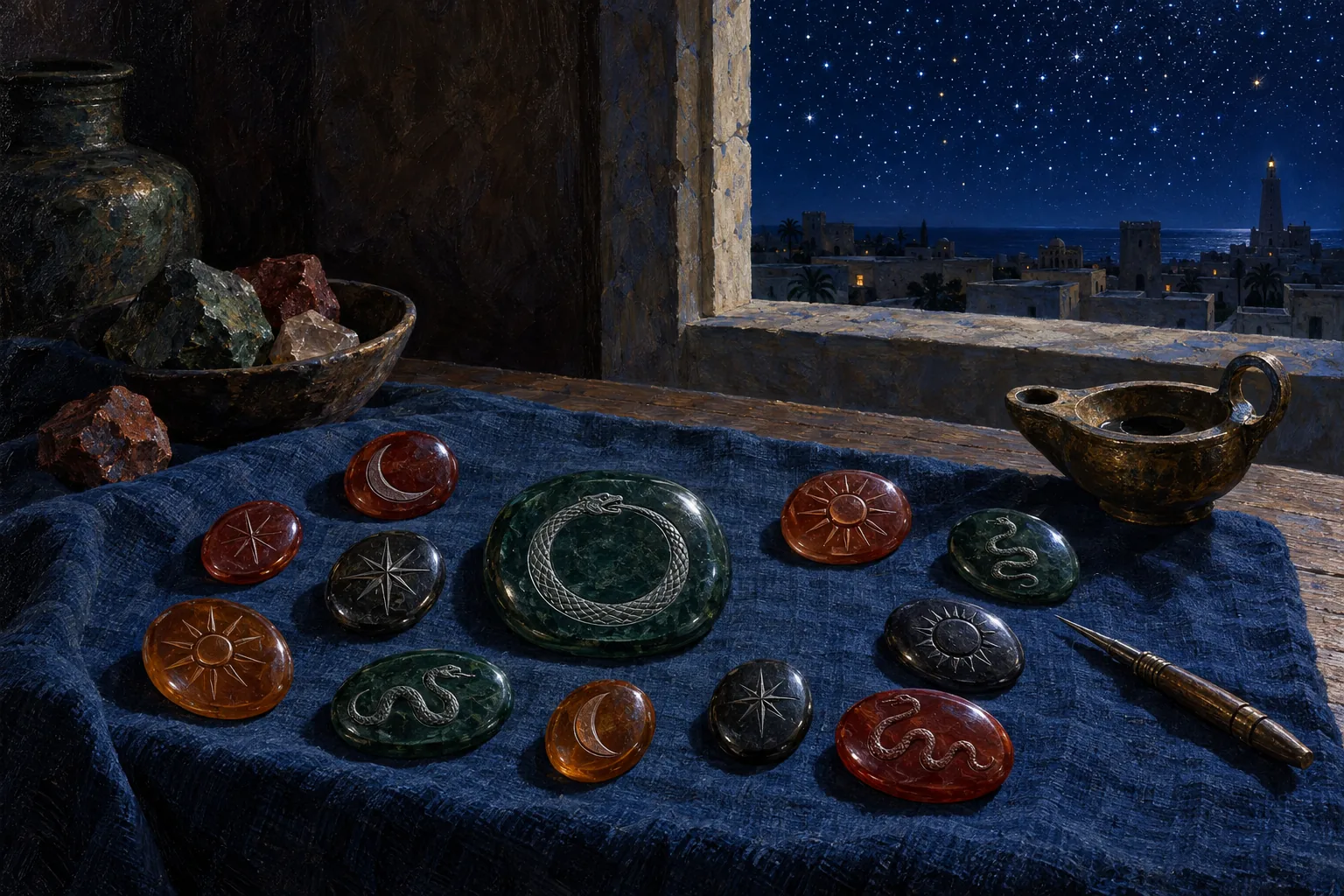
The most visible legacy of the name is not a text but an object. Museums hold hundreds of small engraved stones from the Roman period, usually called Abraxas gems. Many of them show a strange composite figure: a rooster’s head, a human body in armor, and two snakes in place of legs. The figure often holds a whip in one hand and a round shield in the other, and the word IAO or ABRASAX usually runs beside it.
Were these stones Gnostic? For a long time scholars assumed so, because the Church Fathers had linked the name with Basilides. Today most experts think otherwise. The gems were amulets, meant to protect the wearer from illness, demons or bad luck. They belong to the wider world of Greco-Egyptian magic, where magicians freely mixed divine names from many traditions.
Similarly, the Greek Magical Papyri, a collection of spell books from Roman Egypt, confirm this. They use Abrasax as one of many powerful names, together with Jewish ones like Iao and Sabaoth. A name that added up to the year was an obvious choice for a spell that aimed to command the heavens. The 1911 Encyclopaedia Britannica article on Abraxas gives a good picture of how nineteenth-century scholars studied these stones.
Abraxas in the Modern Imagination
The name never quite went away. Medieval and Renaissance writers repeated the old reports, and the gems fascinated collectors. Then, in the twentieth century, Abraxas found a new audience.
In 1916 Carl Jung privately printed a short text called Seven Sermons to the Dead. In it, Abraxas is a god above both the Christian God and the devil, a being who unites good and evil in himself. Jung’s pupil and friend Hermann Hesse took up the idea in his novel Demian in 1919. One of its most quoted passages says that the bird struggles out of the egg, and that the god it flies toward bears the name Abraxas.
Of course, these modern uses have little to do with Basilides. They borrow the name for a new idea, a god beyond moral opposites. Still, they explain why many readers today first meet Abraxas in a novel or on a record cover rather than in a Church Father.
Frequently Asked Questions
Who is Abraxas in Gnosticism?
In the system of Basilides, as Irenaeus reports it, Abraxas is the ruler of the 365 heavens. In Sethian texts from Nag Hammadi, Abrasax is a heavenly minister who helps rescue the elect.
Why is Abraxas linked with the number 365?
The Greek letters of the name, read as numbers, add up to 365. Ancient writers connected this with the days of the solar year and with the 365 heavens of Basilides.
What is an Abraxas gem?
It is a small engraved stone from the Roman period, used as an amulet. Many show a figure with a rooster’s head and snake legs, with the name Abrasax or Iao beside it.
Is Abraxas good or evil?
Ancient sources treat him as a heavenly power, not a demon. The idea of Abraxas as a god uniting good and evil comes from Carl Jung and Hermann Hesse in the twentieth century.
What the Name Tells Us
Abraxas shows how Gnostic thinkers tried to read the structure of heaven in numbers and letters. For Basilides, the year itself became a map of the distance between humanity and God. As a result, each of its days pointed to a heaven that the soul would have to cross on its way home.
Few people today share that vision, and time has swallowed Basilides’ own books. Nevertheless, the name he chose survived him by nearly two thousand years. It passed through the hands of bishops, magicians, collectors, psychologists and novelists, and each of them found something different in it. That long journey is perhaps the best proof that the old teacher picked his word well. For more of the thought world behind it, see Gnostic Archontics.
Check out the author’s book here: The Gnostic Gospels.

Leave a Reply